Sebastião Salgado - Böcker
Visar alla böcker från författaren Sebastião Salgado. Handla med fri frakt och snabb leverans.
7 produkter
7 produkter
517 kr
Skickas inom 7-10 vardagar
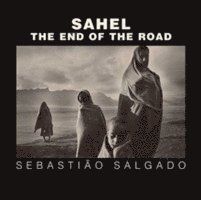
In 1984 Sebastiao Salgado began what would be a fifteen-month project of photographing the drought-stricken Sahel region of Africa in the countries of Chad, Ethiopia, Mali, and Sudan, where approximately one million people died from extreme malnutrition and related causes. Working with the humanitarian organization Doctors Without Borders, Salgado documented the enormous suffering and the great dignity of the refugees. This early work became a template for his future photographic projects about other afflicted people around the world. Since then, Salgado has again and again sought to give visual voice to those millions of human beings who, because of military conflict, poverty, famine, overpopulation, pestilence, environmental degradation, and other forms of catastrophe, teeter on the edge of survival. Beautifully produced, with thoughtful supporting narratives by Orville Schell, Fred Ritchin, and Eduardo Galeano, this first U.S. edition brings some of Salgado's earliest and most important work to an American audience for the first time. Twenty years after the photographs were taken, "Sahel: The End of the Road" is still painfully relevant.Born in Brazil in 1944, Sebastiao Salgado studied economics in Sao Paulo and Paris and worked in Brazil and England. While traveling as an economist to Africa, he began photographing the people he encountered. Working entirely in a black-and-white format, Salgado highlights the larger meaning of what is happening to his subjects with an imagery that testifies to the fundamental dignity of all humanity while simultaneously protesting its violation by war, poverty, and other injustices. 'The planet remains divided,' Salgado explains. 'The first world in a crisis of excess, the third world in a crisis of need.' This disparity between the haves and the have-nots is the subtext of almost all of Salgado's work.
454 kr
Tillfälligt slut
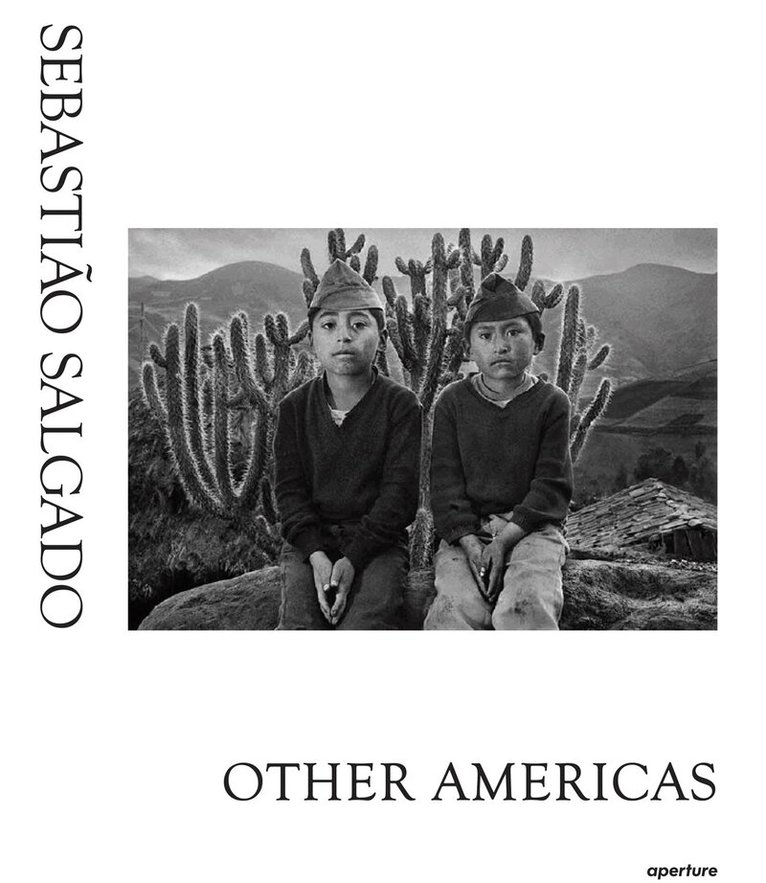
Other Americas, originally published in France in 1986 and designed by Lélia Wanick Salgado, is Sebastião Salgado’s first book. Upon publication it became an award-winning photobook classic, establishing Salgado’s reputation as the visionary reportage photographer of his generation. With forty-nine black-and-white photographs taken between 1977 and 1984, Salgado’s distilled survey of a continent includes images from Brazil, Ecuador, Bolivia, Peru, Guatemala, and Mexico. The images range in subject, capturing spiritual and religious practices, changing rural landscapes, and intimate domestic life. Each photograph shares a sense of sincere connection—connection between the subject and the photographer, between a population and their homeland, and between Salgado and the audience he seeks to engage. In his text, Alan Riding writes, “Salgado has sought out a lost corner of the Americas and he has made it a prism through which the entire continent can be viewed. A philosophy of life is caught in a look; an entire way of life is frozen in a moment . . .”
253 kr
Skickas inom 3-6 vardagar
1 204 kr
Tillfälligt slut
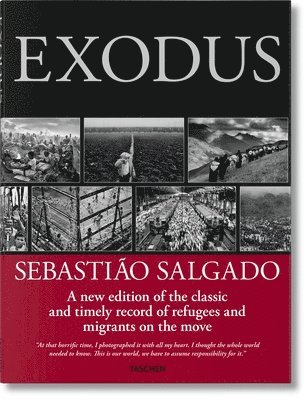
It has been almost a generation since Sebastião Salgado first published Exodus but the story it tells, of fraught human movement around the globe, has changed little in 16 years. The push and pull factors may shift, the nexus of conflict relocates from Rwanda to Syria, but the people who leave their homes tell the same tale: deprivation, hardship, and glimmers of hope, plotted along a journey of great psychological, as well as physical, toil. Salgado spent six years with migrant peoples, visiting more than 35 countries to document displacement on the road, in camps, and in overcrowded city slums where new arrivals often end up. His project includes Latin Americans entering the United States, Jews leaving the former Soviet Union, Kosovars fleeing into Albania, the Hutu refugees of Rwanda, as well as the first “boat people” of Arabs and sub-Saharan Africans trying to reach Europe across the Mediterranean ea. His images feature those who know where they are going and those who are simply in flight, relieved to be alive and uninjured enough to run. The faces he meets present dignity and compassion in the most bitter of circumstances, but also the many ravaged marks of violence, hatred, and greed. With his particular eye for detail and motion, Salgado captures the heart-stopping moments of migratory movement, as much as the mass flux. There are laden trucks, crowded boats, and camps stretched out to a clouded horizon, and then there is the small, bandaged leg; the fingerprint on a page; the interview with a border guard; the bundle and baby clutched to a mother’s breast. Insisting on the scale of the migrant phenomenon, Salgado also asserts, with characteristic humanism, the personal story within the overwhelming numbers. Against the indistinct faces of televised footage or the crowds caught beneath a newspaper headline, what we find here are portraits of individual identities, even in the abyss of a lost land, home, and, often, loved ones. At the same time, Salgado also declares the commonality of the migrant situation as a shared, global experience. He summons his viewers not simply as spectators of the refugee and exile suffering, but as actors in the social, political, economic, and environmental shifts which contribute to the migratory phenomenon. As the boats bobbing up on the Greek and Italian coastline bring migration home to Europe like no mass movement since the Second World War, Exodus cries out not only for our heightened awareness but also for responsibility and engagement. In face of the scarred bodies, the hundreds of bare feet on hot tarmac, our imperative is not to look on in compassion, but, in Salgado’s own words, to temper our behaviors in a “new regimen of coexistence.”
465 kr
Skickas inom 3-6 vardagar
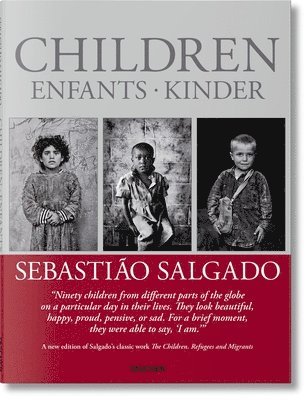
In every crisis situation, children are the greatest victims. Physically weak, they are often the first to succumb to hunger, disease, and dehydration. Innocent to the workings and failings of the world, they are unable to understand why there is danger, why there are people who want to hurt them, or why they must leave, perhaps quite suddenly, and abandon their schools, their friends, and their home.In this companion series to Exodus, Sebastião Salgado presents 90 portraits of the youngest exiles, migrants, and refugees. His subjects are from different countries, victims to different crises, but they are all on the move, and all under the age of 15. Through his extensive refugee project, what struck Salgado about these boys and girls was not only the implicit innocence in their suffering but also their radiant reserves of energy and enthusiasm, even in the most miserable of circumstances. From roadside refuges in Angola and Burundi to city slums in Brazil and sprawling camps in Lebanon and Iraq, the children remained children: they were quick to laugh as much as to cry, they played soccer, splashed in dirty water, got up to mischief with friends, and were typically ecstatic at the prospect of being photographed.For Salgado, the exuberance presented a curious paradox. How can a smiling child represent circumstances of deprivation and despair? What he noticed, though, was that when he asked the children to line up, and took their portraits one by one, the group giddiness would fade. Face to face with his camera, each child would become much more serious. They would look at him not as part of a noisy crowd, but as an individual. Their poses would become earnest. They looked into the lens with a sudden intensity, as if abruptly taking stock of themselves and their situation. And in the expression of their eyes, or the nervous fidget of small hands, or the way frayed clothes hung off painfully thin frames, Salgado found he had a refugee portfolio that deserved a forum of its own.The photographs do not try to make a statement about their subjects’ feelings, or to spell out the particulars of their health, educational, and housing deficits. Rather, the collection allows 90 children to look out at the viewer with all the candor of youth and all the uncertainty of their future. Beautiful, proud, pensive, and sad, they stand before the camera for a moment in their lives, but ask questions that haunt for years to come. Will they remain in exile? Will they always know an enemy? Will they grow up to forgive or seek revenge? Will they grow up at all?
1 477 kr
Skickas inom 3-6 vardagar
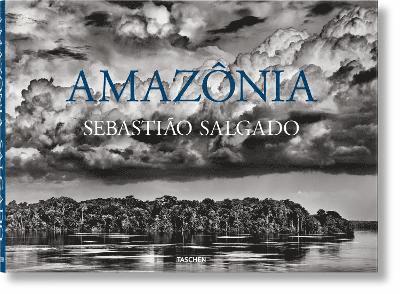
Sebastião Salgado traveled the Brazilian Amazon and photographed the unparalleled beauty of this extraordinary region for six years: the forest, the rivers, the mountains, the people who live there—an irreplaceable treasure of humanity. In the book’s foreword Salgado writes: “For me, it is the last frontier, a mysterious universe of its own, where the immense power of nature can be felt as nowhere else on earth. Here is a forest stretching to infinity that contains one-tenth of all living plant and animal species, the world’s largest single natural laboratory.” Salgado visited a dozen indigenous tribes that exist in small communities scattered across the largest tropical rainforest in the world. He documented the daily life of the Yanomami, the Asháninka, the Yawanawá, the Suruwahá, the Zo’é, the Kuikuro, the Waurá, the Kamayurá, the Korubo, the Marubo, the Awá, and the Macuxi—their warm family bonds, their hunting and fishing, the manner in which they prepare and share meals, their marvelous talent for painting their faces and bodies, the significance of their shamans, and their dances and rituals. Sebastião Salgado has dedicated this book to the indigenous peoples of Brazil’s Amazon region: “My wish, with all my heart, with all my energy, with all the passion I possess, is that in 50 years’ time this book will not resemble a record of a lost world. Amazônia must live on.” INSTITUTO TERRAFounded in 1998 at Aimorés in the state of Minas Gerais, Instituto Terra is the culmination of Lélia Wanick Salgado and Sebastião Salgado’s lifelong activism and work as cultural documentarians. Through a scientific program of planting and raising saplings, the organization has performed a miraculous reforestation of the once infertile region and furthered the Salgados’ mission of reversing the damage done to our planet. TASCHEN is proud to reach carbon zero status through our continued partnership. Also available in a Collector's Edition and four Art Editions, each with a signed silver gelatin print, all with a book stand designed by Renzo Piano.
165 kr
Skickas inom 7-10 vardagar