Seppo Sippu - Böcker
Visar alla böcker från författaren Seppo Sippu. Handla med fri frakt och snabb leverans.
6 produkter
6 produkter
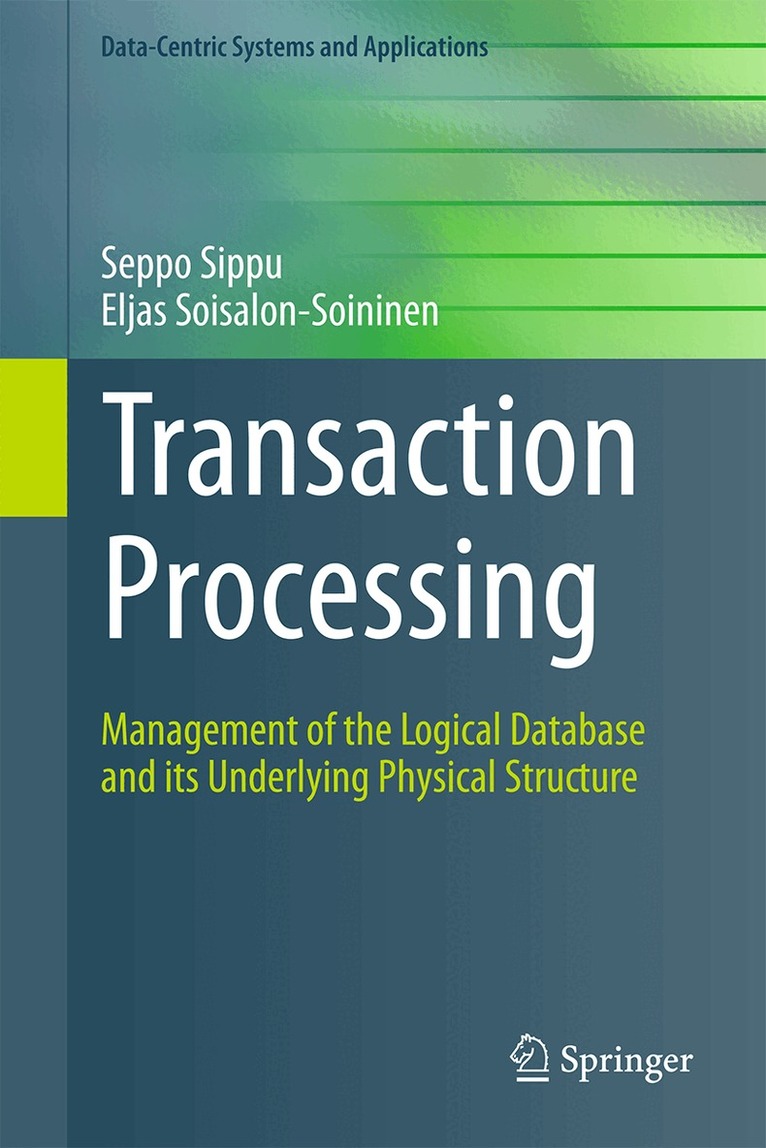
Transaction Processing
Management of the Logical Database and its Underlying Physical Structure
Inbunden, Engelska, 2015
749 kr
Skickas inom 10-15 vardagar
Transactions are a concept related to the logical database as seen from the perspective of database application programmers: a transaction is a sequence of database actions that is to be executed as an atomic unit of work. The processing of transactions on databases is a well- established area with many of its foundations having already been laid in the late 1970s and early 1980s.The unique feature of this textbook is that it bridges the gap between the theory of transactions on the logical database and the implementation of the related actions on the underlying physical database. The authors relate the logical database, which is composed of a dynamically changing set of data items with unique keys, and the underlying physical database with a set of fixed-size data and index pages on disk. Their treatment of transaction processing builds on the “do-redo-undo” recovery paradigm, and all methods and algorithms presented are carefully designed to be compatible with this paradigm as well as with write-ahead logging, steal-and-no-force buffering, and fine-grained concurrency control.Chapters 1 to 6 address the basics needed to fully appreciate transaction processing on a centralized database system within the context of our transaction model, covering topics like ACID properties, database integrity, buffering, rollbacks, isolation, and the interplay of logical locks and physical latches. Chapters 7 and 8 present advanced features including deadlock-free algorithms for reading, inserting and deleting tuples, while the remaining chapters cover additional advanced topics extending on the preceding foundational chapters, including multi-granular locking, bulk actions, versioning, distributed updates, and write-intensive transactions.This book is primarily intended as a text for advanced undergraduate or graduate courses on database management in general or transaction processing in particular.
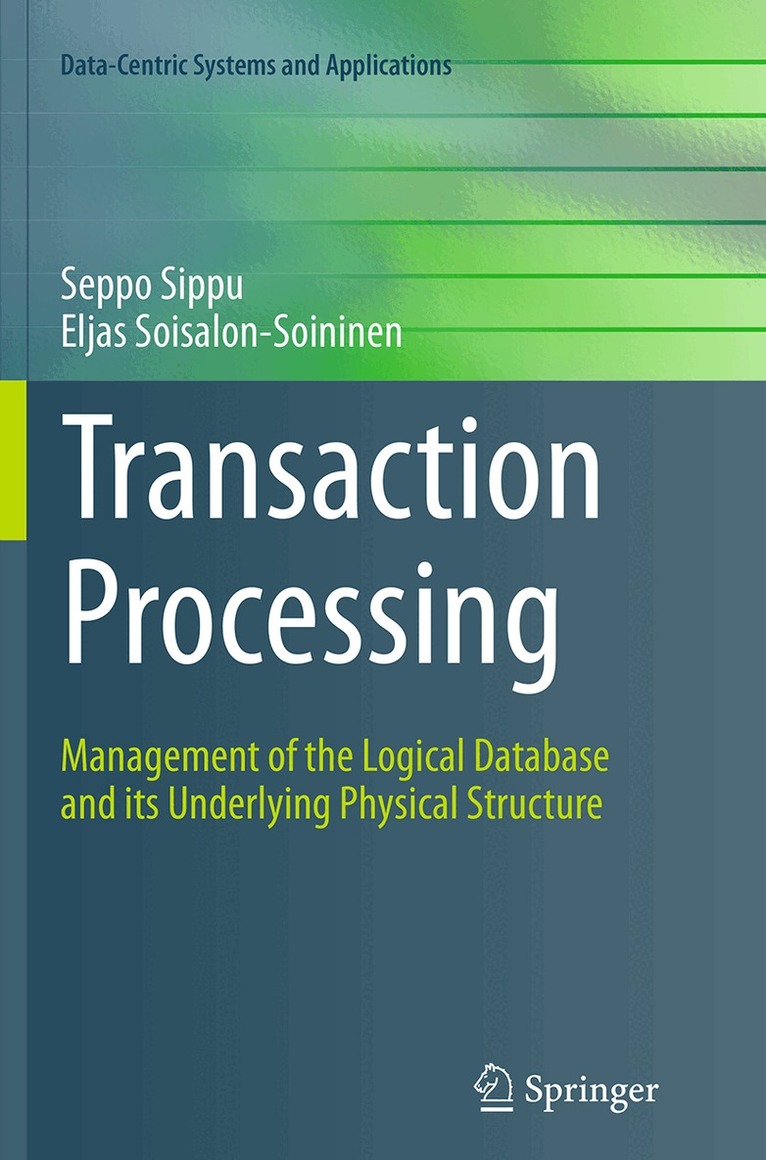
Transaction Processing
Management of the Logical Database and its Underlying Physical Structure
Häftad, Engelska, 2016
643 kr
Skickas inom 10-15 vardagar
Transactions are a concept related to the logical database as seen from the perspective of database application programmers: a transaction is a sequence of database actions that is to be executed as an atomic unit of work. The processing of transactions on databases is a well- established area with many of its foundations having already been laid in the late 1970s and early 1980s.The unique feature of this textbook is that it bridges the gap between the theory of transactions on the logical database and the implementation of the related actions on the underlying physical database. The authors relate the logical database, which is composed of a dynamically changing set of data items with unique keys, and the underlying physical database with a set of fixed-size data and index pages on disk. Their treatment of transaction processing builds on the “do-redo-undo” recovery paradigm, and all methods and algorithms presented are carefully designed to be compatible with this paradigm as well as with write-ahead logging, steal-and-no-force buffering, and fine-grained concurrency control.Chapters 1 to 6 address the basics needed to fully appreciate transaction processing on a centralized database system within the context of our transaction model, covering topics like ACID properties, database integrity, buffering, rollbacks, isolation, and the interplay of logical locks and physical latches. Chapters 7 and 8 present advanced features including deadlock-free algorithms for reading, inserting and deleting tuples, while the remaining chapters cover additional advanced topics extending on the preceding foundational chapters, including multi-granular locking, bulk actions, versioning, distributed updates, and write-intensive transactions.This book is primarily intended as a text for advanced undergraduate or graduate courses on database management in general or transaction processing in particular.
556 kr
Skickas inom 10-15 vardagar
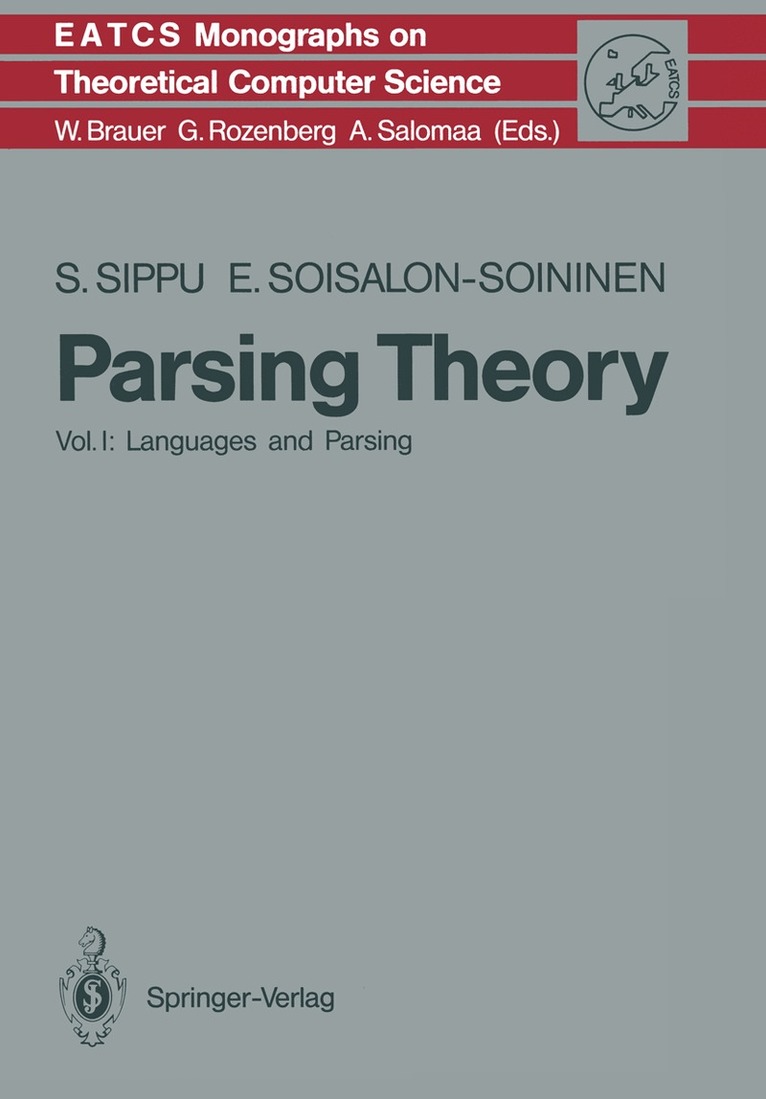
The entire work Parsing Theory appears in two volumes, "Volume I: Languages and Parsing" and "Volume II: LR(k) and LL(k) Parsing". The two volumes form an integral work. Volume I is an introduction to the basic concepts of languages and parsing, and it also contains the relevant mathematical and computer scientific background needed in the development of the theory of deterministic parsing; it deals with topics such as algorithms on relations and graphs, regular languages and lexical analysis, context-free languages, left parsers and right parsers, strong LL(k) parsers and their implementation, simple precedence parsers. Volume II contains a thorough treatment of the theory of LR(k) and LL(k) parsing. "Parsing Theory" is a contemporary reference work on the theory of deterministic parsing of context-free languages. It emphasizes the LR(k) and LL(k) methods, which are developed in a uniform manner and pays special attention to their efficient implementation. Construction algorithms for parsers are derived from general graph-theoretic methods. Complexity questions about parsable grammars are analyzed.The work can be used as a textbook for graduate-level and senior undergraduate-level courses on parsing theory and compiler design. A one-semester course on the basic theory of languages and parsing can be taught from Volume I.
556 kr
Skickas inom 10-15 vardagar
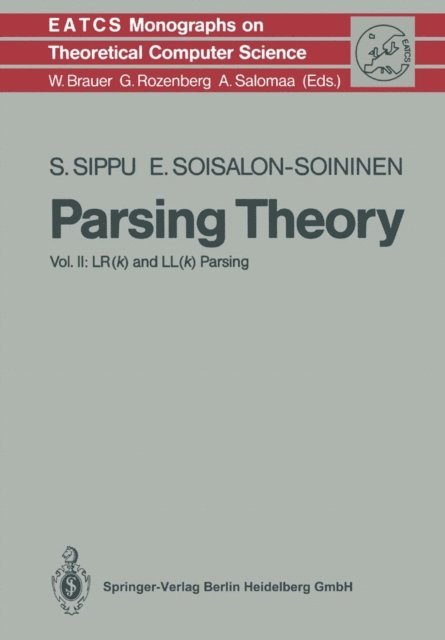
This is the second volume of a two-volume set representing an up-to-date reference work on the theory of deterministic parsing of context-free grammars. Volume I is an introduction to the basic concepts of formal language theory and context-free parsing. Volume II contains a thorough treatment of the theory of the two most important deterministic parsing methods. The two volumes together form an integrated work with chapters, theorems, lemmas, etc. numbered consecutively. The emphasis is on LR(k) and LL(k) methods, and special attention is paid to the efficient implementation of LR(k) and LL(k) parsers. Construction algorithms for parsers are derived from general graph-theoretic methods. Complexity questions about parsable grammars are analysed. The work can be used as a textbook in graduate and senior undergraduate courses on parsing theory and compiler design.
556 kr
Skickas inom 10-15 vardagar
This is the second volume of a two-volume set representing an up-to-date reference work on the theory of deterministic parsing of context-free grammars. Volume I is an introduction to the basic concepts of formal language theory and context-free parsing. Volume II contains a thorough treatment of the theory of the two most important deterministic parsing methods. The two volumes together form an integrated work with chapters, theorems, lemmas, etc. numbered consecutively. The emphasis is on LR(k) and LL(k) methods, and special attention is paid to the efficient implementation of LR(k) and LL(k) parsers. Construction algorithms for parsers are derived from general graph-theoretic methods. Complexity questions about parsable grammars are analysed. The work can be used as a textbook in graduate and senior undergraduate courses on parsing theory and compiler design.
556 kr
Skickas inom 10-15 vardagar
The theory of parsing is an important application area of the theory of formal languages and automata. The evolution of modem high-level programming languages created a need for a general and theoretically dean methodology for writing compilers for these languages. It was perceived that the compilation process had to be "syntax-directed", that is, the functioning of a programming language compiler had to be defined completely by the underlying formal syntax of the language. A program text to be compiled is "parsed" according to the syntax of the language, and the object code for the program is generated according to the semantics attached to the parsed syntactic entities. Context-free grammars were soon found to be the most convenient formalism for describing the syntax of programming languages, and accordingly methods for parsing context-free languages were devel oped. Practical considerations led to the definition of various kinds of restricted context-free grammars that are parsable by means of efficient deterministic linear-time algorithms.