Sergio M. Focardi - Böcker
Visar alla böcker från författaren Sergio M. Focardi. Handla med fri frakt och snabb leverans.
11 produkter
11 produkter
667 kr
Skickas inom 7-10 vardagar
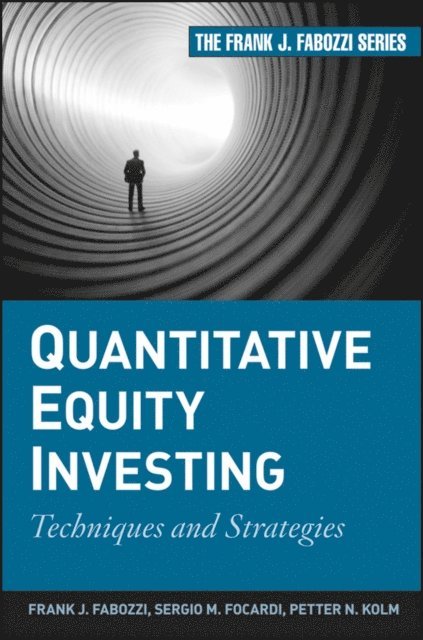
A comprehensive look at the tools and techniques used in quantitative equity managementSome books attempt to extend portfolio theory, but the real issue today relates to the practical implementation of the theory introduced by Harry Markowitz and others who followed. The purpose of this book is to close the implementation gap by presenting state-of-the art quantitative techniques and strategies for managing equity portfolios.Throughout these pages, Frank Fabozzi, Sergio Focardi, and Petter Kolm address the essential elements of this discipline, including financial model building, financial engineering, static and dynamic factor models, asset allocation, portfolio models, transaction costs, trading strategies, and much more. They also provide ample illustrations and thorough discussions of implementation issues facing those in the investment management business and include the necessary background material in probability, statistics, and econometrics to make the book self-contained. Written by a solid author team who has extensive financial experience in this areaPresents state-of-the art quantitative strategies for managing equity portfoliosFocuses on the implementation of quantitative equity asset managementOutlines effective analysis, optimization methods, and risk modelsIn today's financial environment, you have to have the skills to analyze, optimize and manage the risk of your quantitative equity investments. This guide offers you the best information available to achieve this goal.
681 kr
Skickas inom 7-10 vardagar
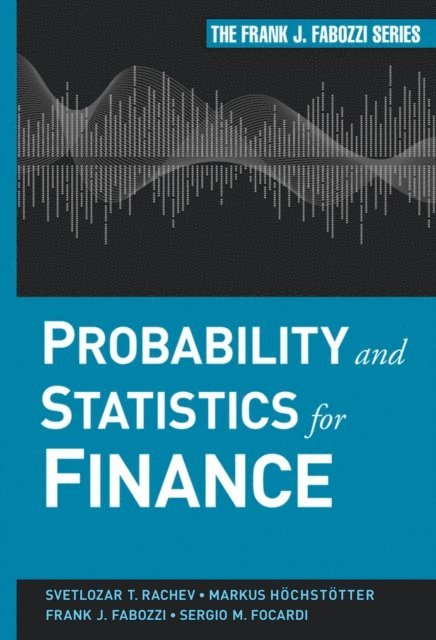
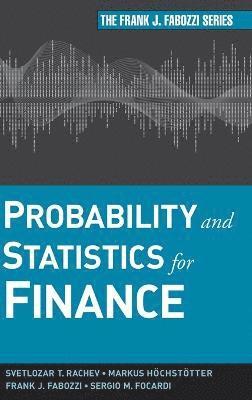
A comprehensive look at how probability and statistics is applied to the investment process Finance has become increasingly more quantitative, drawing on techniques in probability and statistics that many finance practitioners have not had exposure to before. In order to keep up, you need a firm understanding of this discipline.Probability and Statistics for Finance addresses this issue by showing you how to apply quantitative methods to portfolios, and in all matter of your practices, in a clear, concise manner. Informative and accessible, this guide starts off with the basics and builds to an intermediate level of mastery.• Outlines an array of topics in probability and statistics and how to apply them in the world of finance• Includes detailed discussions of descriptive statistics, basic probability theory, inductive statistics, and multivariate analysis• Offers real-world illustrations of the issues addressed throughout the textThe authors cover a wide range of topics in this book, which can be used by all finance professionals as well as students aspiring to enter the field of finance.
Del 144 - Frank J. Fabozzi Series
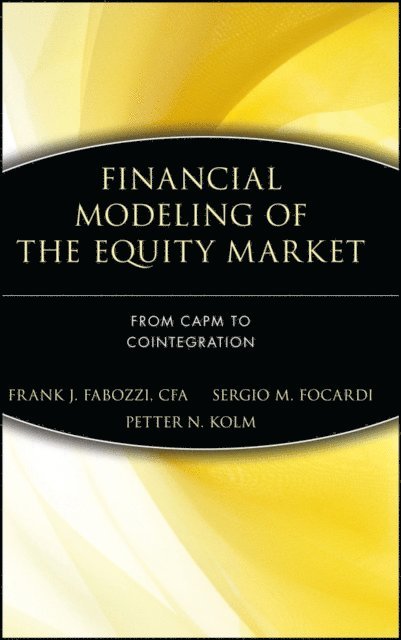
Financial Modeling of the Equity Market
From CAPM to Cointegration
Inbunden, Engelska, 2006
771 kr
Skickas inom 7-10 vardagar
An inside look at modern approaches to modeling equity portfolios Financial Modeling of the Equity Market is the most comprehensive, up-to-date guide to modeling equity portfolios. The book is intended for a wide range of quantitative analysts, practitioners, and students of finance. Without sacrificing mathematical rigor, it presents arguments in a concise and clear style with a wealth of real-world examples and practical simulations. This book presents all the major approaches to single-period return analysis, including modeling, estimation, and optimization issues. It covers both static and dynamic factor analysis, regime shifts, long-run modeling, and cointegration. Estimation issues, including dimensionality reduction, Bayesian estimates, the Black-Litterman model, and random coefficient models, are also covered in depth. Important advances in transaction cost measurement and modeling, robust optimization, and recent developments in optimization with higher moments are also discussed.Sergio M. Focardi (Paris, France) is a founding partner of the Paris-based consulting firm, The Intertek Group. He is a member of the editorial board of the Journal of Portfolio Management. He is also the author of numerous articles and books on financial modeling. Petter N. Kolm, PhD (New Haven, CT and New York, NY), is a graduate student in finance at the Yale School of Management and a financial consultant in New York City. Previously, he worked in the Quantitative Strategies Group of Goldman Sachs Asset Management, where he developed quantitative investment models and strategies.
Del 150 - Frank J. Fabozzi Series
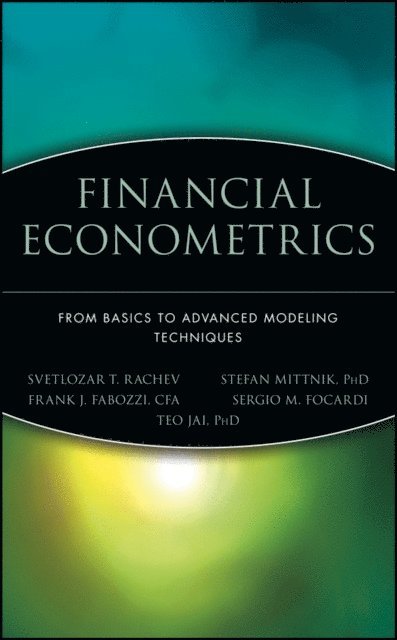
Financial Econometrics
From Basics to Advanced Modeling Techniques
Inbunden, Engelska, 2007
875 kr
Skickas inom 7-10 vardagar
A comprehensive guide to financial econometrics Financial econometrics is a quest for models that describe financial time series such as prices, returns, interest rates, and exchange rates. In Financial Econometrics, readers will be introduced to this growing discipline and the concepts and theories associated with it, including background material on probability theory and statistics. The experienced author team uses real-world data where possible and brings in the results of published research provided by investment banking firms and journals. Financial Econometrics clearly explains the techniques presented and provides illustrative examples for the topics discussed.Svetlozar T. Rachev, PhD (Karlsruhe, Germany) is currently Chair-Professor at the University of Karlsruhe. Stefan Mittnik, PhD (Munich, Germany) is Professor of Financial Econometrics at the University of Munich. Frank J. Fabozzi, PhD, CFA, CFP (New Hope, PA) is an adjunct professor of Finance at Yale University’s School of Management. Sergio M. Focardi (Paris, France) is a founding partner of the Paris-based consulting firm The Intertek Group. Teo Jasic, PhD, (Frankfurt, Germany) is a senior manager with a leading international management consultancy firm in Frankfurt.
806 kr
Skickas inom 7-10 vardagar
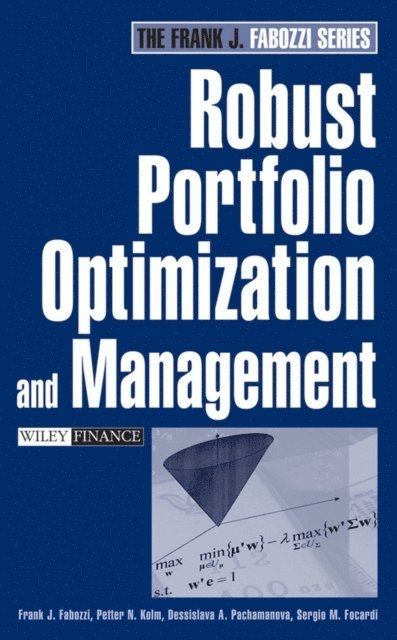
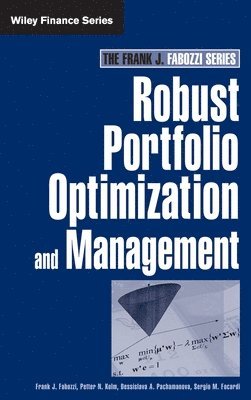
Praise for Robust Portfolio Optimization and Management "In the half century since Harry Markowitz introduced his elegant theory for selecting portfolios, investors and scholars have extended and refined its application to a wide range of real-world problems, culminating in the contents of this masterful book. Fabozzi, Kolm, Pachamanova, and Focardi deserve high praise for producing a technically rigorous yet remarkably accessible guide to the latest advances in portfolio construction."--Mark Kritzman, President and CEO, Windham Capital Management, LLC "The topic of robust optimization (RO) has become 'hot' over the past several years, especially in real-world financial applications. This interest has been sparked, in part, by practitioners who implemented classical portfolio models for asset allocation without considering estimation and model robustness a part of their overall allocation methodology, and experienced poor performance. Anyone interested in these developments ought to own a copy of this book. The authors cover the recent developments of the RO area in an intuitive, easy-to-read manner, provide numerous examples, and discuss practical considerations. I highly recommend this book to finance professionals and students alike."--John M. Mulvey, Professor of Operations Research and Financial Engineering, Princeton University
Del 207 - Frank J. Fabozzi Series
Mathematical Methods for Finance
Tools for Asset and Risk Management
Inbunden, Engelska, 2013
1 322 kr
Skickas inom 7-10 vardagar
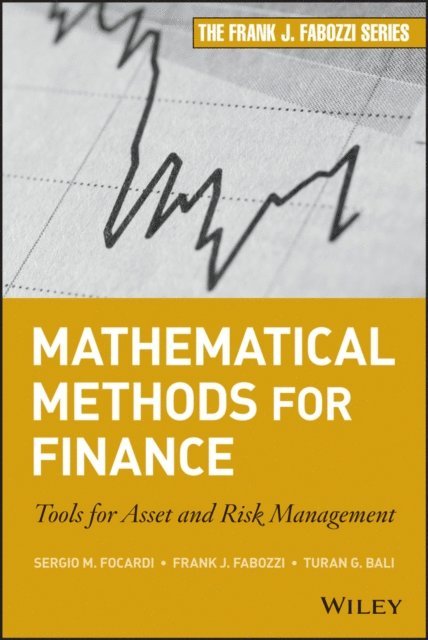
The mathematical and statistical tools needed in the rapidly growing quantitative finance field With the rapid growth in quantitative finance, practitioners must achieve a high level of proficiency in math and statistics. Mathematical Methods and Statistical Tools for Finance, part of the Frank J. Fabozzi Series, has been created with this in mind. Designed to provide the tools needed to apply finance theory to real world financial markets, this book offers a wealth of insights and guidance in practical applications.It contains applications that are broader in scope from what is covered in a typical book on mathematical techniques. Most books focus almost exclusively on derivatives pricing, the applications in this book cover not only derivatives and asset pricing but also risk management—including credit risk management—and portfolio management. Includes an overview of the essential math and statistical skills required to succeed in quantitative financeOffers the basic mathematical concepts that apply to the field of quantitative finance, from sets and distances to functions and variablesThe book also includes information on calculus, matrix algebra, differential equations, stochastic integrals, and much moreWritten by Sergio Focardi, one of the world's leading authors in high-level financeDrawing on the author's perspectives as a practitioner and academic, each chapter of this book offers a solid foundation in the mathematical tools and techniques need to succeed in today's dynamic world of finance.
Del 206 - Frank J. Fabozzi Series
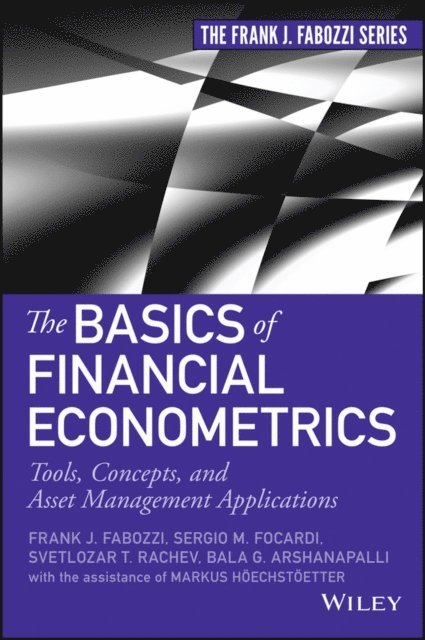
Basics of Financial Econometrics
Tools, Concepts, and Asset Management Applications
Inbunden, Engelska, 2014
945 kr
Skickas inom 7-10 vardagar
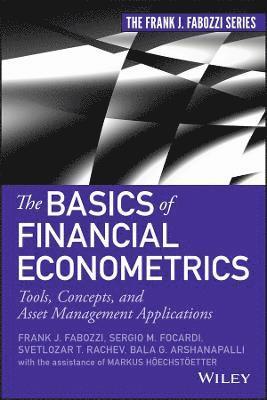
An accessible guide to the growing field of financial econometrics As finance and financial products have become more complex, financial econometrics has emerged as a fast-growing field and necessary foundation for anyone involved in quantitative finance. The techniques of financial econometrics facilitate the development and management of new financial instruments by providing models for pricing and risk assessment. In short, financial econometrics is an indispensable component to modern finance.The Basics of Financial Econometrics covers the commonly used techniques in the field without using unnecessary mathematical/statistical analysis. It focuses on foundational ideas and how they are applied. Topics covered include: regression models, factor analysis, volatility estimations, and time series techniques. Covers the basics of financial econometrics—an important topic in quantitative financeContains several chapters on topics typically not covered even in basic books on econometrics such as model selection, model risk, and mitigating model riskGeared towards both practitioners and finance students who need to understand this dynamic discipline, but may not have advanced mathematical training, this book is a valuable resource on a topic of growing importance.
2 150 kr
Skickas inom 10-15 vardagar
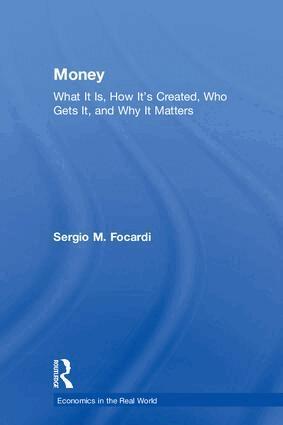
By enabling the storage and transfer of purchasing power, money facilitates economic transactions and coordinates economic activity. But what is money? How is it generated? Distributed? How does money acquire value and that value change? How does money impact the economy, society?This book explores money as a system of "tokens" that represent the purchasing power of individual agents. It looks at how money developed from debt/credit relationships, barter and coins into a system of gold-backed currencies and bank credit and on to the present system of fiat money, bank credit, near-money and, more recently, digital currencies. The author successively examines how the money circuit has changed over the last 50 years, a period of stagnant wages, increased household borrowing and growing economic complexity, and argues for a new theory of economies as complex systems, coordinated by a banking and financial system.Money: What It Is, How It’s Created, Who Gets It and Why It Matters will be of interest to students of economics and finance theory and anyone wanting a more complete understanding of monetary theory, economics, money and banking.
593 kr
Skickas inom 10-15 vardagar
By enabling the storage and transfer of purchasing power, money facilitates economic transactions and coordinates economic activity. But what is money? How is it generated? Distributed? How does money acquire value and that value change? How does money impact the economy, society?This book explores money as a system of "tokens" that represent the purchasing power of individual agents. It looks at how money developed from debt/credit relationships, barter and coins into a system of gold-backed currencies and bank credit and on to the present system of fiat money, bank credit, near-money and, more recently, digital currencies. The author successively examines how the money circuit has changed over the last 50 years, a period of stagnant wages, increased household borrowing and growing economic complexity, and argues for a new theory of economies as complex systems, coordinated by a banking and financial system.Money: What It Is, How It’s Created, Who Gets It and Why It Matters will be of interest to students of economics and finance theory and anyone wanting a more complete understanding of monetary theory, economics, money and banking.
Del 14 - Frank J. Fabozzi Series
Modeling the Market
New Theories and Techniques
Inbunden, Engelska, 1997
1 156 kr
Skickas inom 7-10 vardagar
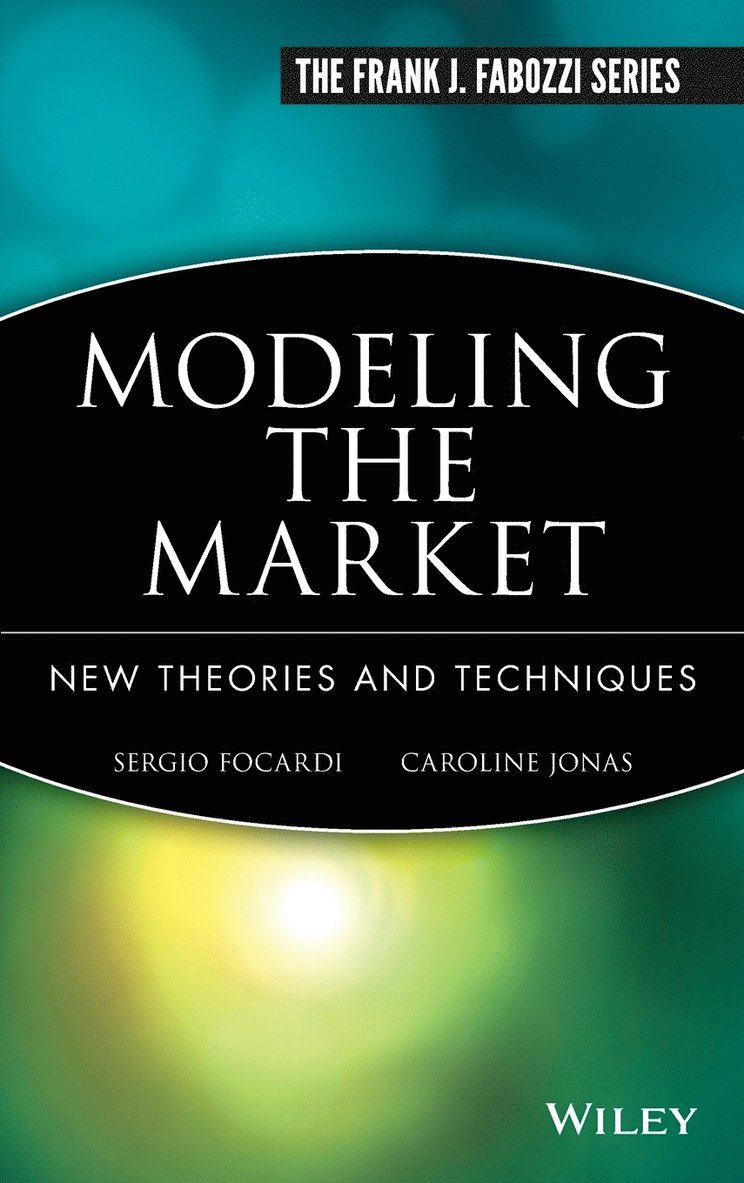
The authors have done an admirable job...This book is a revealing and fascinating glimpse of the technologies which may rule the financial world in the years to come. --The Financial Times, February 1997 [This] new book looks at the progress made, both in practice and in theory, toward producing a usable model of the market. Some of the theoretical foundations of efficient market theory are being demolished.
Del 33 - Frank J. Fabozzi Series
Risk Management
Framework, Methods, and Practice
Inbunden, Engelska, 1998
1 805 kr
Skickas inom 7-10 vardagar
Risk management is one of the most critical areas in investment and finance-especially in today's volatile trading environment. With Risk Management: Framework, Methods, and Practice you'll learn about risk management across industries through firsthand, real life war stories rather than mathematical formulas. Concise and readable, it covers both the theoretical underpinnings of risk management, as well as practical techniques for coping with financial market volatility. Focardi and Jonas give you a broad conceptual view of risk management: how far we have progressed, and the problems that remain. Using vivid analogies, this book takes you through key risk measurement issues such as fat tails and extreme events, the pros and cons of VAR, and the different ways of modeling credit risk. This book is a rarity in that it does not presuppose any knowledge of sophisticated mathematical techniques, but rather interprets these in their intuitive sense.