Sharon Anderson-Gold - Böcker
Visar alla böcker från författaren Sharon Anderson-Gold. Handla med fri frakt och snabb leverans.
4 produkter
4 produkter
784 kr
Skickas inom 7-10 vardagar
Kant infamously claimed that all human beings, without exception, are evil by nature. This collection of essays critically examines and elucidates what he must have meant by this indictment. It shows the role which evil plays in his overall philosophical project and analyses its relation to individual autonomy. Furthermore, it explores the relevance of Kant's views for understanding contemporary questions such as crimes against humanity and moral reconstruction. Leading scholars in the field engage a wide range of sources from which a distinctly Kantian theory of evil emerges, both subtle and robust, and capable of shedding light on the complex dynamics of human immorality.
82 kr
Skickas inom 7-10 vardagar
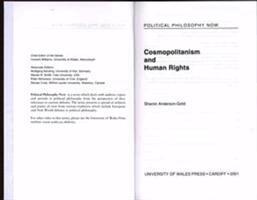
If human rights express the equal claim of every person to the recognition and protection of their vital interests, they necessarily assert universal obligations of justice that cross borders. In this book, Sharon Anderson-Gold asks whether there is a normative consensus on human rights and articulates the role of a cosmopolitan or global community in shaping the theory and practice of international politics. She considers several important works in the field of universal human rights and discusses whether a cosmopolitan system of law is a necessary condition for the stable association of nation states. Cosmopolitanism and Human Rights presents an ethical foundation for the idea of human development and attempts to demonstrate the normative character of universal human rights. It claims that Kant's idea of a federation of nations based upon principles of international right remains highly relevant to contemporary aspirations for global justice, and concludes by suggesting that a 'cosmopolitan community' is the locus of a global democratic order and is the necessary framework for the maintenance of human rights.
552 kr
Skickas inom 3-6 vardagar
Demonstrates the systematic connection between Kant's ethics and his philosophy of history.No philosopher has been more committed to the idea of the moral progress of humanity than Immanuel Kant. But is this idea of the moral advancement of the species compatible with the individualist basis of Kantian ethics? Do individuals have obligations to contribute toward the welfare of future generations? Here, Sharon Anderson-Gold affirms the compatibility of Immanuel Kant's philosophy of history and ethics by reversing the individualistic reading of the nature of virtue and vice. Arguing that Kant's definition of radical evil as a characteristic of the social condition of humanity makes virtue a collective task, she concludes that Kant's views on the moral progress of the species are essential to a proper appreciation of the collective character of moral goals and the social context of both virtue and vice. The author also expands the role of reflective judgment in the development of a cosmopolitan discourse specifying duties supporting international institutions, human rights and global economic justice. She argues that reflective judgments contain both phenomenological and normative components, making a moral evaluation of social institutions possible, thereby providing an orientation or guide for individual action.
560 kr
Skickas inom 7-10 vardagar
Kant infamously claimed that all human beings, without exception, are evil by nature. This collection of essays critically examines and elucidates what he must have meant by this indictment. It shows the role which evil plays in his overall philosophical project and analyses its relation to individual autonomy. Furthermore, it explores the relevance of Kant's views for understanding contemporary questions such as crimes against humanity and moral reconstruction. Leading scholars in the field engage a wide range of sources from which a distinctly Kantian theory of evil emerges, both subtle and robust, and capable of shedding light on the complex dynamics of human immorality.