Shelby Steele - Böcker
Visar alla böcker från författaren Shelby Steele. Handla med fri frakt och snabb leverans.
5 produkter
5 produkter
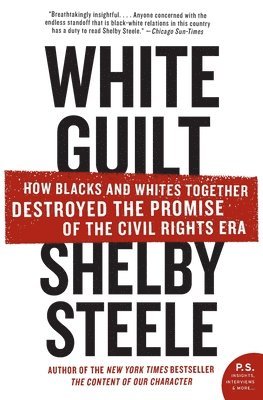
White Guilt
How Blacks and Whites Together Destroyed the Promise of the Civil Rights Era
Häftad, Engelska, 2007
225 kr
Skickas inom 3-6 vardagar
180 kr
Skickas inom 5-8 vardagar
140 kr
Skickas inom 5-8 vardagar
468 kr
Skickas inom 5-8 vardagar
The United States today is hopelessly polarized the political Right and Left have hardened into rigid and deeply antagonistic camps, preventing any sort of progress. Amid the bickering and inertia, the promise of the 1960s,when we came together as a nation to fight for equality and universal justice,remains unfulfilled.As Shelby Steele reveals in Shame , the roots of this impasse can be traced back to that decade of protest, when in the act of uncovering and dismantling our national hypocrisies,racism, sexism, militarism,liberals internalized the idea that there was something inauthentic, if not evil, in the America character. Since then, liberalism has been wholly concerned with redeeming modern American from the sins of the past, and has derived its political legitimacy from the premise of a morally bankrupt America. The result has been a half-century of well-intentioned but ineffective social programs, such as Affirmative Action. Steele reveals that not only have these programs failed, but they have in almost every case actively harmed America's minorities and poor. Ultimately, Steele argues, post-60s liberalism has utterly failed to achieve its stated aim: true equality. Liberals, intending to atone for our past sins, have ironically perpetuated the exploitation of this country's least fortunate citizens.It therefore falls to the Right to defend the American dream. Only by reviving our founding principles of individual freedom and merit-based competition can the fraught legacy of American history be redeemed, and only through freedom can we ever hope to reach equality.Approaching political polarization from a wholly new perspective, Steele offers a rigorous critique of the failures of liberalism and a cogent argument for the relevance and power of conservatism.
156 kr
Skickas inom 5-8 vardagar
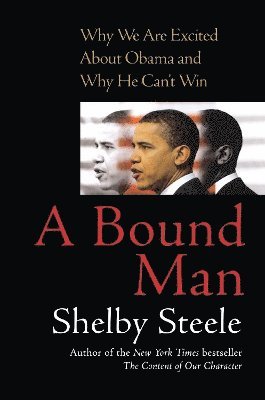
An illuminating examination of the complex racial issues that President Barack Obama faced in his race for the White House, a quest that forced a national dialogue on the current state of race relations in America, by the author of the New York Times bestseller and NBCC winner The Content of Our Character.Poverty and inequality are typically the focus of dialogues that take place during presidential elections, but Obama’s bid for so high an office pushed the conversation to a more abstract level where race is a politics of guilt and innocence generated by our painful racial history—a kind of morality play between (and within) the races in which innocence is power and guilt is impotence. Steele writes of how Obama was caught between the two classic postures that Blacks have always used to make their way in the white American mainstream: bargaining and challenging. Bargainers strike a “bargain” with white America in which they say, I will not rub America’s ugly history of racism in your face if you will not hold my race against me. Challengers do the opposite of bargainers. They charge whites with inherent racism and then demand that they prove themselves innocent by supporting Black-friendly policies like affirmative action and diversity. Steele maintains that, during the race, Obama was too constrained by these elaborate politics to find his own true political voice. Obama has the temperament, intelligence, and background—an interracial family, a sterling education—to guide America beyond the exhausted racial politics that now prevail. And yet he is a Promethean figure, a bound man. Says Steele, Americans are constrained by a racial correctness so totalitarian that we are afraid even to privately ask ourselves what we think about racial matters. Like Obama, most of us find it easier to program ourselves for correctness rather than risk knowing and expressing what we truly feel. Obama emerges as a kind of Everyman in whom we can see our own struggle to accept and honor what we honestly feel about race. In A Bound Man, Steele makes clear the precise constellation of forces that bind Obama and proposes a way for him to break these bonds and find his own voice. The courage to trust in one’s own careful judgment is the new racial progress, the “way out” from the forces that now bind us all.