Sibyl A. Schwarzenbach - Böcker
Visar alla böcker från författaren Sibyl A. Schwarzenbach. Handla med fri frakt och snabb leverans.
4 produkter
4 produkter
1 170 kr
Skickas inom 7-10 vardagar
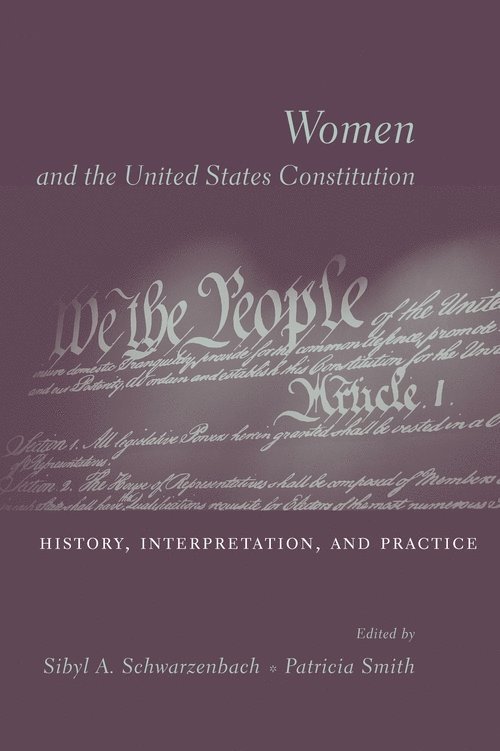
Women and the U.S. Constitution is about much more than the nineteenth amendment. This provocative volume incorporates law, history, political theory, and philosophy to analyze the U.S. Constitution as a whole in relation to the rights and fate of women. Divided into three parts-History, Interpretation, and Practice-this book views the Constitution as a living document, struggling to free itself from the weight of a two-hundred-year-old past and capable of evolving to include women and their concerns. Feminism lacks both a constitutional theory as well as a clearly defined theory of political legitimacy within the framework of democracy. The scholars included here take significant and crucial steps toward these theories. In addition to constitutional issues such as federalism, gender discrimination, basic rights, privacy, and abortion, Women and the U.S. Constitution explores other issues of central concern to contemporary women-areas that, strictly speaking, are not yet considered a part of constitutional law.Women's traditional labor and its unique character, and women and the welfare state, are two examples of topics treated here from the perspective of their potentially transformative role in the future development of constitutional law.
297 kr
Skickas inom 7-10 vardagar
Women and the U.S. Constitution is about much more than the nineteenth amendment. This provocative volume incorporates law, history, political theory, and philosophy to analyze the U.S. Constitution as a whole in relation to the rights and fate of women. Divided into three parts-History, Interpretation, and Practice-this book views the Constitution as a living document, struggling to free itself from the weight of a two-hundred-year-old past and capable of evolving to include women and their concerns. Feminism lacks both a constitutional theory as well as a clearly defined theory of political legitimacy within the framework of democracy. The scholars included here take significant and crucial steps toward these theories. In addition to constitutional issues such as federalism, gender discrimination, basic rights, privacy, and abortion, Women and the U.S. Constitution explores other issues of central concern to contemporary women-areas that, strictly speaking, are not yet considered a part of constitutional law.Women's traditional labor and its unique character, and women and the welfare state, are two examples of topics treated here from the perspective of their potentially transformative role in the future development of constitutional law.

934 kr
Tillfälligt slut
Women have performed the vast majority of often unpaid friendship labor for centuries. Embodying the freedom, equality, and ideals of the Constitution, civic friendship emerges as a necessary condition for genuine justice. Through a critical examination of social and political relationships from ancient times to today, Sibyl Schwarzenbach develops a truly innovative, feminist theory of the democratic state. Beginning with an analysis of Aristotle's notion of political friendship, Schwarzenbach brings the philosopher's insights to bear on the social and political requirements of the modern state. She elaborates a conception of civic friendship that, with its ethical reproductive praxis, functions differently from male-centered notions of fraternity and, with its female participants, remains fundamentally separate from generalized, male-inflected claims of Marxist solidarity. Schwarzenbach also distinguishes civic friendship from feminist calls for public care, arguing that friendship, unlike care, not only is reciprocal but also seeks to establish and maintain equality.Schwarzenbach concludes with various public institutions-economic, legal, and social-that can promote civic friendship without sacrificing crucial liberties. In fact, women's entrance into the public sphere en masse makes such ideals realistic within a competitive, individualistic society.
292 kr
Skickas inom 7-10 vardagar
Women have performed the vast majority of often unpaid friendship labor for centuries. Embodying the freedom, equality, and ideals of the Constitution, civic friendship emerges as a necessary condition for genuine justice. Through a critical examination of social and political relationships from ancient times to today, Sibyl Schwarzenbach develops a truly innovative, feminist theory of the democratic state. Beginning with an analysis of Aristotle's notion of political friendship, Schwarzenbach brings the philosopher's insights to bear on the social and political requirements of the modern state. She elaborates a conception of civic friendship that, with its ethical reproductive praxis, functions differently from male-centered notions of fraternity and, with its female participants, remains fundamentally separate from generalized, male-inflected claims of Marxist solidarity. Schwarzenbach also distinguishes civic friendship from feminist calls for public care, arguing that friendship, unlike care, not only is reciprocal but also seeks to establish and maintain equality.Schwarzenbach concludes with various public institutions-economic, legal, and social-that can promote civic friendship without sacrificing crucial liberties. In fact, women's entrance into the public sphere en masse makes such ideals realistic within a competitive, individualistic society.