Sidney I. Resnick - Böcker
Visar alla böcker från författaren Sidney I. Resnick. Handla med fri frakt och snabb leverans.
8 produkter
8 produkter
959 kr
Skickas inom 10-15 vardagar
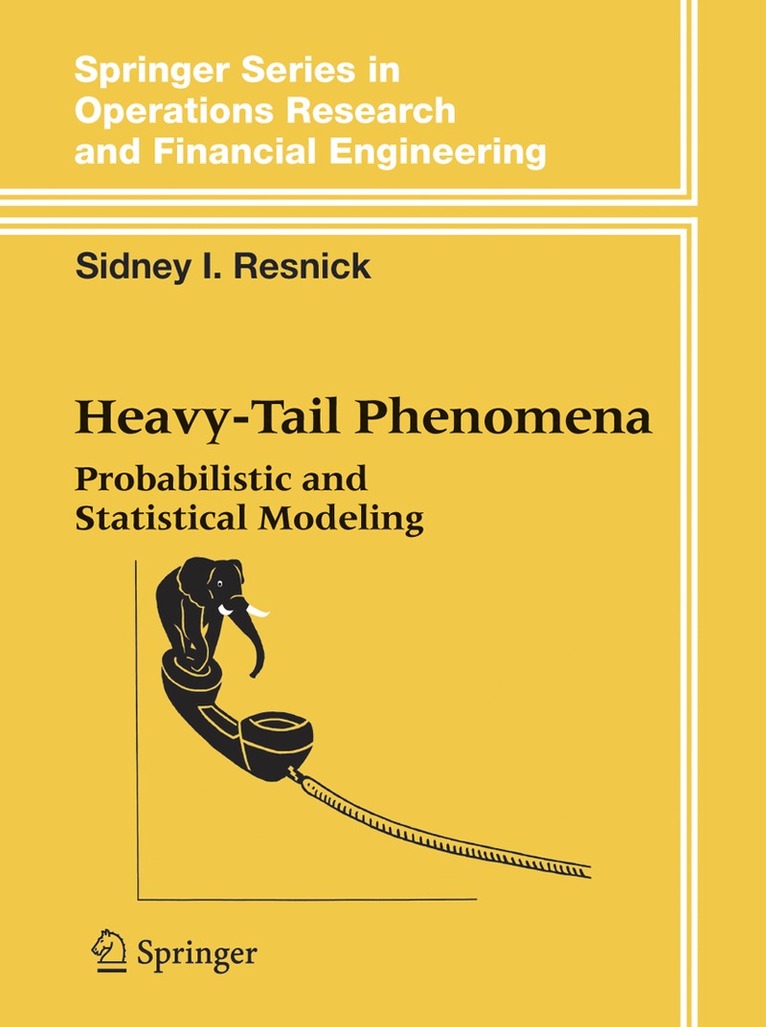
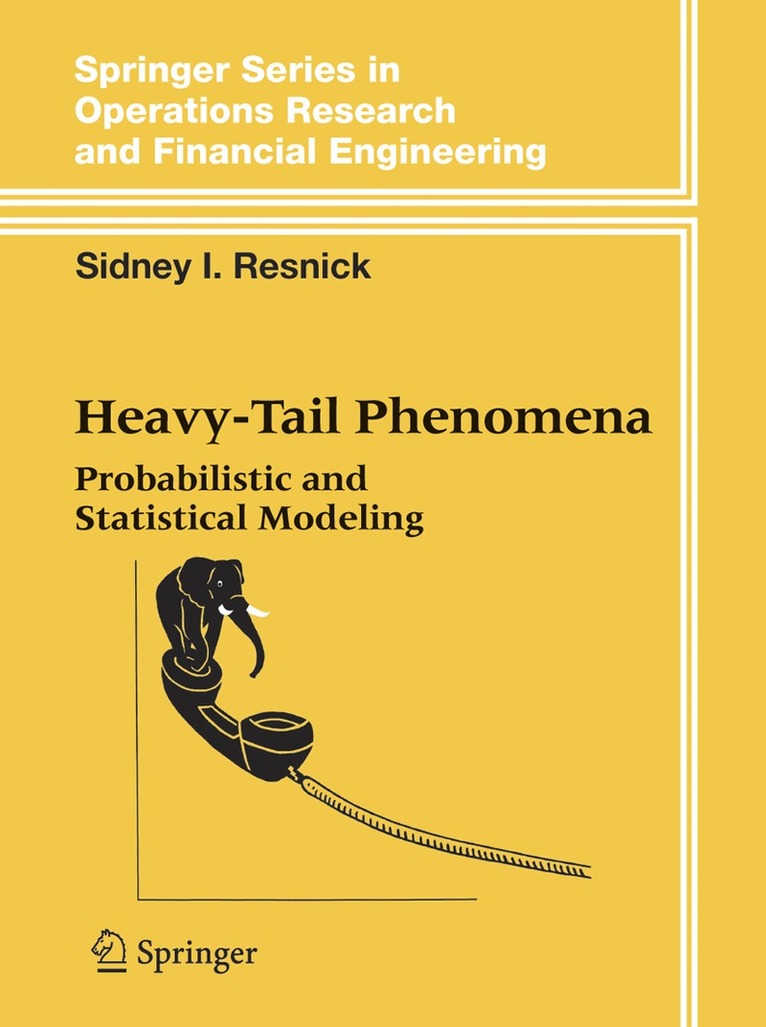
This comprehensive text gives an interesting and useful blend of the mathematical, probabilistic and statistical tools used in heavy-tail analysis. Heavy tails are characteristic of many phenomena where the probability of a single huge value impacts heavily. Record-breaking insurance losses, financial-log returns, files sizes stored on a server, transmission rates of files are all examples of heavy-tailed phenomena. Key features: * Unique text devoted to heavy-tails * Emphasizes both probability modeling and statistical methods for fitting models. Most treatments focus on one or the other but not both * Presents broad applicability of heavy-tails to the fields of data networks, finance (e.g., value-at- risk), insurance, and hydrology * Clear, efficient and coherent exposition, balancing theory and actual data to show the applicability and limitations of certain methods * Examines in detail the mathematical properties of the methodologies as well as their implementation in Splus or R statistical languages * Exposition driven by numerous examples and exercises Prerequisites for the reader include a prior course in stochastic processes and probability, some statistical background, some familiarity with time series analysis, and ability to use (or at least to learn) a statistics package such as R or Splus.This work will serve second-year graduate students and researchers in the areas of applied mathematics, statistics, operations research, electrical engineering, and economics.
1 276 kr
Skickas inom 10-15 vardagar
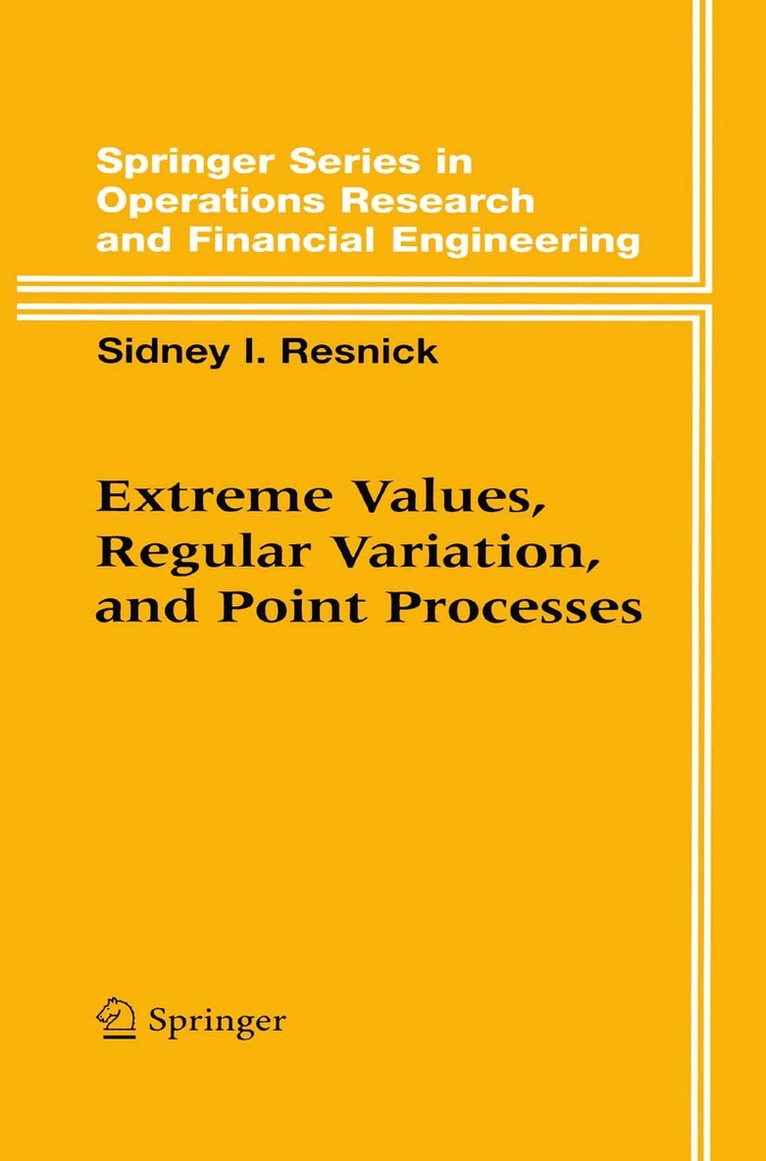
Extremes Values, Regular Variation and Point Processes is a readable and efficient account of the fundamental mathematical and stochastic process techniques needed to study the behavior of extreme values of phenomena based on independent and identically distributed random variables and vectors. It presents a coherent treatment of the distributional and sample path fundamental properties of extremes and records. It emphasizes the core primacy of three topics necessary for understanding extremes: the analytical theory of regularly varying functions; the probabilistic theory of point processes and random measures; and the link to asymptotic distribution approximations provided by the theory of weak convergence of probability measures in metric spaces.The book is self-contained and requires an introductory measure-theoretic course in probability as a prerequisite. Almost all sections have an extensive list of exercises which extend developments in the text, offer alternate approaches, test mastery and provide for enjoyable muscle flexing by a reader. The material is aimed at students and researchers in probability, statistics, financial engineering, mathematics, operations research, civil engineering and economics who need to know about: asymptotic methods for extremes; models for records and record frequencies; stochastic process and point process methods and their applications to obtaining distributional approximations; pervasive applications of the theory of regular variation in probability theory, statistics and financial engineering.“This book is written in a very lucid way. The style is sober, the mathematics tone is pleasantly conversational, convincing and enthusiastic. A beautiful book!”Bulletin of the Dutch Mathematical Society“This monograph is written in a very attractive style. It contains a lot of complementary exercises and practically all important bibliographical reference.”Revue Roumaine deMathématiques Pures et Appliquées
1 109 kr
Skickas inom 10-15 vardagar
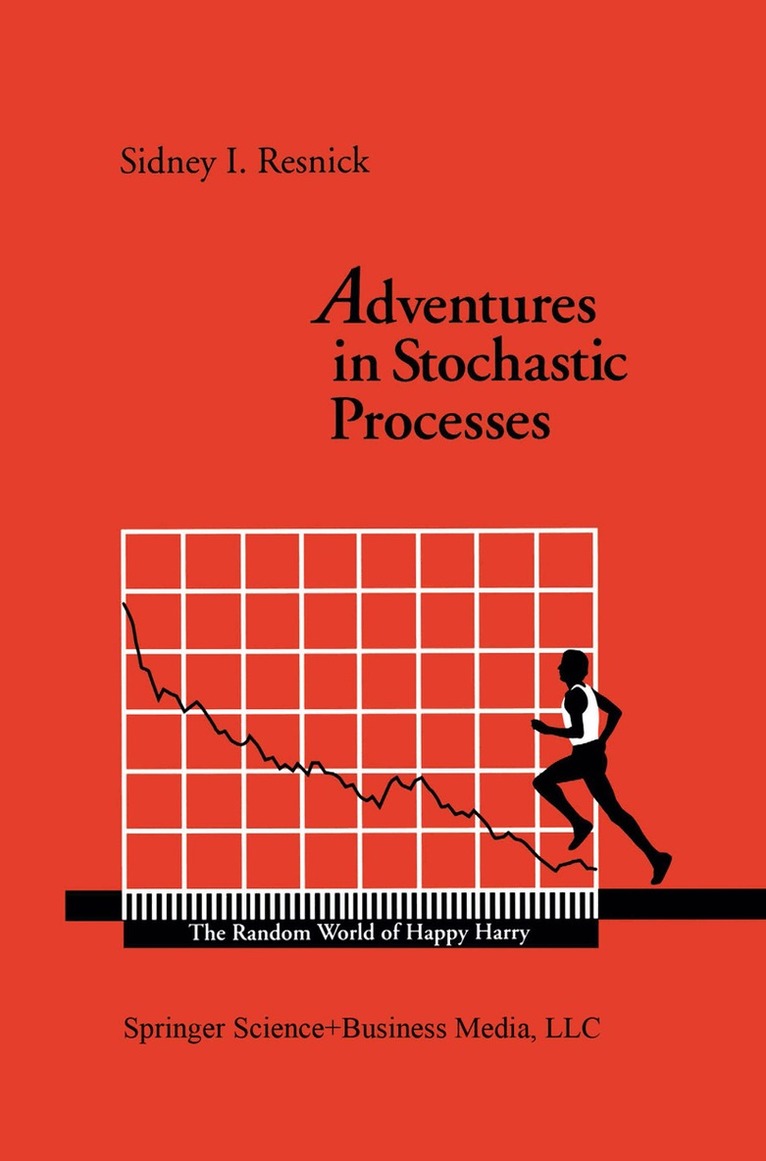
Stochastic processes are necessary ingredients for building models of a wide variety of phenomena exhibiting time varying randomness. In a lively and imaginative presentation, studded with examples, exercises, and applications, and supported by inclusion of computational procedures, the author has created a textbook that provides easy access to this fundamental topic for many students of applied sciences at many levels. With its carefully modularized discussion and crystal clear differentiation between rigorous proof and plausibility argument, it is accessible to beginners but flexible enough to serve as well those who come to the course with strong backgrounds. The prerequisite background for reading the book is a graduate level pre-measure theoretic probability course. No knowledge of measure theory is presumed and advanced notions of conditioning are scrupulously avoided until the later chapters of the book. The tools of applied probability---discrete spaces, Markov chains, renewal theory, point processes, branching processes, random walks, Brownian motion---are presented to the reader in illuminating discussion. Applications include such topics as queuing, storage, risk analysis, genetics, inventory, choice, economics, sociology, and other. Because of the conviction that analysts who build models should know how to build them for each class of process studied, the author has included such constructions.
1 892 kr
Skickas inom 10-15 vardagar
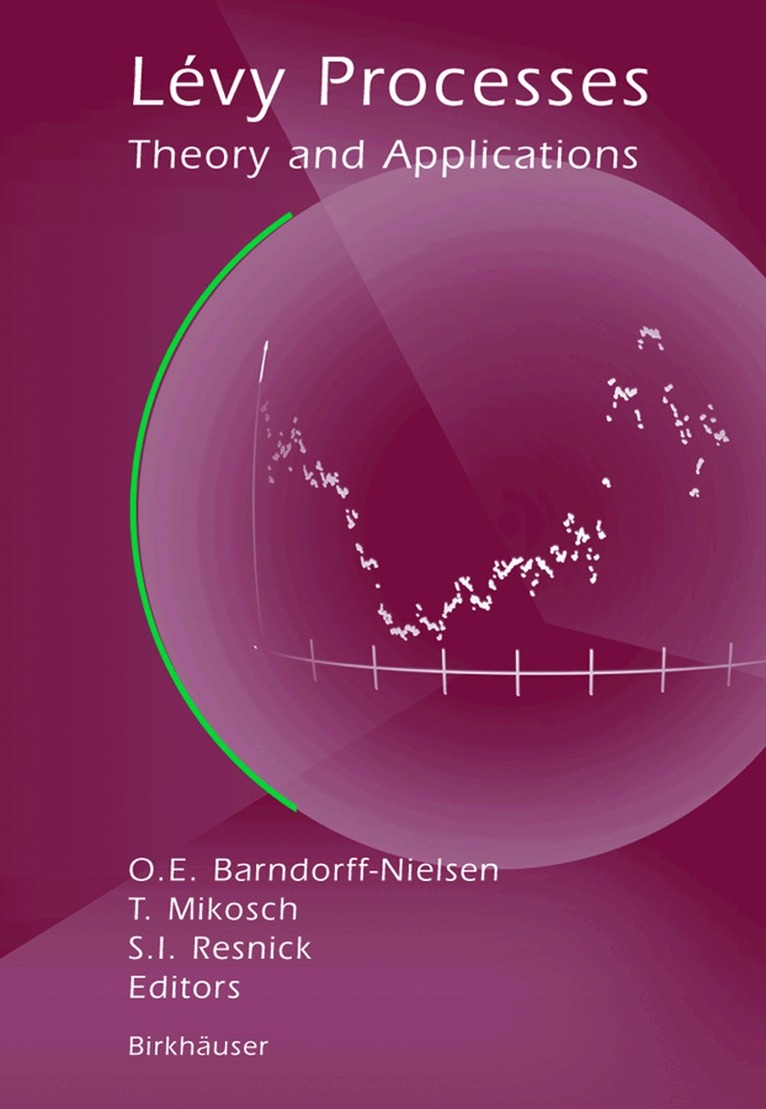
A Lévy process is a continuous-time analogue of a random walk, and as such, is at the cradle of modern theories of stochastic processes. Martingales, Markov processes, and diffusions are extensions and generalizations of these processes. In the past, representatives of the Lévy class were considered most useful for applications to either Brownian motion or the Poisson process. Nowadays the need for modeling jumps, bursts, extremes and other irregular behavior of phenomena in nature and society has led to a renaissance of the theory of general Lévy processes. Researchers and practitioners in fields as diverse as physics, meteorology, statistics, insurance, and finance have rediscovered the simplicity of Lévy processes and their enormous flexibility in modeling tails, dependence and path behavior. This volume, with an excellent introductory preface, describes the state-of-the-art of this rapidly evolving subject with special emphasis on the non-Brownian world. Leading experts present surveys of recent developments, or focus on some most promising applications. Despite its special character, every topic is aimed at the non- specialist, keen on learning about the new exciting face of a rather aged class of processes. An extensive bibliography at the end of each article makes this an invaluable comprehensive reference text. For the researcher and graduate student, every article contains open problems and points out directions for futurearch. The accessible nature of the work makes this an ideal introductory text for graduate seminars in applied probability, stochastic processes, physics, finance, and telecommunications, and a unique guide to the world of Lévy processes.
572 kr
Skickas inom 5-8 vardagar
Instead, A Probability Path is designed for those requiring a deep understanding of advanced probability for their research in statistics, applied probability, biology, operations research, mathematical finance and engineering.
694 kr
Skickas inom 10-15 vardagar
This comprehensive text gives an interesting and useful blend of the mathematical, probabilistic and statistical tools used in heavy-tail analysis. It is uniquely devoted to heavy-tails and emphasizes both probability modeling and statistical methods for fitting models. Prerequisites for the reader include a prior course in stochastic processes and probability, some statistical background, some familiarity with time series analysis, and ability to use a statistics package. This work will serve second-year graduate students and researchers in the areas of applied mathematics, statistics, operations research, electrical engineering, and economics.
2 101 kr
Skickas inom 10-15 vardagar
A Lévy process is a continuous-time analogue of a random walk, and as such, is at the cradle of modern theories of stochastic processes. Martingales, Markov processes, and diffusions are extensions and generalizations of these processes. In the past, representatives of the Lévy class were considered most useful for applications to either Brownian motion or the Poisson process. Nowadays the need for modeling jumps, bursts, extremes and other irregular behavior of phenomena in nature and society has led to a renaissance of the theory of general Lévy processes. Researchers and practitioners in fields as diverse as physics, meteorology, statistics, insurance, and finance have rediscovered the simplicity of Lévy processes and their enormous flexibility in modeling tails, dependence and path behavior. This volume, with an excellent introductory preface, describes the state-of-the-art of this rapidly evolving subject with special emphasis on the non-Brownian world. Leading experts present surveys of recent developments, or focus on some most promising applications. Despite its special character, every topic is aimed at the non- specialist, keen on learning about the new exciting face of a rather aged class of processes. An extensive bibliography at the end of each article makes this an invaluable comprehensive reference text. For the researcher and graduate student, every article contains open problems and points out directions for futurearch. The accessible nature of the work makes this an ideal introductory text for graduate seminars in applied probability, stochastic processes, physics, finance, and telecommunications, and a unique guide to the world of Lévy processes.
694 kr
Skickas inom 10-15 vardagar
Stochastic processes are necessary ingredients for building models of a wide variety of phenomena exhibiting time varying randomness. In a lively and imaginative presentation, studded with examples, exercises, and applications, and supported by inclusion of computational procedures, the author has created a textbook that provides easy access to this fundamental topic for many students of applied sciences at many levels. With its carefully modularized discussion and crystal clear differentiation between rigorous proof and plausibility argument, it is accessible to beginners but flexible enough to serve as well those who come to the course with strong backgrounds. The prerequisite background for reading the book is a graduate level pre-measure theoretic probability course. No knowledge of measure theory is presumed and advanced notions of conditioning are scrupulously avoided until the later chapters of the book. The tools of applied probability---discrete spaces, Markov chains, renewal theory, point processes, branching processes, random walks, Brownian motion---are presented to the reader in illuminating discussion. Applications include such topics as queuing, storage, risk analysis, genetics, inventory, choice, economics, sociology, and other. Because of the conviction that analysts who build models should know how to build them for each class of process studied, the author has included such constructions.