Siegfried Zielinski - Böcker
Visar alla böcker från författaren Siegfried Zielinski. Handla med fri frakt och snabb leverans.
10 produkter
10 produkter
Deep Time of the Media
Toward an Archaeology of Hearing and Seeing by Technical Means
Häftad, Engelska, 2008
553 kr
Skickas inom 3-6 vardagar
524 kr
Skickas inom 7-10 vardagar
The life and work of the outstanding Catalan-Majorcan philosopher, logician, and mystic Ramon Llull continues to fascinate thinkers, artists, and scholars worldwideIn this book, international experts from Europe and the United States address Lullism as a remarkable and distinctive method of thinking and experimenting. The origins and impact of Ramon Llull’s oeuvre as a modern thinker are presented, and their interdisciplinary and intercultural implications, which continue to this day, are explored. Ars combinatoria, generative and permutative generation of texts, the epistemic and poetic power of algorithmic systems, plus the principle of unconditional dialogue between cultural groups and their individual members, are the most important coordinates of this combinatorial–dialogical media and communication theory, which appeared very early in the history of science, technology, and art. It was developed in the work of Ramon Llull during the transition from the thirteenth to the fourteenth century when Arab-Islamic, Jewish, and Christian cultures intersected. The legacy of Lullism lives on in poetry and in the visual and electronic-based arts, as well as in research on the history of informatics, formal logic, and media archaeology. The primary idea of Llull’s teachings-to enable rational and therefore trustworthy dialogue between cultures and religions through a universally valid system of symbols-is today still topical and of great relevance, especially in the tensions prevailing in globalized spaces of possibility.Contributors: Miquel Bassols, Florian Cramer, Salvador DalÍ, Fernando DomÍnguez Reboiras, Diane Doucet-Rosenstein, Jordi GayÀ, Jonathan Gray, Daniel Irrgang, David Link, SebastiÁn Moro Tornese, Josep E. Rubio, Henning Schmidgen, Wilhelm Schmidt-Biggemann, Gianni Vattimo, Janet Zweig.
1 473 kr
Skickas inom 7-10 vardagar
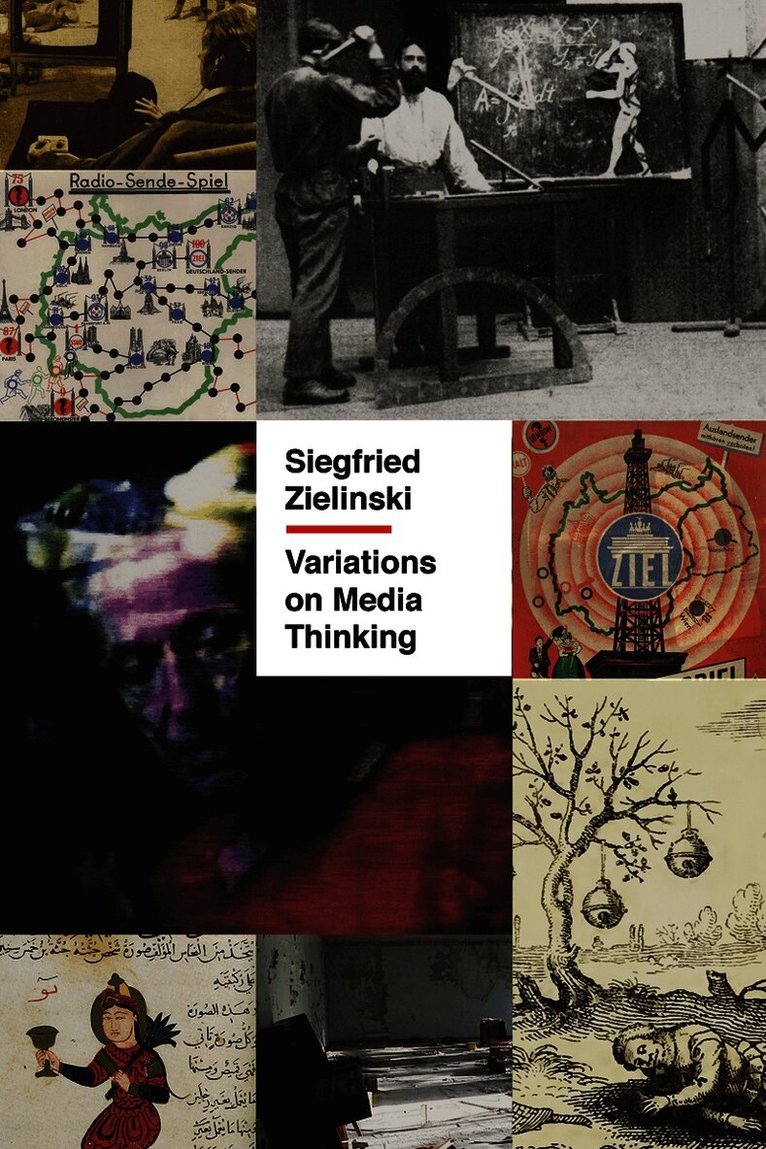
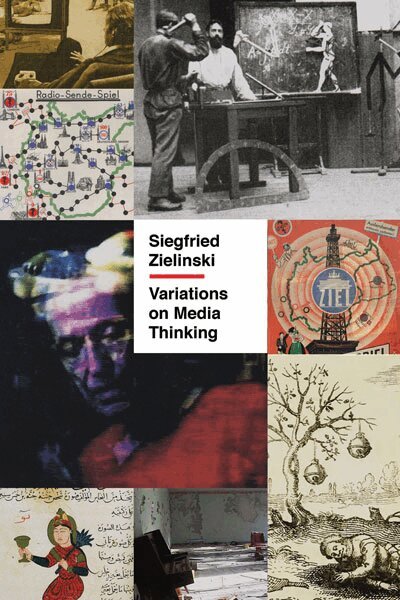
A diverse, enriching volume of media analysis from a pioneering thinker in the fieldExpanding on Siegfried Zielinski’s groundbreaking inquiry into “deep time” of the media, the essays in Variations on Media Thinking further the eminent media theorist’s unique method of expanded hermeneutics, which means for him interpreting technical artifacts as essential parts of our cultural lives. Covering such topics as the televisualized “Holocaust,” the ubiquity of media today, the Internet, the genealogy of sound art, and history’s first hacker movement, these essays further diversify Zielinski’s insight into the hidden layers of media development, which he first articulated in his pioneering work Deep Time of the Media.Including many previously untranslated and scarce essays, these “written time machines” open new lines of investigation for cultural scholars. From the automata of the Arabic-Islamic Renaissance (800–1200) to the largest and loudest techno-event ever, known as The Symphony of Sirens-which transformed Baku in 1922 into an immense music box of modern noise-Variations on Media Thinking covers Zielinski’s inquiries since 1975. Richly illustrated and full of provocation, brilliant insight, and fascinating research, this volume is perfect for students of media archaeology, philosophy, and technology, as well as any adventurous, rigorous thinkers engaged with culture and media.
373 kr
Skickas inom 11-20 vardagar
A diverse, enriching volume of media analysis from a pioneering thinker in the fieldExpanding on Siegfried Zielinski’s groundbreaking inquiry into “deep time” of the media, the essays in Variations on Media Thinking further the eminent media theorist’s unique method of expanded hermeneutics, which means for him interpreting technical artifacts as essential parts of our cultural lives. Covering such topics as the televisualized “Holocaust,” the ubiquity of media today, the Internet, the genealogy of sound art, and history’s first hacker movement, these essays further diversify Zielinski’s insight into the hidden layers of media development, which he first articulated in his pioneering work Deep Time of the Media.Including many previously untranslated and scarce essays, these “written time machines” open new lines of investigation for cultural scholars. From the automata of the Arabic-Islamic Renaissance (800–1200) to the largest and loudest techno-event ever, known as The Symphony of Sirens-which transformed Baku in 1922 into an immense music box of modern noise-Variations on Media Thinking covers Zielinski’s inquiries since 1975. Richly illustrated and full of provocation, brilliant insight, and fascinating research, this volume is perfect for students of media archaeology, philosophy, and technology, as well as any adventurous, rigorous thinkers engaged with culture and media.
221 kr
Skickas inom 11-20 vardagar
In On Doubt, VilÉm Flusser refines Martin Heidegger’s famous declaration that “language is the dwelling of Being.” For Flusser, “the word is the dwelling of being,” because in fact, in the beginning, there was the word.On Doubt is a treatise on the human intellect, its relation to language, and the reality-forming discourses that subsequently emerge. For Flusser, the faith that the modern age places in Cartesian doubt plays a role similar to the one that faith in God played in previous eras-a faith that needs to be challenged. Descartes doubts the world through his proposition cogito ergo sum, but leaves doubt itself untouched as indubitable and imperious. His cogito ergo sum may have proved to the Western intellect that thoughts exist, but it did not prove the existence of that which thinks: one can eliminate thinking and yet continue being.Therefore, should we not doubt doubt itself? Should we not try to go beyond this last step of Cartesian doubt and look for a new faith? The twentieth century has seen many attempts to defeat Cartesian doubt, however, this doubt of doubt has instead generated a complete loss of faith, which the West experiences as existential nihilism. Hence, the emergent emptying of values that results from such extreme doubt. Everything loses its meaning. Can this climate be overcome? Will the West survive the modern age?
1 213 kr
Skickas inom 10-15 vardagar
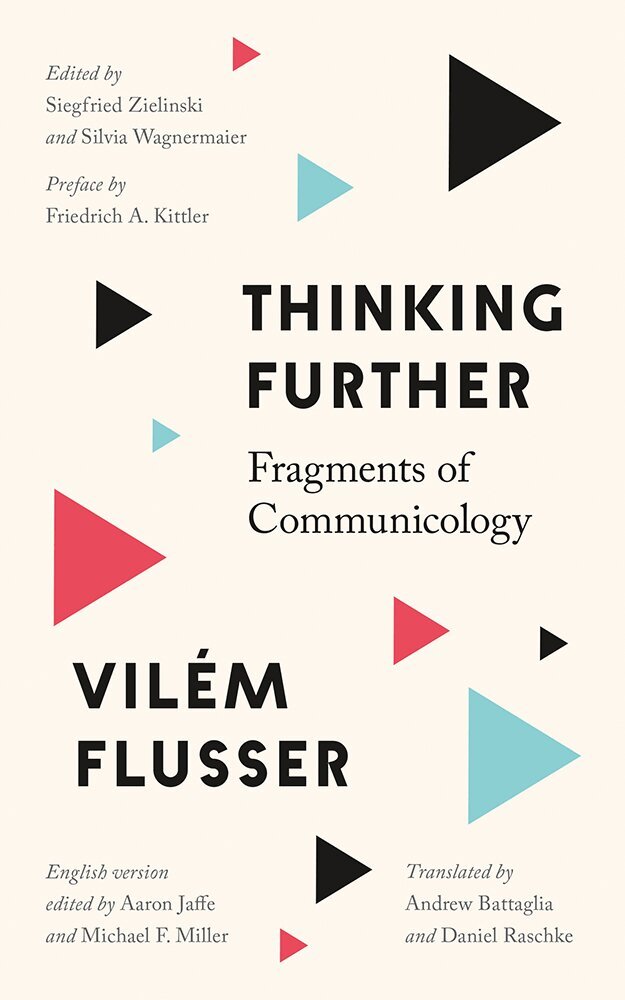
The first English-language translation of Vilém Flusser's final series of lectures: the definitive introduction to his methods and ideas in new media theoryIn summer 1991, shortly before his death, Vilém Flusser gave a series of lectures as guest professor at Ruhr University Bochum at the invitation of Friedrich Kittler. Flusser intended for these lectures to be the definitive introduction to his "communicology," the study of human communication and the means by which acquired information is saved, processed, and passed on. In Thinking Further, Aaron Jaffe and Michael F. Miller have curated "fragments" from these lectures – first published in German in 2008 – to present the most exciting and timely parts of Flusser's foundational contributions to what is now known as media studies.These fragments capture Flusser's engagements with a wide range of theories, approaches, and interventions, including ecocriticism, posthumanities, game theory, cybernetics, and translinguistic exchanges. Offering sustained engagements with the ideas of Walter Benjamin, Michel Foucault, Michel Serres, and Jean Baudrillard, Thinking Further models possibilities for thinking through and clarifying the most obscure and obdurate implications of technology and modernity.As they demonstrate Flusser's contextual positionality and antiuniversalism, the writings presented here also underscore the pleasures and the power of his aphoristic style. Focusing less on Flusser-as-philosopher and more on his role as wry sage at the end of history, Thinking Further is a comprehensive but approachable introduction to his boundary-transcending exploration of the possibilities for communication, writing, and the human condition.Retail e-book files for this title are screen-reader friendly.
284 kr
Skickas inom 7-10 vardagar
The first English-language translation of Vilém Flusser's final series of lectures: the definitive introduction to his methods and ideas in new media theoryIn summer 1991, shortly before his death, Vilém Flusser gave a series of lectures as guest professor at Ruhr University Bochum at the invitation of Friedrich Kittler. Flusser intended for these lectures to be the definitive introduction to his "communicology," the study of human communication and the means by which acquired information is saved, processed, and passed on. In Thinking Further, Aaron Jaffe and Michael F. Miller have curated "fragments" from these lectures – first published in German in 2008 – to present the most exciting and timely parts of Flusser's foundational contributions to what is now known as media studies.These fragments capture Flusser's engagements with a wide range of theories, approaches, and interventions, including ecocriticism, posthumanities, game theory, cybernetics, and translinguistic exchanges. Offering sustained engagements with the ideas of Walter Benjamin, Michel Foucault, Michel Serres, and Jean Baudrillard, Thinking Further models possibilities for thinking through and clarifying the most obscure and obdurate implications of technology and modernity.As they demonstrate Flusser's contextual positionality and antiuniversalism, the writings presented here also underscore the pleasures and the power of his aphoristic style. Focusing less on Flusser-as-philosopher and more on his role as wry sage at the end of history, Thinking Further is a comprehensive but approachable introduction to his boundary-transcending exploration of the possibilities for communication, writing, and the human condition.Retail e-book files for this title are screen-reader friendly.
271 kr
Skickas inom 7-10 vardagar
The media are now redundant. In an overview of developments spanning the past seventy years, Siegfried Zielinski’s [ . . . After the Media] discusses how the means of technology-based communication assumed a systemic character and how theory, art, and criticism were operative in this process. Media-explicit thinking is contrasted with media-implicit thought. Points of contact with an arts perspective include a reinterpretation of the artist Nam June Paik and an introduction to the work of Jake and Dinos Chapman. The essay ends with two appeals. In an outline of a precise philology of exact things, Zielinski suggests possibilities of how things could proceed after the media. With a vade mecum against psychopathia medialis in the form of a manifesto, the book advocates for a distinction to be made between online existence and offline being.
518 kr
Skickas inom 3-6 vardagar
412 kr
Skickas inom 3-6 vardagar