Silva Ladewig - Böcker
Visar alla böcker från författaren Silva Ladewig. Handla med fri frakt och snabb leverans.
3 produkter
3 produkter
7 720 kr
Skickas inom 3-6 vardagar
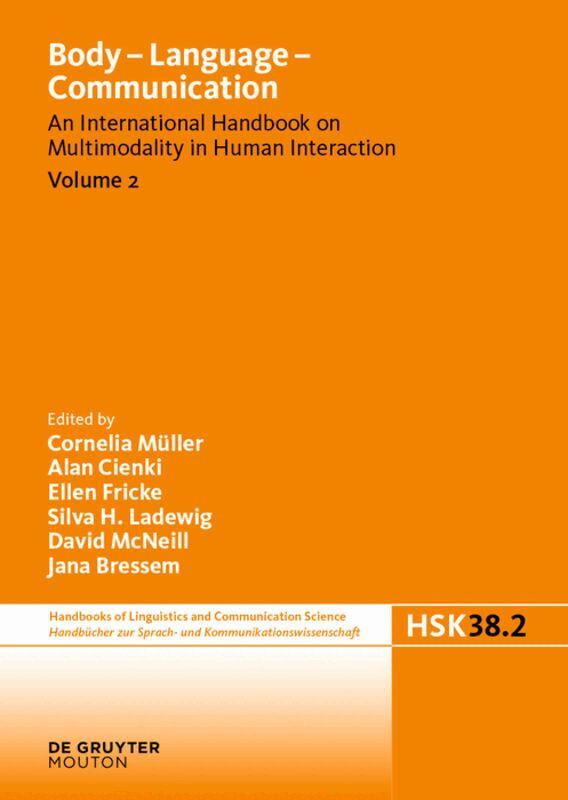
Volume II of the handbook offers a unique collection of exemplary case studies. In five chapters and 99 articles it presents the state of the art on how body movements are used for communication around the world. Topics include the functions of body movements, their contexts of occurrence, their forms and meanings, their integration with speech, and how bodily motion can function as language. By including an interdisciplinary chapter on ‘embodiment’, volume II explores the body and its role in the grounding of language and communication from one of the most widely discussed current theoretical perspectives. Volume II of the handbook thus entails the following chapters: VI. Gestures across cultures, VII. Body movements: functions, contexts and interactions, VIII. Gesture and language,IX. Embodiment: the body and its role for cognition, emotion, and communication, X. Sign Language: Visible body movements as language. Authors include: Mats Andrèn, Richard Asheley, Benjamin Bergen, Ulrike Bohle, Dominique Boutet, Heather Brookes, Penelope Brown, Kensy Cooperrider, Onno Crasborn, Seana Coulson, James Essegby, Maria Graziano, Marianne Gullberg, Simon Harrison, Hermann Kappelhoff, Mardi Kidwell, Irene Kimbara, Stefan Kopp, Grigoriy Kreidlin, Dan Loehr, Irene Mittelberg, Aliyah Morgenstern, Rafael Nuñez, Isabella Poggi, David Quinto-Pozos, Monica Rector, Pio Enrico Ricci-Bitti, Göran Sonesson, Timo Sowa, Gale Stam, Eve Sweetser, Mark Tutton, Ipke Wachsmuth, Linda Waugh, Sherman Wilcox.
1 648 kr
Skickas inom 5-8 vardagar
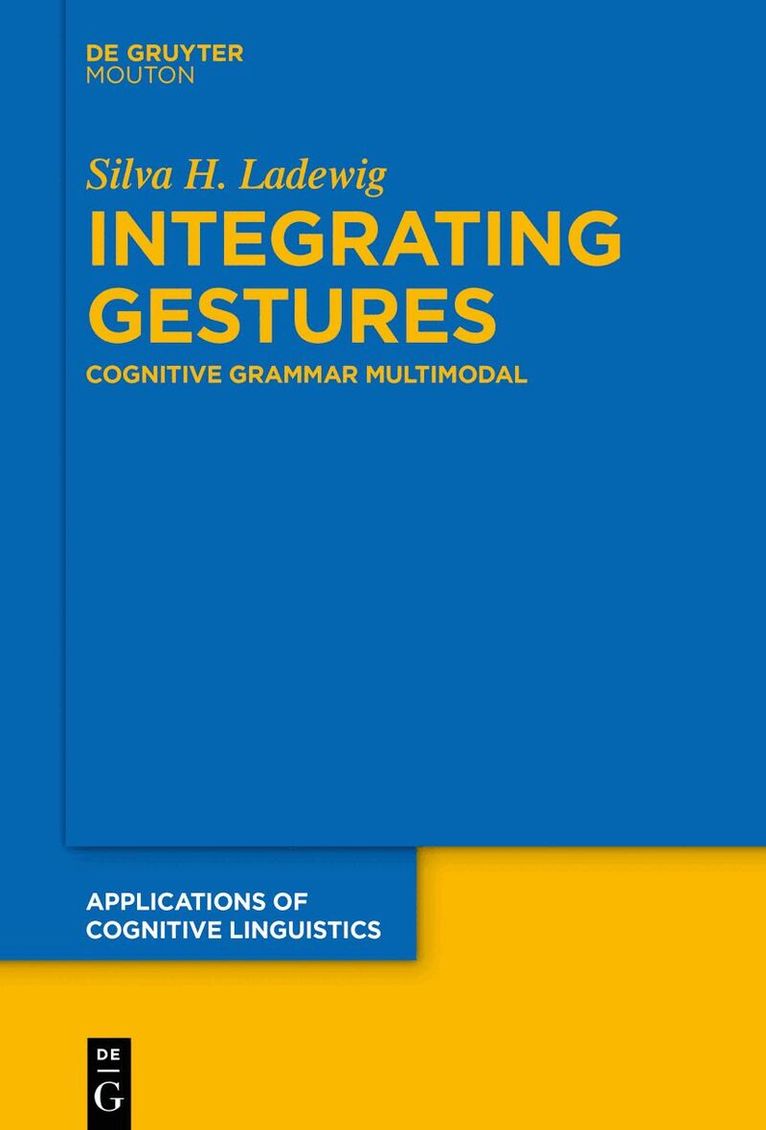
Gestures are now viewed as an integral part of spoken language. But little attention has been paid to the recipients’ cognitive processes of integrating both gesture and speech. How do people understand a speaker’s gestures when inserted into gaps in the flow of speech? What cognitive-semiotic mechanisms allow this integration to occur? And what linguistic and gestural properties do people draw on when construing multimodal meaning? This book offers answers by investigating multimodal utterances in which speech is replaced by gestures. Through fine-grained cognitive-linguistic and cognitive-semiotic analyses of multimodal utterances combined with naturalistic perception experiments, six chapters explore gestures’ potential to realize grammatical notions of nouns and verbs and to integrate with speech by merging into multimodal syntactic constructions. Analyses of speech-replacing gestures and a range of related phenomena compel us to consider gestures as well as spoken and signed language as manifestations of the same conceptual system. An overarching framework is proposed for studying these different modalities together – a multimodal cognitive grammar.
294 kr
Skickas inom 5-8 vardagar
Gestures are now viewed as an integral part of spoken language. But little attention has been paid to the recipients’ cognitive processes of integrating both gesture and speech. How do people understand a speaker’s gestures when inserted into gaps in the flow of speech? What cognitive-semiotic mechanisms allow this integration to occur? And what linguistic and gestural properties do people draw on when construing multimodal meaning? This book offers answers by investigating multimodal utterances in which speech is replaced by gestures. Through fine-grained cognitive-linguistic and cognitive-semiotic analyses of multimodal utterances combined with naturalistic perception experiments, six chapters explore gestures’ potential to realize grammatical notions of nouns and verbs and to integrate with speech by merging into multimodal syntactic constructions. Analyses of speech-replacing gestures and a range of related phenomena compel us to consider gestures as well as spoken and signed language as manifestations of the same conceptual system. An overarching framework is proposed for studying these different modalities together – a multimodal cognitive grammar.