Simon Robins - Böcker
Visar alla böcker från författaren Simon Robins. Handla med fri frakt och snabb leverans.
6 produkter
6 produkter
Families of the Missing
A Test for Contemporary Approaches to Transitional Justice
Inbunden, Engelska, 2013
1 983 kr
Skickas inom 10-15 vardagar
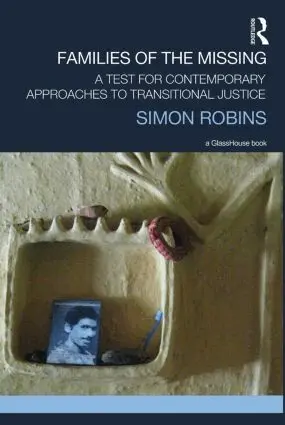
Families of the Missing interrogates the current practice of transitional justice from the viewpoint of the families of those disappeared and missing as a result of conflict and political violence. Studying the needs of families of the missing in two contexts, Nepal and Timor-Leste, the practice of transitional justice is seen to be rooted in discourses that are alien to predominantly poor and rural victims of violence, and that are driven by elites with agendas that diverge from those of the victims. In contrast to the legalist orientation of the global transitional justice project, victims do not see judicial process as a priority. Rather, they urgently seek an answer concerning the fate of the missing, and to retrieve human remains. As important are livelihood issues where families are struggling to cope with the loss of breadwinners and seek support to ensure economic security. Although rights are the product of a discourse that claims to be global and universal, needs are necessarily local and particular, the product of culture and context. And it is from this perspective that this volume seeks both to understand the limitations of transitional justice processes in addressing the priorities of victims, and to provide the basis of an emancipatory victim-centred approach to transitional justice.
Families of the Missing
A Test for Contemporary Approaches to Transitional Justice
Häftad, Engelska, 2015
618 kr
Skickas inom 10-15 vardagar
Families of the Missing interrogates the current practice of transitional justice from the viewpoint of the families of those disappeared and missing as a result of conflict and political violence. Studying the needs of families of the missing in two contexts, Nepal and Timor-Leste, the practice of transitional justice is seen to be rooted in discourses that are alien to predominantly poor and rural victims of violence, and that are driven by elites with agendas that diverge from those of the victims. In contrast to the legalist orientation of the global transitional justice project, victims do not see judicial process as a priority. Rather, they urgently seek an answer concerning the fate of the missing, and to retrieve human remains. As important are livelihood issues where families are struggling to cope with the loss of breadwinners and seek support to ensure economic security. Although rights are the product of a discourse that claims to be global and universal, needs are necessarily local and particular, the product of culture and context. And it is from this perspective that Families of the Missing seeks both to understand the limitations of transitional justice processes in addressing the priorities of victims, and to provide the basis of an emancipatory victim-centred approach to transitional justice.
1 930 kr
Skickas inom 10-15 vardagar
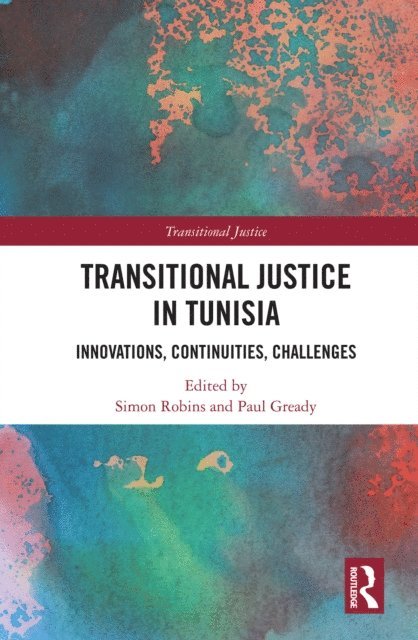
This book engages comprehensively with the dynamics of the transitional justice process in Tunisia and its mechanisms, elaborating lessons for transitional justice practice globally. Grounded in new empirical material as well as a broader awareness of transitional justice, this book provides a thorough assessment of transitional justice in Tunisia. Beyond an overview of the process, it critically engages with key questions such as the extent to which the process articulated global contemporary practice, such as liberal state-building and narrow conceptions of justice as civil-political rights, and to which it generated novel approaches at odds with the mainstream that can inform global practice. The book examines how the transitional justice process in Tunisia has been contextualised and made relevant to the nation’s circumstances and needs. It looks at innovation at the level of formal mechanisms and at the dynamics of mobilisation and contestation surrounding transitional justice both from civil society organisations and victims’ groups. Bringing together analysis from legal scholars, social scientists as well as activists and practitioners, the book challenges the legalism of transitional justice discourse globally, engendering a dialogue between these legal and judicial approaches on the one hand and alternative, more diverse and radical approaches to justice on the other, in order to both deal with the past and to address ongoing injustice. This first book in English to address the dynamics and mechanisms of the transitional justice process in Tunisia will appeal to students and scholars of transitional justice, human rights, peacebuilding, conflict and peace studies, development, and security studies, as well as policymakers and practitioners in these fields, and others with interests in Middle Eastern studies.
638 kr
Skickas inom 10-15 vardagar
This book engages comprehensively with the dynamics of the transitional justice process in Tunisia and its mechanisms, elaborating lessons for transitional justice practice globally. Grounded in new empirical material as well as a broader awareness of transitional justice, this book provides a thorough assessment of transitional justice in Tunisia. Beyond an overview of the process, it critically engages with key questions such as the extent to which the process articulated global contemporary practice, such as liberal state-building and narrow conceptions of justice as civil-political rights, and to which it generated novel approaches at odds with the mainstream that can inform global practice. The book examines how the transitional justice process in Tunisia has been contextualised and made relevant to the nation’s circumstances and needs. It looks at innovation at the level of formal mechanisms and at the dynamics of mobilisation and contestation surrounding transitional justice both from civil society organisations and victims’ groups. Bringing together analysis from legal scholars, social scientists as well as activists and practitioners, the book challenges the legalism of transitional justice discourse globally, engendering a dialogue between these legal and judicial approaches on the one hand and alternative, more diverse and radical approaches to justice on the other, in order to both deal with the past and to address ongoing injustice. This first book in English to address the dynamics and mechanisms of the transitional justice process in Tunisia will appeal to students and scholars of transitional justice, human rights, peacebuilding, conflict and peace studies, development, and security studies, as well as policymakers and practitioners in these fields, and others with interests in Middle Eastern studies.
1 266 kr
Skickas inom 7-10 vardagar
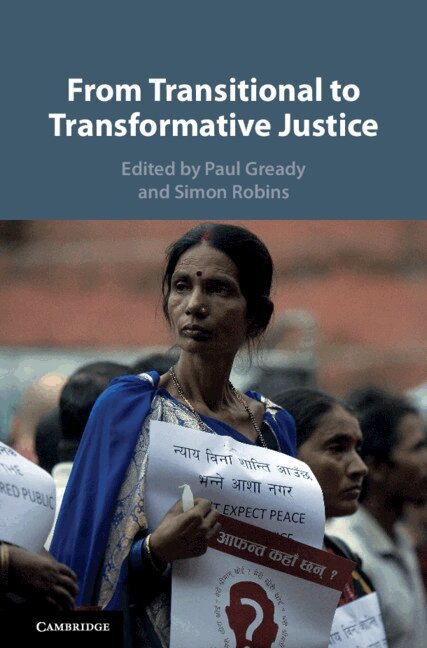
Transitional justice has become the principle lens used by countries emerging from conflict and authoritarian rule to address the legacies of violence and serious human rights abuses. However, as transitional justice practice becomes more institutionalized with support from NGOs and funding from Western donors, questions have been raised about the long-term effectiveness of transitional justice mechanisms. Core elements of the paradigm have been subjected to sustained critique, yet there is much less commentary that goes beyond critique to set out, in a comprehensive fashion, what an alternative approach might look like. This volume discusses one such alternative, transformative justice, and positions this quest in the wider context of ongoing fall-out from the 2008 global economic and political crisis, as well as the failure of social justice advocates to respond with imagination and ambition. Drawing on diverse perspectives, contributors illustrate the wide-ranging purchase of transformative justice at both conceptual and empirical levels.
309 kr
Skickas inom 7-10 vardagar
Transitional justice has become the principle lens used by countries emerging from conflict and authoritarian rule to address the legacies of violence and serious human rights abuses. However, as transitional justice practice becomes more institutionalized with support from NGOs and funding from Western donors, questions have been raised about the long-term effectiveness of transitional justice mechanisms. Core elements of the paradigm have been subjected to sustained critique, yet there is much less commentary that goes beyond critique to set out, in a comprehensive fashion, what an alternative approach might look like. This volume discusses one such alternative, transformative justice, and positions this quest in the wider context of ongoing fall-out from the 2008 global economic and political crisis, as well as the failure of social justice advocates to respond with imagination and ambition. Drawing on diverse perspectives, contributors illustrate the wide-ranging purchase of transformative justice at both conceptual and empirical levels.