
Søren Dietz - Böcker
Visar alla böcker från författaren Søren Dietz. Handla med fri frakt och snabb leverans.
4 produkter
4 produkter
Communities in Transition
The Circum-Aegean Area in the 5th and 4th Millennia BC
Inbunden, Engelska, 2018
1 325 kr
Tillfälligt slut
Communities in Transition brings together scholars from different countries and backgrounds united by a common interest in the transition between the Neolithic and the Early Bronze Age in the lands around the Aegean. Neolithic community was transformed, in some places incrementally and in others rapidly, during the 5th and 4th millennia BC into one that we would commonly associate with the Bronze Age. Many different names have been assigned to this period: Final Neolithic, Chalcolithic, Eneolithic, Late Neolithic [I]-II, Copper Age which, to some extent, reflects the diversity of archaeological evidence from varied geographical regions. During this long heterogeneous period developments occurred that led to significant changes in material culture, the use of space, the adoption of metallurgical practices, establishment of far-reaching interaction and exchange networks, and increased social complexity. The 5th to 4th millennium BC transition is one of inclusions, entanglements, connectivity, and exchange of ideas, raw materials, finished products and, quite possibly, worldviews and belief systems. Most of the papers presented here are multifaceted and complex in that they do not deal with only one topic or narrowly focus on a single line of reasoning or dataset. Arranged geographically they explore a series of key themes: Chronology, cultural affinities, and synchronization in material culture; changing social structure and economy; inter- and intra-site space use and settlement patterns, caves and include both site reports and regional studies.
197 kr
Skickas inom 7-10 vardagar
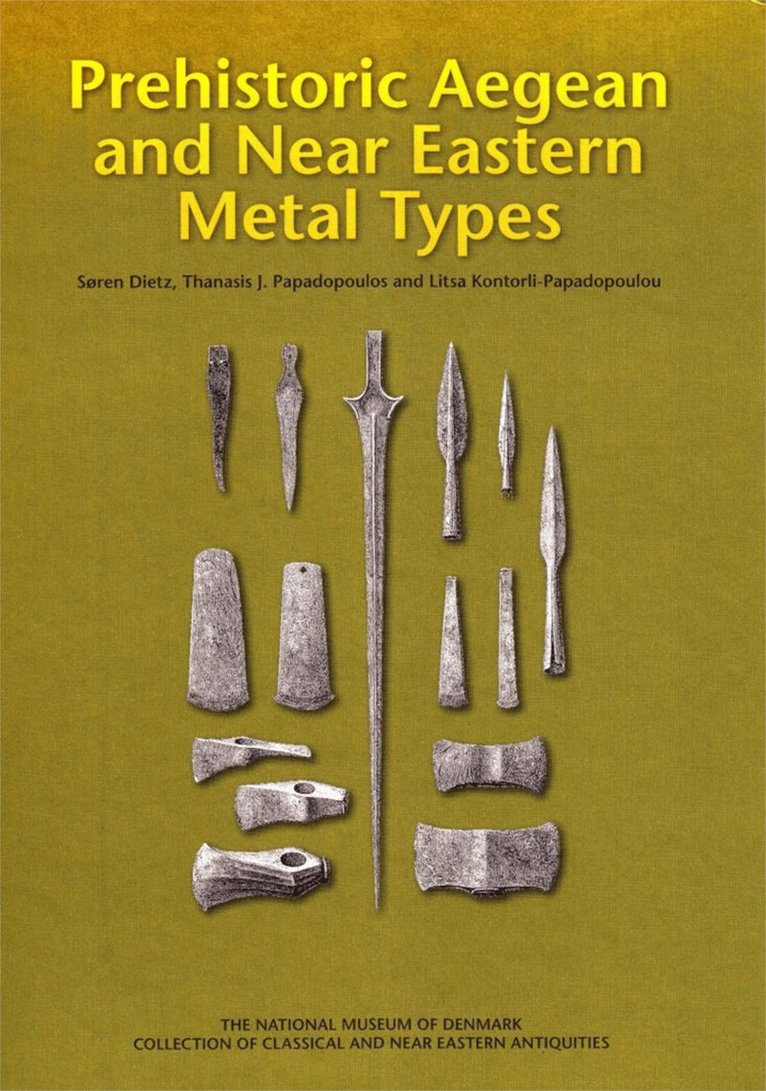
The present publication attempts to make the collection of Prehistoric Aegean and Near Eastern bronzes in the National Museum of Denmark known to scholars in the field. The catalogue contains all Aegean metals kept in the Department of Ancient Cultures of Denmark and the Mediterrenean. In the section on the Near Eastern metals, bronzes from Hama, however, are not included. Except for that, all metal objects from the Near East dated before 1000 BC are found in the catalogue.
Kalydon in Aitolia I II Reports and Studies
Danish/Greek Field Work 2001-2005
Inbunden, Engelska, 2011
795 kr
Skickas inom 7-10 vardagar
In 2001 the Danish Institute at Athens commenced a large scale archaeological field project in ancient Kalydon in Aitolia. Kalydon is located around eight kilometres as the crow flies from Chalkis, on the west side of Mount Varassova in the direction of the present-day capital of Aitolia, Messolonghi. Kalydon plays a considerable role in ancient mythology as described in Homer's Iliad. For that reason, the important Sanctuary of Artemis Laphria outside the city walls and a so-called Heroon/palaestra, were excavated by a team of Danish and Greek archaeologists during the years 1926 to 1935. The new investigations are thus a continuation of an earlier Danish/Greek cooperation, this time with focus on the town itself. Various methods were used in order to examine the town itself. A surveyor initiated the topographical measurements of the city, the fortification walls and the visible remains of terrace walls and buildings. The town inside the walls was surveyed by a team, which collected and counted the objects from the surface - pottery, tiles, metals, loom weights etc. Finally, excavations concentrated on a peristyle building which was partly excavated, and a tile kiln situated in the so-called Lower Town. Larger sections of the remains on the Acropolis were excavated and a small-scale survey of the Central Town gave indications of the use of the habitation quarters. The town within the walls comprised an area of approximately 35 ha (350,000 m2). The investigations gave a good picture of the town in antiquity and of the function of the various quarters. The most important building in the Lower Town was probably the peristyle building with its colonnade and courtyard where athletic games took place. In a room in one of the corners of the building, a cult of the Anatolian goddess Cybele was established. Findings of marble sculpture, incense burners, clay figurines and lamps indicate the function of the room. The objects were found almost as they were left when the roof collapsed around the middle of the 1st century AD. On the Acropolis a shrine was already established by late Archaic times, in the late 6th century BC.
Africa Proconsularis, Volumes 1 & 2
Regional Studies in the Segermes Valley of Northern Tunisia
Inbunden, Engelska, 1998
795 kr
Skickas inom 7-10 vardagar
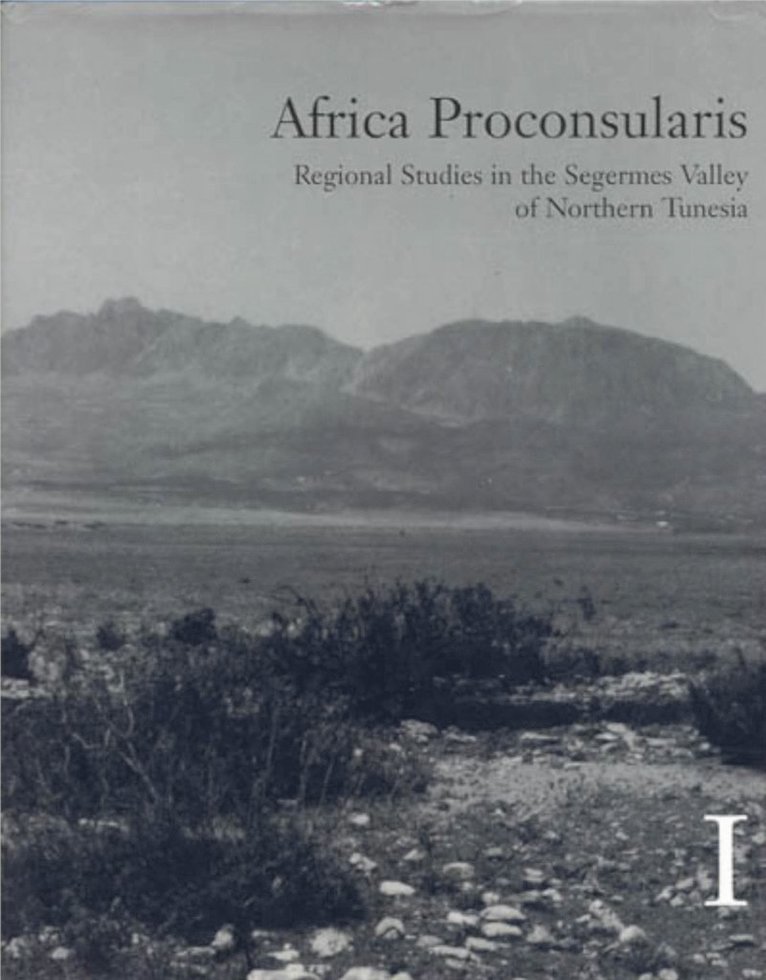
What was the relationship between city and country in the Roman Empire? The writings which have been preserved show an enormous empire, divided into "cells", each with a city at its centre. But the written sources are few, and focus mainly on the cities of Italy; they do not tell what life was like in the Roman provinces. Through systematic studies of the ancient landscape in Northern Tunisia, archaeologists have reconstructed the day-to-day history and economic activity of the rural population around the city of Segermes. Over 100 persons have been involved in this joint Danish-Tunisian project. The findings presented in these two volumes indicate that in Roman times, the valley was given over to intensive cultivation of wheat and olives, maintained at a high output level by means of extensive irrigation works. The population was dense and, surprisingly, reached its peak between 350 and 550 AD, a period of economic decline elsewhere in the Roman Empire.