Soeren Urbansky - Böcker
Visar alla böcker från författaren Soeren Urbansky. Handla med fri frakt och snabb leverans.
10 produkter
10 produkter
412 kr
Skickas inom 7-10 vardagar
A comprehensive history of the Sino-Russian border, one of the longest and most important land borders in the worldThe Sino-Russian border, once the world’s longest land border, has received scant attention in histories about the margins of empires. Beyond the Steppe Frontier rectifies this by exploring the demarcation’s remarkable transformation—from a vaguely marked frontier in the seventeenth century to its twentieth-century incarnation as a tightly patrolled barrier girded by watchtowers, barbed wire, and border guards. Through the perspectives of locals, including railroad employees, herdsmen, and smugglers from both sides, Sören Urbansky explores the daily life of communities and their entanglements with transnational and global flows of people, commodities, and ideas. Urbansky challenges top-down interpretations by stressing the significance of the local population in supporting, and undermining, border making.Because Russian, Chinese, and native worlds are intricately interwoven, national separations largely remained invisible at the border between the two largest Eurasian empires. This overlapping and mingling came to an end only when the border gained geopolitical significance during the twentieth century. Relying on a wealth of sources culled from little-known archives from across Eurasia, Urbansky demonstrates how states succeeded in suppressing traditional borderland cultures by cutting kin, cultural, economic, and religious connections across the state perimeter, through laws, physical force, deportation, reeducation, forced assimilation, and propaganda.Beyond the Steppe Frontier sheds critical new light on a pivotal geographical periphery and expands our understanding of how borders are determined.
282 kr
Skickas inom 7-10 vardagar
A comprehensive history of the Sino-Russian border, one of the longest and most important land borders in the worldThe Sino-Russian border, once the world’s longest land border, has received scant attention in histories about the margins of empires. Beyond the Steppe Frontier rectifies this by exploring the demarcation’s remarkable transformation—from a vaguely marked frontier in the seventeenth century to its twentieth-century incarnation as a tightly patrolled barrier girded by watchtowers, barbed wire, and border guards. Through the perspectives of locals, including railroad employees, herdsmen, and smugglers from both sides, Sören Urbansky explores the daily life of communities and their entanglements with transnational and global flows of people, commodities, and ideas. Urbansky challenges top-down interpretations by stressing the significance of the local population in supporting, and undermining, border making.Because Russian, Chinese, and native worlds are intricately interwoven, national separations largely remained invisible at the border between the two largest Eurasian empires. This overlapping and mingling came to an end only when the border gained geopolitical significance during the twentieth century. Relying on a wealth of sources culled from little-known archives from across Eurasia, Urbansky demonstrates how states succeeded in suppressing traditional borderland cultures by cutting kin, cultural, economic, and religious connections across the state perimeter, through laws, physical force, deportation, reeducation, forced assimilation, and propaganda.Beyond the Steppe Frontier sheds critical new light on a pivotal geographical periphery and expands our understanding of how borders are determined.
874 kr
Skickas inom 7-10 vardagar
China’s meteoric rise and ever expanding economic and cultural footprint have been accompanied by widespread global disquiet. Whether admiring or alarmist, media discourse and representations of China often tap into the myths and prejudices that emerged through specific historical encounters. These deeply embedded anxieties have shown great resilience, as in recent media treatments of SARS and the H5N1 virus, which echoed past beliefs connecting China and disease. Popular perceptions of Asia, too, continue to be framed by entrenched racial stereotypes: its people are unfathomable, exploitative, cunning, or excessively hardworking. This interdisciplinary collection of original essays offers a broad view of the mechanics that underlie Yellow Peril discourse by looking at its cultural deployment and repercussions worldwide.Building on the richly detailed historical studies already published in the context of the United States and Europe, contributors to Yellow Perils confront the phenomenon in Italy, Australia, South Africa, Nigeria, Mongolia, Hong Kong, and China itself. With chapters based on archival material and interviews, the collection supplements and often challenges superficial journalistic accounts and top-down studies by economists and political scientists. Yellow Peril narratives, contributors find, constitute cultural vectors of multiple kinds of anxieties, spanning the cultural, racial, political, and economic. Indeed, the emergence of the term “Yellow Peril” in such disparate contexts cannot be assumed to be singular, to refer to the same fears, or to revolve around the same stereotypes. The discourse, even when used in reference to a single country like China, is therefore inherently fractured and multiple.The term “Yellow Peril” may feel unpalatable and dated today, but the ethnographic, geographic, and historical breadth of this collection—experiences of Chinese migration and diaspora, historical reflections on the discourse of the Yellow Peril in China, and contemporary analyses of the global reverberations of China’s economic rise—offers a unique overview of the ways in which anti-Chinese narratives continue to play out in today’s world. This timely and provocative book will appeal to Chinese and Asian Studies scholars, but will also be highly relevant to historians and anthropologists working on diasporic communities and on ethnic formations both within and beyond Asia.
292 kr
Skickas inom 7-10 vardagar
China's meteoric rise and ever expanding economic and cultural footprint have been accompanied by widespread global disquiet. Whether admiring or alarmist, media discourse and representations of China often tap into the myths and prejudices that emerged through specific historical encounters. These deeply embedded anxieties have shown great resilience, as in recent media treatments of SARS and the H5N1 virus, which echoed past beliefs connecting China and disease. Popular perceptions of Asia, too, continue to be framed by entrenched racial stereotypes: its people are unfathomable, exploitative, cunning, or excessively hardworking. This interdisciplinary collection of original essays offers a broad view of the mechanics that underlie Yellow Peril discourse by looking at its cultural deployment and repercussions worldwide.Building on the richly detailed historical studies already published in the context of the United States and Europe, contributors to Yellow Perils confront the phenomenon in Italy, Australia, South Africa, Nigeria, Mongolia, Hong Kong, and China itself. With chapters based on archival material and interviews, the collection supplements and often challenges superficial journalistic accounts and top-down studies by economists and political scientists. Yellow Peril narratives, contributors find, constitute cultural vectors of multiple kinds of anxieties, spanning the cultural, racial, political, and economic. Indeed, the emergence of the term "Yellow Peril" in such disparate contexts cannot be assumed to be singular, to refer to the same fears, or to revolve around the same stereotypes. The discourse, even when used in reference to a single country like China, is therefore inherently fractured and multiple.The term "Yellow Peril" may feel unpalatable and dated today, but the ethnographic, geographic, and historical breadth of this collection—experiences of Chinese migration and diaspora, historical reflections on the discourse of the Yellow Peril in China, and contemporary analyses of the global reverberations of China’s economic rise—offers a unique overview of the ways in which anti-Chinese narratives continue to play out in today’s world. This timely and provocative book will appeal to Chinese and Asian Studies scholars, but will also be highly relevant to historians and anthropologists working on diasporic communities and on ethnic formations both within and beyond Asia.
2 151 kr
Skickas inom 10-15 vardagar
This volume examines relations between the People’s Republic of China (PRC) and socialist Eastern European states during the Cold War. The chapters take previous findings on government policy and China’s role as a global player in the Cold War game as a starting point to locate the PRC in the socialist world and assess levels of interaction beyond diplomatic and governmental relations. By focusing on transfers and interconnections and the social dimension of governmental interactions, the primary goal of this book is to explore structures, institutions, and spaces of interaction between China and Eastern Europe and their potential autonomy from political conjunctures.The guiding question that the book raises is: To what extent did Chinese and Eastern European players, outside the range of the power centres, have room to manoeuvre beyond the agendas of the Kremlin, national governments, or party leaderships? The question of the relative autonomy becomes especially vibrant against the backdrop of the development of Sino–Soviet relations from alliance to split to reconciliation through the Cold War era.This book contributes to the growing scholarship on East-South and intra-bloc relations from the perspective of global and transnational history and will be of interest to researchers, students and policy makers in the fields of History, East European and Russian studies, International Relations and politics. The chapters in this book were originally published as a special issue of Cold War History.
594 kr
Skickas inom 10-15 vardagar
This volume examines relations between the People’s Republic of China (PRC) and socialist Eastern European states during the Cold War. The chapters take previous findings on government policy and China’s role as a global player in the Cold War game as a starting point to locate the PRC in the socialist world and assess levels of interaction beyond diplomatic and governmental relations. By focusing on transfers and interconnections and the social dimension of governmental interactions, the primary goal of this book is to explore structures, institutions, and spaces of interaction between China and Eastern Europe and their potential autonomy from political conjunctures.The guiding question that the book raises is: To what extent did Chinese and Eastern European players, outside the range of the power centres, have room to manoeuvre beyond the agendas of the Kremlin, national governments, or party leaderships? The question of the relative autonomy becomes especially vibrant against the backdrop of the development of Sino–Soviet relations from alliance to split to reconciliation through the Cold War era.This book contributes to the growing scholarship on East-South and intra-bloc relations from the perspective of global and transnational history and will be of interest to researchers, students and policy makers in the fields of History, East European and Russian studies, International Relations and politics. The chapters in this book were originally published as a special issue of Cold War History.
266 kr
Kommande
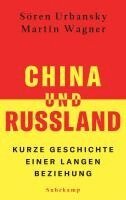
As expansionist empires, socialist superpowers, and authoritarian regimes, China and Russia have much in common. While many in the West fear the formation of an authoritarian alliance between these two great powers and while Vladimir Putin and Xi Jinping call themselves 'good friends', the geopolitical interests of Beijing and Moscow are often at odds with each other. They may be comrades but they don't always march to the same beat.In order to gain a clear understanding of China–Russia relations in the twenty-first century, we need first to understand the long history that brought them to this point. In Entangled Empires Sören Urbansky and Martin Wagner offer an introduction to the 400-year history of these two distant neighbours: from their first official contact in 1618 and the falling out of the two communist regimes under Khrushchev and Mao through to China's response to Russia's full-scale invasion of Ukraine in 2022.This expertly researched history of China-Russia relations will be essential reading for all students and scholars of Chinese and Russian history and politics and for anyone interested in these countries and their histories and in the changing balance of power in the world today.
299 kr
Skickas inom 3-6 vardagar
287 kr
Skickas inom 3-6 vardagar
464 kr
Skickas inom 3-6 vardagar