Sonja Opper - Böcker
Visar alla böcker från författaren Sonja Opper. Handla med fri frakt och snabb leverans.
3 produkter
3 produkter
1 539 kr
Skickas inom 3-6 vardagar
Strong Bridges is a book about a contradiction and the opportunity it offers. For decades, social network theory has drawn its maps of advantage from the idea that brokers sit astride structural holes, reaping value from weak ties that bridge disconnected worlds. But what if some of those bridges are not weak? What if the real advantage lies not just in structure, but in trust forged in interpersonal history regardless of structure? This is the puzzle Strong Bridges takes up. It begins with guanxi, the colloquial Chinese term for relationship advantage, often dismissed as cultural peculiarity or corruption. But the authors treat guanxi as a strategic research site, not a cultural relic. They view it a niche-word pointing to a broader category of human experience. Combining analytic rigor with quality network data, they pull apart the Siamese twins of tie strength and network structure, documenting the prevalence and competitive value of high-trust ties that span structural holes, i.e., strong bridges. The book offers two discovery stories; one empirical, one theoretical. The first tracks how guanxi bridges operate in the personal networks of Chinese entrepreneurs. The second reshapes core assumptions in network theory. Across industries, events, and even a pandemic, strong bridges emerge as resilient assets distinct from embedded ties, more predictive of cooperation, and more durable than theory currently expects. This is a book about the anatomy of network advantage. It reframes brokerage not as a fragile position, but as a relationship earned, remembered, and surprisingly strong.
278 kr
Kommande
Strong Bridges is a book about a contradiction and the opportunity it offers. For decades, social network theory has drawn its maps of advantage from the idea that brokers sit astride structural holes, reaping value from weak ties that bridge disconnected worlds. But what if some of those bridges are not weak? What if the real advantage lies not just in structure, but in trust forged in interpersonal history regardless of structure? This is the puzzle Strong Bridges takes up. It begins with guanxi, the colloquial Chinese term for relationship advantage, often dismissed as cultural peculiarity or corruption. But the authors treat guanxi as a strategic research site, not a cultural relic. They view it a niche-word pointing to a broader category of human experience. Combining analytic rigor with quality network data, they pull apart the Siamese twins of tie strength and network structure, documenting the prevalence and competitive value of high-trust ties that span structural holes, i.e., strong bridges. The book offers two discovery stories; one empirical, one theoretical. The first tracks how guanxi bridges operate in the personal networks of Chinese entrepreneurs. The second reshapes core assumptions in network theory. Across industries, events, and even a pandemic, strong bridges emerge as resilient assets distinct from embedded ties, more predictive of cooperation, and more durable than theory currently expects. This is a book about the anatomy of network advantage. It reframes brokerage not as a fragile position, but as a relationship earned, remembered, and surprisingly strong.
564 kr
Skickas inom 10-15 vardagar
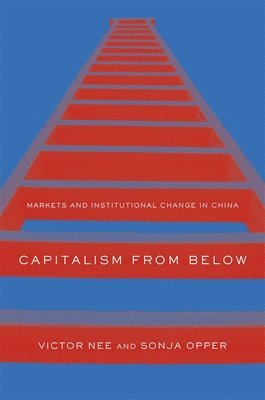
More than 630 million Chinese have escaped poverty since the 1980s, reducing the fraction remaining from 82 to 10 percent of the population. This astonishing decline in poverty, the largest in history, coincided with the rapid growth of a private enterprise economy. Yet private enterprise in China emerged in spite of impediments set up by the Chinese government. How did private enterprise overcome these initial obstacles to become the engine of China’s economic miracle? Where did capitalism come from?Studying over 700 manufacturing firms in the Yangzi region, Victor Nee and Sonja Opper argue that China’s private enterprise economy bubbled up from below. Through trial and error, entrepreneurs devised institutional innovations that enabled them to decouple from the established economic order to start up and grow small, private manufacturing firms. Barriers to entry motivated them to build their own networks of suppliers and distributors, and to develop competitive advantage in self-organized industrial clusters. Close-knit groups of like-minded people participated in the emergence of private enterprise by offering financing and establishing reliable business norms.This rapidly growing private enterprise economy diffused throughout the coastal regions of China and, passing through a series of tipping points, eroded the market share of state-owned firms. Only after this fledgling economy emerged as a dynamic engine of economic growth, wealth creation, and manufacturing jobs did the political elite legitimize it as a way to jump-start China’s market society. Today, this private enterprise economy is one of the greatest success stories in the history of capitalism.