Sosanya Jones – författare
Visar alla böcker från författaren Sosanya Jones. Handla med fri frakt och snabb leverans.
5 produkter
5 produkter
Inbunden, Engelska, 2024
365 kr
Skickas inom 5-8 vardagar
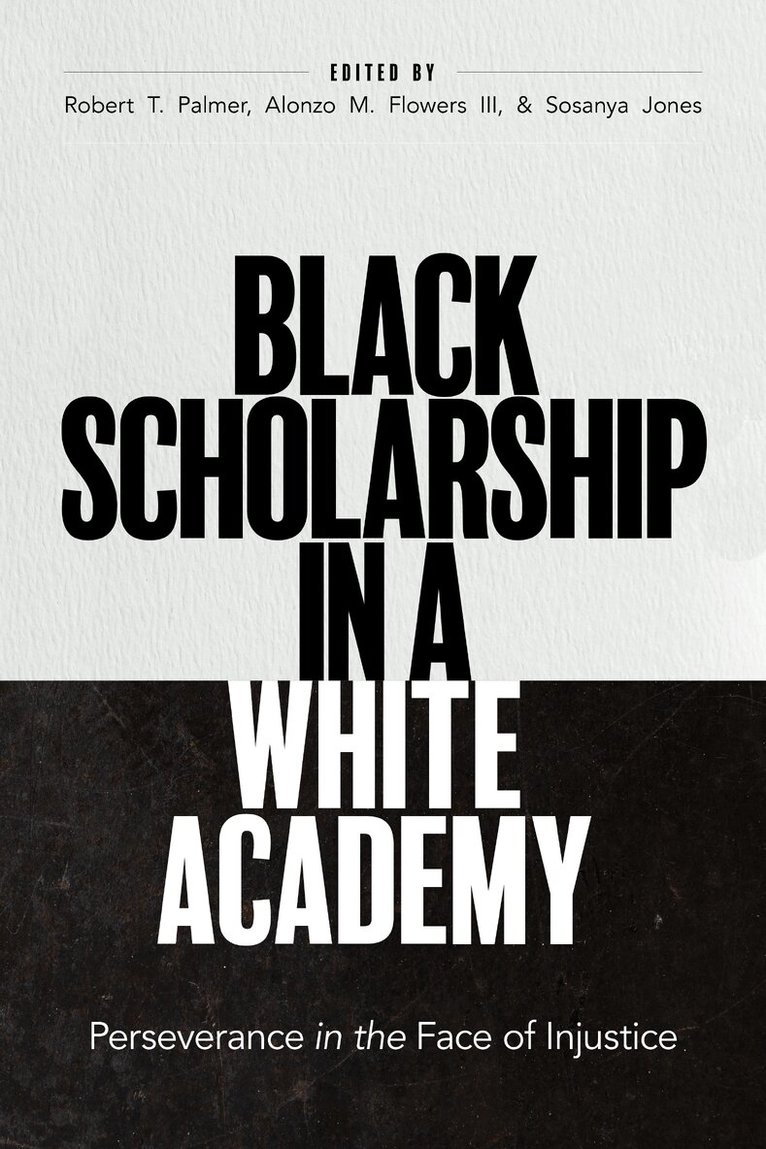
Examines the experience of Black scholarship and faculty in predominantly White academic spaces.While research has emphasized the importance of a diverse faculty, higher education has done little to bring this goal to fruition. The hidden politics at play during the traditional tenure and promotion process represent a significant obstacle to the advancement of Black faculty. While research productivity is the cornerstone of a successful tenure and promotion case at most universities and colleges, Black faculty are more likely to be tasked with extra service activities, which constrains time for research. Many Black faculty are also community-conscious scholars dedicated to conducting research to help uplift their communities, which may not be seen as credible or as valuable in the tenure and promotion process.Edited by Robert T. Palmer, Alonzo M. Flowers III, and Sosanya Jones, Black Scholarship in a White Academy offers important perspectives on how Black faculty and their scholarship have been historically devalued within the academy, particularly in predominantly White academic spaces. Using anti-Blackness theory as a framework, contributors discuss how White hegemony operates to undervalue and obstruct Black scholarship and faculty. Covering such diverse topics as navigating the tenure process, building Black spaces for inclusion, and exploring the intersection of Blackness and disability in higher education, this book presents ways Black faculty can navigate and challenge systemic racism and racist toxicity within their institutions.Contributors: Fred A. Bonner II, NiCole T. Buchanan, Sheron Fraser-Burgess, Beverly-Jean M. Daniel, Kristie Dotson, Antonio L. Ellis, Edward C. Fletcher Jr., Alonzo M. Flowers III, Donna Y. Ford, H. Bernard Hall, Erik M. Hines, Martinque K. Jones, Sosanya Jones, Nicole Johnson, Chad E. Kee, aretha f. marbley, James L. Moore III, Robert T. Palmer, Stella L. Smith, Isis H. Settles, Terrell L. Strayhorn, Katrina Struloeff, Blanca Elizabeth Vega, Larry J. Walker, Brian L. Wright
E-bok
Engelska, 2019225 kr
Läs direkt efter köp
Straight Talk for Veterans: A Guide to Success in College answers the call by veterans and practitioners to move away from academic volumes that don't resonate with the reader and frankly fall short of really helping veterans succeed in college. Veteran-friendliness is a straightforward concept that is, in most contexts, more lip-service than action and is rarely achieved. Conceptualizing veteran-friendliness is best done in plain language, the way veterans talk to each other, and is about improving the cultural competency of non-veterans. Too many volumes written by people that either aren't veterans or do not really understand veterans have left the field wanting for a text that can both inform practitioners who intend to help veterans succeed and speak in no-nonsense language that veterans prefer. Straight Talk for Veterans is a straight-forward guide primarily intended for those transitioning from the military to higher education, but also for general veteran transitions to civilian life. Designed as a companion text aligned with veteran transition curricula, it serves the dual purpose of guiding veterans through the initial culture shock that can come with joining and academic community directly from the military and guiding practitioners to be able to support veterans through a more culturally competent lens. Straight talk's diverse chapter authors deliver a comprehensive array of accessible information that covers concepts of negotiating transitions, navigating higher education, skills assessment and translation, and a series of fresh perspectives on concepts frequently misunderstood or mischaracterized by civilians. This text is most valuable to the student veteran or the campus that wants to focus their energies on the real success of student veterans: graduating and finding a job. Written in a style that speaks directly to the student, this is not an attempt to over analyze student veterans with anecdotal observations and small-scale research. Expert chapter authors come from positions of extensive experience as either veterans, those who have served veterans for a long time, those who have conducted meaningful research on the experiences of student veterans, or a combination of these. These elite scholars include Kevin Jones, Janine Wert, Aynsley Diamond, Adam Fullerton, Sharon Young, Michael Kirchner, Sarah Minnis, Glenn Phillips, and Sosanya Jones. The end-state of attending college for veterans is not simply to earn a degree, but to improve prospects for a career that will move a veteran forward to increasing economic prosperity. As such, the book takes a progressive approach from transitioning out of the military, into and through higher education and out into the work world. The reader's time is not spent rehashing the original GI Bill and its history, or education benefits - topics that have been well-trodden in the field. This book combines proven research, best practices and first-hand experience to deliver on what every student veteran needs: solid advice on how to succeed in the transition through college to the workplace.
Inbunden, Engelska, 2017
633 kr
Skickas inom 10-15 vardagar
This book examines how Performance or Outcomes Based Funding (POBF) policies impact racial equity in higher education. Through POBF, public colleges and universities receive state funding through formulas that no longer rely solely on student enrollment, but are instead based on student outcomes.
E-bok
Engelska, 2017816 kr
Läs direkt efter köp
This book examines how Performance or Outcomes Based Funding (POBF) policies impact racial equity in higher education. Over the last decade, higher education has become entrenched in a movement that holds colleges and universities more accountable to its supporters. There are pressures to answer questions about student outcomes and performance, the value of education, the effectiveness of instructors, and the ability of existing leaders to manage efficiently and effectively. It is within this climate that states have adopted POBF policies. Through POBF, public colleges and universities receive state funding through formulas that no longer rely solely on student enrollment, but are instead based on student outcomes. This book provides an overview for policymakers of how racial equity has been addressed, the impact of these approaches, and recommendations for moving forward.
Häftad, Engelska, 2016
380 kr
Tillfälligt slut
Seeking greater accountability in higher education, many states have adopted performance funding, tying state financial support of colleges and universities directly to institutional performance based on specific outcomes such as student retention, progression, and graduation. Now in place in over thirty states, performance funding for higher education has been endorsed by the US Department of Education and major funders like the Gates and Lumina foundations. Focusing on three states that are regarded as leaders in the movement-Indiana, Ohio, and Tennessee- Performance Funding for Higher Education presents the findings of a three-year research study on its implementation and impacts.Written by leading authorities and drawing on extensive interviews with government officials and college and university staff members, this book * describes the policy instruments states use to implement performance funding; * explores the organizational processes colleges rely on to determine how to respond to performance funding; * analyzes the influence of performance funding on institutional policies and programs; * reviews the impacts of performance funding on student outcomes; * examines the obstacles institutions encounter in responding to performance funding demands;* investigates the unintended impacts of performance funding. The authors conclude that, while performance funding clearly grabs the attention of colleges and leads them to change their policies and practices, it also encounters major obstacles and has unintended impacts. Colleges subject to performance funding are hindered in posting good results by inappropriate performance measures, insufficient organizational infrastructure, and the commitment to enroll many students who are poorly prepared or not interested in degrees.These obstacles help explain why multivariate statistical studies have failed to date to find a significant impact of performance funding on student outcomes, and why colleges are tempted to resort to weakening academic quality and restricting the admission of less-prepared and less-advantaged students in order to improve their apparent performance. These findings have wide-ranging implications for policy and research. Ultimately, the authors recommend that states create new ways of helping colleges with many at-risk students, define performance indicators and measures better tailored to institutional missions, and improve the capacity of colleges to engage in organizational learning.