Speckmann - Böcker
Visar alla böcker från författaren Speckmann. Handla med fri frakt och snabb leverans.
3 produkter
3 produkter
2 179 kr
Skickas inom 10-15 vardagar
What is the source of the electroencephalogram, or "EEG", the human electrical brain activity that manifests itself in scalp recordings? Although encephalography is still one of the most widely-used measurement techniques in neurological diagnostics and neurophysiological research, the generators in the brain of the EEG recordings are still widely unknown. This volume, commemorating the discovery of EEG by Hans Berger, brings together the latest ideas and findings of international experts in neurological and neurophysiological research. Combining new scientific findings with thorough state-of-the-art reviews of the basic mechanisms of the EEG, the chapters examine the relationships between cortical single-cell activity and EEG, the significance of subcortical structures and transmitter systems to the dynamics of the EEG, the generation of cortical field potentials, the relevance of glial cell activities and cell metabolism to EEG. These relationships are explored in their neurophysiological, clinical and neuropathological aspects.
2 179 kr
Skickas inom 10-15 vardagar
This volume is based on selected and updated papers from the symposium on "Basic Mechanisms of the EEG," which was held under the sponsor ship of the German EEG Society in Hamburg on September 28-29, 1990. The intention of this symposium was to relate recent experimental, clini cal, and neuropathological data on the basic mechanism that underlie the EEG. Although we know much about these mechanisms, there is still much more to be learned. The symposium was partly the continuation of an earlier symposium on "Origin of Cerebral Field Potentials" held in 1979 in Munster under the leadership of one of the present editors (E. -J. Speckmann) and H. Caspers. The present work combines new experimental and clinical results with state-of-the-art reports giving excellent general views. The first chapter presents a historical survey of the roots of current developments in neu rophysiology. It seems that in the near future we may decipher the EEG, which we have considered up to now somewhat as a cryptogram (chap ter 2). After chapter 3-a chapter concerned with more general points of the generation of cortical field potentials-chapters 4, 5, and 6 deal with several aspects and models of interactions and rhythms of cortical neurons. The role of glial cells in cortical electrical field generation is considered in chapter 7. Chapter 8 emphasizes the significance of brain metabolism.
534 kr
Skickas inom 10-15 vardagar
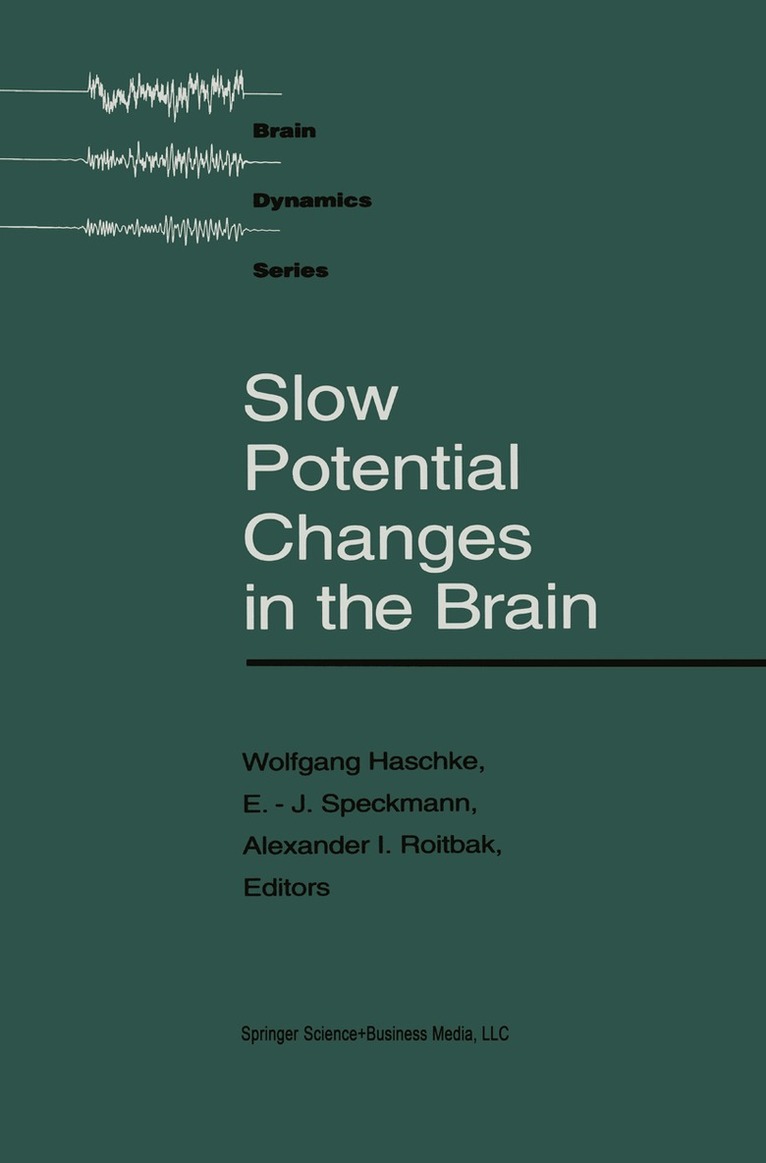
DC-potential changes, comprising fast fluctuations and slow shifts, rep resent objective concomitants of neuronal processes in the brain. They can be recorded not only in animals, but also in humans under various conditions. As far as slow brain potentials are concerned, exciting results have been detected with respect to their correlation to psychophysiolog ical events. Although a large amount of data has been accumulated by psychophysiologists, neurophysiologists, and other scientists involved, the neurophysiological basis of these field potentials is still not clear, and remains controversial. Scientists from European countries participated in an interdisciplinary symposium in the summer of 1990, July 2 to 6, at the Friedrich Schiller University in Jena, which covered the field of slow brain potentials from the psychophysiological to the cellular level, including glial cells and microenvironment. From this conference the idea derived to present an up-to-date overview on important aspects of the field concerned. The Introductory Remarks are given to elucidate what is thought to be a "generator" of slow potentials of the brain. The large number of sources, implications of the "inverse problem" to analyze field potentials are taken into account.