Stacy D. Fahrenthold – författare
Visar alla böcker från författaren Stacy D. Fahrenthold. Handla med fri frakt och snabb leverans.
4 produkter
4 produkter
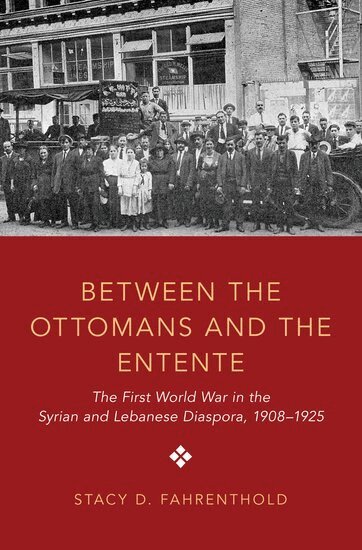
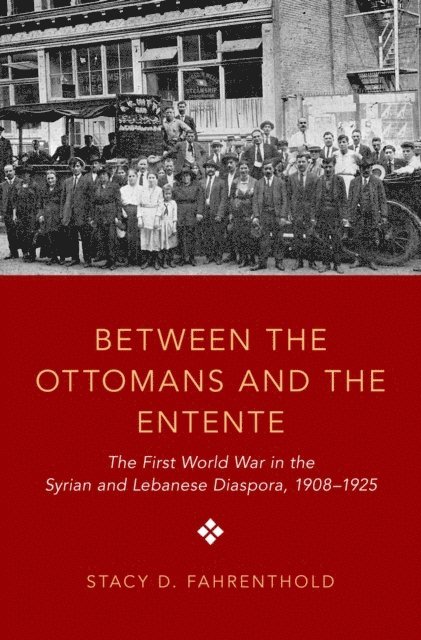
Between the Ottomans and the Entente
The First World War in the Syrian and Lebanese Diaspora, 1908-1925
Inbunden, Engelska, 2019
961 kr
Skickas inom 5-8 vardagar
Since 2011 over 5.6 million Syrians have fled to Turkey, Lebanon, Jordan, and beyond, and another 6.6 million are internally displaced. The contemporary flight of Syrian refugees comes one century after the region's formative experience with massive upheaval, displacement, and geopolitical intervention: the First World War.In this book, Stacy Fahrenthold examines the politics of Syrian and Lebanese migration around the period of the First World War. Some half million Arab migrants, nearly all still subjects of the Ottoman Empire, lived in a diaspora concentrated in Brazil, Argentina, and the United States. They faced new demands for their political loyalty from Istanbul, which commanded them to resist European colonialism. From the Western hemisphere, Syrian migrants grappled with political suspicion, travel restriction, and outward displays of support for the war against the Ottomans. From these diasporic communities, Syrians used their ethnic associations, commercial networks, and global press to oppose Ottoman rule, collaborating with the Entente powers because they believed this war work would bolster the cause of Syria's liberation. Between the Ottomans and the Entente shows how these communities in North and South America became a geopolitical frontier between the Young Turk Revolution and the early French Mandate. It examines how empires at war-from the Ottomans to the French-embraced and claimed Syrian migrants as part of the state-building process in the Middle East. In doing so, they transformed this diaspora into an epicenter for Arab nationalist politics.Drawing on transnational sources from migrant activists, this wide-ranging work reveals the degree to which Ottoman migrants "became Syrians" while abroad and brought their politics home to the post-Ottoman Middle East.
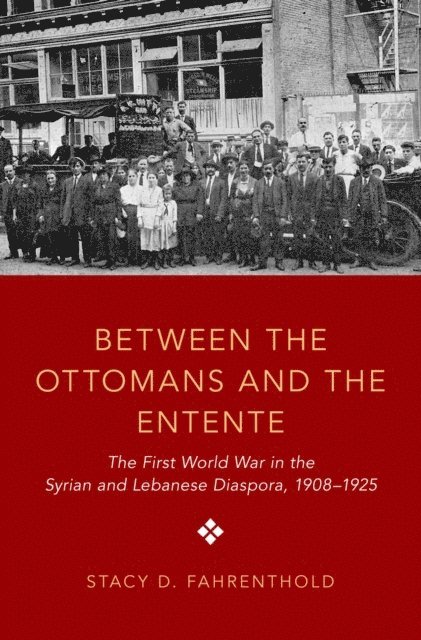
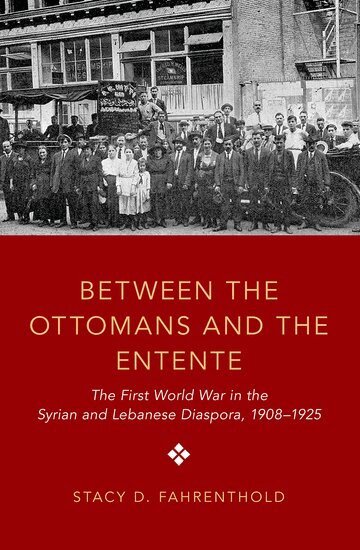
Between the Ottomans and the Entente
The First World War in the Syrian and Lebanese Diaspora, 1908-1925
Häftad, Engelska, 2021
515 kr
Skickas inom 3-6 vardagar
Since 2011 over 5.6 million Syrians have fled to Turkey, Lebanon, Jordan, and beyond, and another 6.6 million are internally displaced. The contemporary flight of Syrian refugees comes one century after the region's formative experience with massive upheaval, displacement, and geopolitical intervention: the First World War.In this book, Stacy Fahrenthold examines the politics of Syrian and Lebanese migration around the period of the First World War. Some half million Arab migrants, nearly all still subjects of the Ottoman Empire, lived in a diaspora concentrated in Brazil, Argentina, and the United States. They faced new demands for their political loyalty from Istanbul, which commanded them to resist European colonialism. From the Western hemisphere, Syrian migrants grappled with political suspicion, travel restriction, and outward displays of support for the war against the Ottomans. From these diasporic communities, Syrians used their ethnic associations, commercial networks, and global press to oppose Ottoman rule, collaborating with the Entente powers because they believed this war work would bolster the cause of Syria's liberation. Between the Ottomans and the Entente shows how these communities in North and South America became a geopolitical frontier between the Young Turk Revolution and the early French Mandate. It examines how empires at war-from the Ottomans to the French-embraced and claimed Syrian migrants as part of the state-building process in the Middle East. In doing so, they transformed this diaspora into an epicenter for Arab nationalist politics.Drawing on transnational sources from migrant activists, this wide-ranging work reveals the degree to which Ottoman migrants "became Syrians" while abroad and brought their politics home to the post-Ottoman Middle East.
808 kr
Skickas inom 5-8 vardagar
A historical and contemporary study of Palestinian musicianship in exile in the Middle East, spanning half a century in disparate locationsPalestinian Music in Exile is a historical and contemporary study of Palestinian musicianship in exile in the Middle East, spanning half a century in disparate locations, including Gaza, Turkey, Kuwait, and Egypt. Grassroots musicians emerge here as powerful actors, their stories taking center stage, offering critiques of existing conditions, and new perspectives on displacement and the transmission of Palestinian narratives, and presenting alternative visions for the future.Louis Brehony argues that, under conditions of colonial relations and repeated displacement, the reclaiming of public space has gone hand in hand with aesthetic revolution, both broadening and traditionalizing the sounds of Palestine, and carrying messages of sumud (steadfastness) and resistance. Based on a decade’s research in Europe and the Middle East, this timely and inspiring collection of musical ethnographies provides a rich oral history of contemporary Palestinian musicianship and encompasses a broad range of experiences of the ghurba, or state of exile.
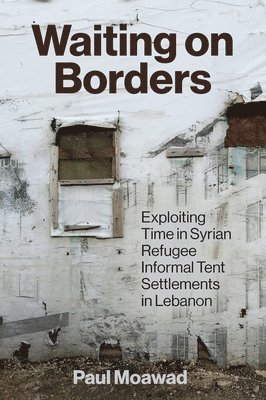
Waiting on Borders
Exploiting Time in Syrian Refugee Informal Tent Settlements in Lebanon
Inbunden, Engelska, 2026
1 123 kr
Skickas inom 11-20 vardagar
A powerful contribution to ongoing debates on refugees, borders, and camps and the politics of waitingThe Lebanese–Syrian borderscape is predominantly porous and ambiguous, without an actual border control, and is incessantly contested. Repeated internal displacement and refugee crises have been a pervading political condition in Lebanon since the early twentieth century, but the most destabilizing refugee and displacement crisis stems from the regional influx into the country in 2011 of thousands of Syrian refugees.In Waiting on Borders, Paul Moawad focuses on informal tented settlements (ITSs) inhabited by Syrian refugees on this border, to offer a compelling conceptualization of the politics of time and waiting, especially in relation to how temporal strategies are used as deterrence mechanisms in border regimes and informal spaces. Here, waiting is not just an active political instrument used by authorities to manage and control mobility, nor is it just a passive state refugees find themselves in. Waiting also becomes a tool of defiance, resilience, and self-governance. He further integrates rhythm analysis in his approach to understand the daily coping mechanisms that refugees develop with local actors, host-communities, and their own communities, to alleviate uncertainty and anxiety due to place detachment and home rupture. Rooted in border studies and urban studies, and drawing on rich empirical cases, Waiting on Borders demonstrates how states weaponize time and waiting modalities—through prolonged uncertainty, bureaucratic delays, and forced stagnation—to discipline, control, and exclude refugees.