Stanislaw H. Zak – författare
2 763 kr
Skickas inom 5-8 vardagar
1 216 kr
Läs direkt efter köp
1 389 kr
Läs direkt efter köp
"...an excellent introduction to optimization theory..." (Journal of Mathematical Psychology, 2002)
"A textbook for a one-semester course on optimization theory and methods at the senior undergraduate or beginning graduate level." (SciTech Book News, Vol. 26, No. 2, June 2002)
Explore the latest applications of optimization theory and methods
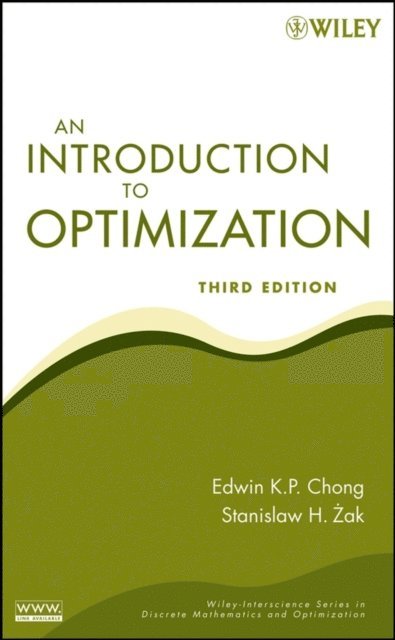
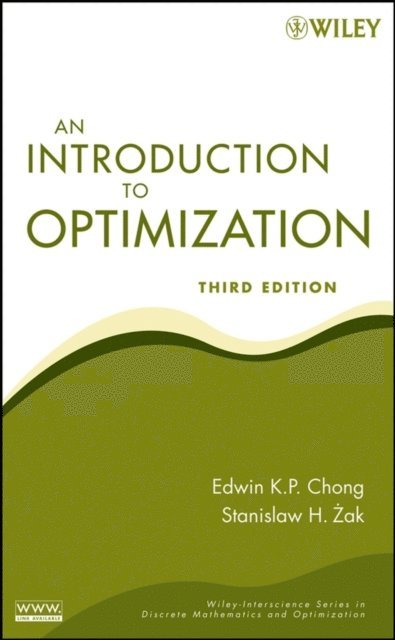
Optimization is central to any problem involving decision making in many disciplines, such as engineering, mathematics, statistics, economics, and computer science. Now, more than ever, it is increasingly vital to have a firm grasp of the topic due to the rapid progress in computer technology, including the development and availability of user-friendly software, high-speed and parallel processors, and networks. Fully updated to reflect modern developments in the field, An Introduction to Optimization, Third Edition fills the need for an accessible, yet rigorous, introduction to optimization theory and methods.
The book begins with a review of basic definitions and notations and also provides the related fundamental background of linear algebra, geometry, and calculus. With this foundation, the authors explore the essential topics of unconstrained optimization problems, linear programming problems, and nonlinear constrained optimization. An optimization perspective on global search methods is featured and includes discussions on genetic algorithms, particle swarm optimization, and the simulated annealing algorithm. In addition, the book includes an elementary introduction to artificial neural networks, convex optimization, and multi-objective optimization, all of which are of tremendous interest to students, researchers, and practitioners.
Additional features of the Third Edition include:
New discussions of semidefinite programming and Lagrangian algorithms
A new chapter on global search methods
A new chapter on multipleobjective optimization
New and modified examples and exercises in each chapter as well as an updated bibliography containing new references
An updated Instructor''s Manual with fully worked-out solutions to the exercises
Numerous diagrams and figures found throughout the text complement the written presentation of key concepts, and each chapter is followed by MATLAB exercises and drill problems that reinforce the discussed theory and algorithms. With innovative coverage and a straightforward approach, An Introduction to Optimization, Third Edition is an excellent book for courses in optimization theory and methods at the upper-undergraduate and graduate levels. It also serves as a useful, self-contained reference for researchers and professionals in a wide array of fields.
1 389 kr
Läs direkt efter köp
"...an excellent introduction to optimization theory..." (Journal of Mathematical Psychology, 2002)
"A textbook for a one-semester course on optimization theory and methods at the senior undergraduate or beginning graduate level." (SciTech Book News, Vol. 26, No. 2, June 2002)
Explore the latest applications of optimization theory and methods
Optimization is central to any problem involving decision making in many disciplines, such as engineering, mathematics, statistics, economics, and computer science. Now, more than ever, it is increasingly vital to have a firm grasp of the topic due to the rapid progress in computer technology, including the development and availability of user-friendly software, high-speed and parallel processors, and networks. Fully updated to reflect modern developments in the field, An Introduction to Optimization, Third Edition fills the need for an accessible, yet rigorous, introduction to optimization theory and methods.
The book begins with a review of basic definitions and notations and also provides the related fundamental background of linear algebra, geometry, and calculus. With this foundation, the authors explore the essential topics of unconstrained optimization problems, linear programming problems, and nonlinear constrained optimization. An optimization perspective on global search methods is featured and includes discussions on genetic algorithms, particle swarm optimization, and the simulated annealing algorithm. In addition, the book includes an elementary introduction to artificial neural networks, convex optimization, and multi-objective optimization, all of which are of tremendous interest to students, researchers, and practitioners.
Additional features of the Third Edition include:
New discussions of semidefinite programming and Lagrangian algorithms
A new chapter on global search methods
A new chapter on multipleobjective optimization
New and modified examples and exercises in each chapter as well as an updated bibliography containing new references
An updated Instructor''s Manual with fully worked-out solutions to the exercises
Numerous diagrams and figures found throughout the text complement the written presentation of key concepts, and each chapter is followed by MATLAB exercises and drill problems that reinforce the discussed theory and algorithms. With innovative coverage and a straightforward approach, An Introduction to Optimization, Third Edition is an excellent book for courses in optimization theory and methods at the upper-undergraduate and graduate levels. It also serves as a useful, self-contained reference for researchers and professionals in a wide array of fields.
1 382 kr
Skickas
1 474 kr
Läs direkt efter köp
Accessible introductory textbook on optimization theory and methods, with an emphasis on engineering design, featuring MATLAB® exercises and worked examples
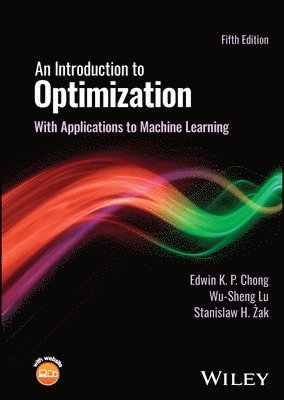
Fully updated to reflect modern developments in the field, the Fifth Edition of An Introduction to Optimization fills the need for an accessible, yet rigorous, introduction to optimization theory and methods, featuring innovative coverage and a straightforward approach. The book begins with a review of basic definitions and notations while also providing the related fundamental background of linear algebra, geometry, and calculus.
With this foundation, the authors explore the essential topics of unconstrained optimization problems, linear programming problems, and nonlinear constrained optimization. In addition, the book includes an introduction to artificial neural networks, convex optimization, multi-objective optimization, and applications of optimization in machine learning.
Numerous diagrams and figures found throughout the book complement the written presentation of key concepts, and each chapter is followed by MATLAB® exercises and practice problems that reinforce the discussed theory and algorithms.
The Fifth Edition features a new chapter on Lagrangian (nonlinear) duality, expanded coverage on matrix games, projected gradient algorithms, machine learning, and numerous new exercises at the end of each chapter.
An Introduction to Optimization includes information on:
The mathematical definitions, notations, and relations from linear algebra, geometry, and calculus used in optimization Optimization algorithms, covering one-dimensional search, randomized search, and gradient, Newton, conjugate direction, and quasi-Newton methods Linear programming methods, covering the simplex algorithm, interior point methods, and duality Nonlinear constrained optimization, covering theory and algorithms, convex optimization, and Lagrangian duality Applications of optimization in machine learning, including neural network training, classification, stochastic gradient descent, linear regression, logistic regression, support vector machines, and clustering.An Introduction to Optimization is an ideal textbook for a one- or two-semester senior undergraduate or beginning graduate course in optimization theory and methods. The text is also of value for researchers and professionals in mathematics, operations research, electrical engineering, economics, statistics, and business.
1 474 kr
Läs direkt efter köp
Accessible introductory textbook on optimization theory and methods, with an emphasis on engineering design, featuring MATLAB® exercises and worked examples
Fully updated to reflect modern developments in the field, the Fifth Edition of An Introduction to Optimization fills the need for an accessible, yet rigorous, introduction to optimization theory and methods, featuring innovative coverage and a straightforward approach. The book begins with a review of basic definitions and notations while also providing the related fundamental background of linear algebra, geometry, and calculus.
With this foundation, the authors explore the essential topics of unconstrained optimization problems, linear programming problems, and nonlinear constrained optimization. In addition, the book includes an introduction to artificial neural networks, convex optimization, multi-objective optimization, and applications of optimization in machine learning.
Numerous diagrams and figures found throughout the book complement the written presentation of key concepts, and each chapter is followed by MATLAB® exercises and practice problems that reinforce the discussed theory and algorithms.
The Fifth Edition features a new chapter on Lagrangian (nonlinear) duality, expanded coverage on matrix games, projected gradient algorithms, machine learning, and numerous new exercises at the end of each chapter.
An Introduction to Optimization includes information on:
The mathematical definitions, notations, and relations from linear algebra, geometry, and calculus used in optimization Optimization algorithms, covering one-dimensional search, randomized search, and gradient, Newton, conjugate direction, and quasi-Newton methods Linear programming methods, covering the simplex algorithm, interior point methods, and duality Nonlinear constrained optimization, covering theory and algorithms, convex optimization, and Lagrangian duality Applications of optimization in machine learning, including neural network training, classification, stochastic gradient descent, linear regression, logistic regression, support vector machines, and clustering.An Introduction to Optimization is an ideal textbook for a one- or two-semester senior undergraduate or beginning graduate course in optimization theory and methods. The text is also of value for researchers and professionals in mathematics, operations research, electrical engineering, economics, statistics, and business.