Stanton E.F. Wortham - Böcker
Visar alla böcker från författaren Stanton E.F. Wortham. Handla med fri frakt och snabb leverans.
3 produkter
3 produkter
656 kr
Skickas inom 10-15 vardagar
Over the years, linguistic anthropological research has shown how classrooms are socializing institutions and how language functions as one medium through which this socialization is accomplished. Early work in the field has captured the immediacy of social practice and language use in educational contexts, and has created useful characterizations of variations in communicative competence.The present work builds on the strengths of prior work, showing how new theoretical concepts and empirical methods developed in linguistic anthropology over the last decade can further illuminate educational settings. The authors introduce an updated Linguistic Anthropology of Education which recognizes that, in the rapidly changing field of cultural production within which children and teachers operate today, the exploration of multiple, pre-existing forms of communicative competence is not enough. This volume elaborates theory and illustrates the tools and practices of the Linguistic Anthropology of Education to account for today's research context in which the multiplicity of identity, and the multiple ways language can be used to represent it, have important ramifications for how learning and social reproduction emerge within educational contexts.
980 kr
Skickas inom 10-15 vardagar
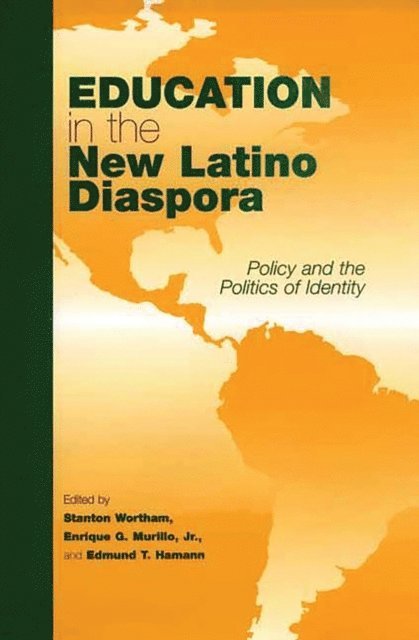
The authors describe a new demographic phenomenon: the settlement of Latino families in areas of the United States where previously there has been little Latino presence.This New Latino Diaspora places pressures on host communities, both to develop conceptualizations of Latino newcomers and to provide needed services.These pressures are particularly felt in schools; in some New Latino Diaspora locations the percentage of Latino students in local public schools has risen from zero to 30 or even 50 percent in less than a decade.Latino newcomers, of course, bring their own language and their own cultural conceptions of parenting, education,inter-ethnic relations and the like.Through case studies of Latino Diaspora communities in Georgia, North Carolina, Maine, Colorado, Illinois, and Indiana, the eleven chapters in this volume describe what happens when host community conceptions of and policies toward newcomer Latinos meet Latinos' own conceptions. The chapters focus particularly on the processes of educational policy formation and implementation, processes through which host communities and newcomer Latinos struggle to define themselves and to meet the educational needs and opportunities brought by new Latino students.Most schools in the New Latino Diaspora are unsure about what to do with Latino children, and their emergent responses are alternately cruel, uninformed, contradictory, and inspirational.By describing how the challenges of accommodating the New Latino Diaspora are shared across many sites the authors hope to inspire others to develop more sensitive ways of serving Latino Diaspora children and families.
461 kr
Skickas inom 10-15 vardagar
The authors describe a new demographic phenomenon: the settlement of Latino families in areas of the United States where previously there has been little Latino presence.This New Latino Diaspora places pressures on host communities, both to develop conceptualizations of Latino newcomers and to provide needed services.These pressures are particularly felt in schools; in some New Latino Diaspora locations the percentage of Latino students in local public schools has risen from zero to 30 or even 50 percent in less than a decade.Latino newcomers, of course, bring their own language and their own cultural conceptions of parenting, education,inter-ethnic relations and the like.Through case studies of Latino Diaspora communities in Georgia, North Carolina, Maine, Colorado, Illinois, and Indiana, the eleven chapters in this volume describe what happens when host community conceptions of and policies toward newcomer Latinos meet Latinos' own conceptions. The chapters focus particularly on the processes of educational policy formation and implementation, processes through which host communities and newcomer Latinos struggle to define themselves and to meet the educational needs and opportunities brought by new Latino students.Most schools in the New Latino Diaspora are unsure about what to do with Latino children, and their emergent responses are alternately cruel, uninformed, contradictory, and inspirational.By describing how the challenges of accommodating the New Latino Diaspora are shared across many sites the authors hope to inspire others to develop more sensitive ways of serving Latino Diaspora children and families.