
Steen Krenk – författare
Visar alla böcker från författaren Steen Krenk. Handla med fri frakt och snabb leverans.
4 produkter
4 produkter
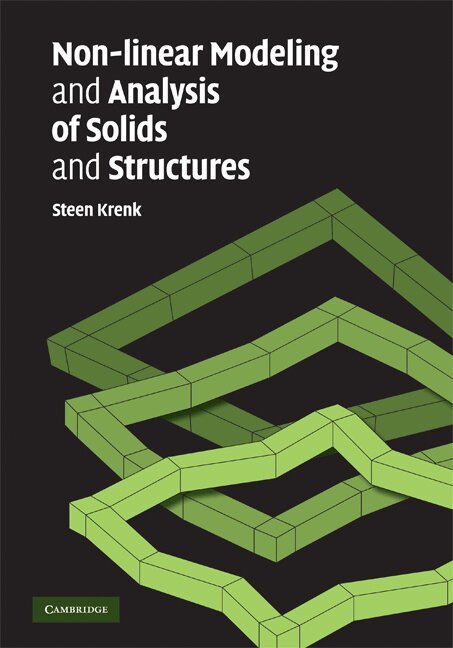
Inbunden, Engelska, 2009
1 214 kr
Skickas inom 7-10 vardagar
This book presents a theoretical treatment of nonlinear behaviour of solids and structures in such a way that it is suitable for numerical computation, typically using the Finite Element Method. Starting out from elementary concepts, the author systematically uses the principle of virtual work, initially illustrated by truss structures, to give a self-contained and rigorous account of the basic methods. The author illustrates the combination of translations and rotations by finite deformation beam theories in absolute and co-rotation format, and describes the deformation of a three-dimensional continuum in material form. A concise introduction to finite elasticity is followed by an extension to elasto-plastic materials via internal variables and the maximum dissipation principle. Finally, the author presents numerical techniques for solution of the nonlinear global equations and summarises recent results on momentum and energy conserving integration of time-dependent problems. Exercises, examples and algorithms are included throughout.
Häftad, Engelska, 2014
539 kr
Skickas inom 10-15 vardagar
The book illustrates the use of simple mathematical analysis techniques within the area of basic structural mechanics, in particular the elementary theories of beams, columns and cables. The focus is on: i) Identification of the physical background of the theories and their particular mathematical properties. ii) Demonstration of mathematical techniques for analysis of simple problems in structural mechanics, and identification of the relevant parameters and properties of the solution. iii) Derivation of the solutions to a number of basic problems of structural mechanics in a form suitable for later reference. The presentation concentrates on the main principles and the characteristics of the solutions. The theory also serves as a basis for the formulation of numerical models and for intelligent interpretation of their results.
Inbunden, Engelska, 2013
752 kr
Skickas inom 10-15 vardagar
The statics and mechanics of structures form a core aspect of civil engineering. This book provides an introduction to the subject, starting from classic hand-calculation types of analysis and gradually advancing to a systematic form suitable for computer implementation. It starts with statically determinate structures in the form of trusses, beams and frames. Instability is discussed in the form of the column problem - both the ideal column and the imperfect column used in actual column design. The theory of statically indeterminate structures is then introduced, and the force and deformation methods are explained and illustrated. An important aspect of the book’s approach is the systematic development of the theory in a form suitable for computer implementation using finite elements. This development is supported by two small computer programs, MiniTruss and MiniFrame, which permit static analysis of trusses and frames, as well as linearized stability analysis. The book’s final section presents related strength of materials subjects in greater detail; these include stress and strain, failure criteria, and normal and shear stresses in general beam flexure and in beam torsion. The book is well-suited as a textbook for a two-semester introductory course on structures.
Häftad, Engelska, 2016
539 kr
Skickas inom 10-15 vardagar
The statics and mechanics of structures form a core aspect of civil engineering. This book provides an introduction to the subject, starting from classic hand-calculation types of analysis and gradually advancing to a systematic form suitable for computer implementation. It starts with statically determinate structures in the form of trusses, beams and frames. Instability is discussed in the form of the column problem - both the ideal column and the imperfect column used in actual column design. The theory of statically indeterminate structures is then introduced, and the force and deformation methods are explained and illustrated. An important aspect of the book’s approach is the systematic development of the theory in a form suitable for computer implementation using finite elements. This development is supported by two small computer programs, MiniTruss and MiniFrame, which permit static analysis of trusses and frames, as well as linearized stability analysis. The book’s final section presents related strength of materials subjects in greater detail; these include stress and strain, failure criteria, and normal and shear stresses in general beam flexure and in beam torsion. The book is well-suited as a textbook for a two-semester introductory course on structures.