Stephanie Siewert – författare
Visar alla böcker från författaren Stephanie Siewert. Handla med fri frakt och snabb leverans.
6 produkter
Synthetic Biology and the Question of Public Participation
Governance and Ethics in Dealing with Emerging Technologies
Av Stephanie Siewert, Katharina Kieslich m. fl.
Häftad, 2023
497 kr
Lägg i varukorg
The book considers the relationship between governance and participation, and the ways participation has been understood, framed and applied in the context of synthetic biology (SB) governance approaches. Based on fundamental questions about the scope, purpose, and responsibilities assigned to …
Synthetic Biology and the Question of Public Participation
Governance and Ethics in Dealing with Emerging Technologies
Av Peter Dabrock, Matthias Braun m. fl.
E-bok, 2023
638 kr
Lägg i varukorg
The book considers the relationship between governance and participation, and the ways participation has been understood, framed and applied in the context of synthetic biology (SB) governance approaches. Based on fundamental questions about the scope, purpose, and responsibilities assigned to …
Morbidity of Culture
Melancholy, Trauma, Illness and Dying in Literature and Film
Av Stephanie Siewert, Antonia Mehnert
Häftad, 2012
491 kr
Lägg i varukorg
The essay collection focuses on morbid phenomena such as melancholy, trauma, illness and death which engage with questions of «cultural vitality» and «cultural mortality». The figurations and representations of social pathologies not only display time in its existential drama, but furthermore show …
Der Gefangene als Phantom
Anordnungen des Verschwindenmachens in Literatur und Medien
E-bok
561 kr
Lägg i varukorg
Der »hooded man« aus dem Abu-Ghraib-Folterskandal war 2004 medial omnipräsent und erhitzt seitdem Diskussionen über die Repräsentation von Gefangenschaft als Form der Selbst- und Fremdbeschreibung. Stephanie Siewert zeigt, dass die Inszenierungen von Gemeinschaft in Darstellungen der Gefangenschaft …
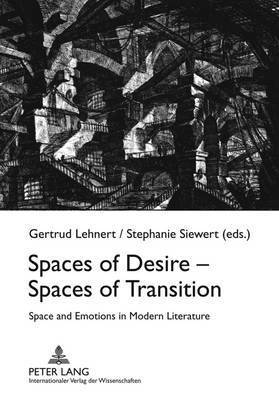
Spaces of Desire – Spaces of Transition
Space and Emotions in Modern Literature
Av Gertrud Lehnert, Stephanie Siewert
Häftad, 2011
330 kr
Tillfälligt slut
In the last decade, the so called «spatial turn» has produced a broad discussion of space and spatiality in the social sciences, in architecture and art, as well as in philosophy, and also in literary criticism. The book focuses on one aspect largely ignored by literary historians as well as by …