Stephen Connelly - Böcker
Visar alla böcker från författaren Stephen Connelly. Handla med fri frakt och snabb leverans.
6 produkter
6 produkter
604 kr
Skickas inom 10-15 vardagar
For the student who wishes to understand law as it is practised in a modern financial context, Finance Law offers the only up-to-date university-level textbook which explains legal principles as they are applied in today’s advanced financial transactions.Essential for any student or researcher seeking an introduction to this complex and fast-moving world, this text:is based on the author’s extensive teaching experience in finance lawcovers the modern form of credit facilities agreements, security, syndication, securities and securitization, derivatives, and payment and clearing systemsis packed with interesting case studies, including the Mozambique Tuna Bond Scandal, the takeover of Manchester Utd plc, and the securitization of student loansmotivates study with theoretical discussions and historical contextualisationexplains key transaction structures, such as investment grade lending to groups, intercreditor agreements, interest rate swaps, and multilateral payment systemsgrants insight into key legal principles and structuring applicable to trillion dollar deals across the globeis written by a structured finance practitioner and academic with extensive post-qualification experience of advising lenders, corporate borrowers and sovereigns on international financeDesigned for final-year undergraduates and LLM students, Finance Law is not only the perfect accompaniment to any finance module, but can support any advanced programme on insolvency law, mergers and acquisitions (M&A), corporate governance, international economic law and more.
1 812 kr
Skickas inom 10-15 vardagar
For the student who wishes to understand law as it is practised in a modern financial context, Finance Law offers the only up-to-date university-level textbook which explains legal principles as they are applied in today’s advanced financial transactions.Essential for any student or researcher seeking an introduction to this complex and fast-moving world, this text:is based on the author’s extensive teaching experience in finance lawcovers the modern form of credit facilities agreements, security, syndication, securities and securitization, derivatives, and payment and clearing systemsis packed with interesting case studies, including the Mozambique Tuna Bond Scandal, the takeover of Manchester Utd plc, and the securitization of student loansmotivates study with theoretical discussions and historical contextualisationexplains key transaction structures, such as investment grade lending to groups, intercreditor agreements, interest rate swaps, and multilateral payment systemsgrants insight into key legal principles and structuring applicable to trillion dollar deals across the globeis written by a structured finance practitioner and academic with extensive post-qualification experience of advising lenders, corporate borrowers and sovereigns on international financeDesigned for final-year undergraduates and LLM students, Finance Law is not only the perfect accompaniment to any finance module, but can support any advanced programme on insolvency law, mergers and acquisitions (M&A), corporate governance, international economic law and more.
751 kr
Skickas inom 10-15 vardagar
Against jurisprudential reductions of Spinoza’s thinking to a kind of eccentric version of Hobbes, this book argues that Spinoza’s theory of natural right contains an important idea of absolute freedom, which would be inconceivable within Hobbes’ own schema. Spinoza famously thought that the universe and all of the beings and events within it are fully determined by their causes. This has led jurisprudential commentators to believe that Spinoza has no room for natural right – in the sense that whatever happens by definition has a ‘right’ to happen. But, although this book demonstrates how Spinoza constructs a system in which right is understood as the work of machines, by fixing right as determinate and invariable, Stephen Connolly argues that Spinoza is not limiting his theory. The universe as a whole is capable of acting only in determinate ways but, he argues, for Spinoza these exist within a field of infinite possibilities. In an analysis that offers much to ongoing attempts to conceive of justice post-foundationally, the argument of this book is that Spinoza opens up right to a future of determinate interventions –as when an engineer, working with already-existing materials, improves a machine. As such, an idea of freedom emerges in Spinoza: as the artful rearrangement of the given into new possibilities. An exciting and original contribution, this book is an invaluable addition, both to the new wave of interest in Spinoza’s philosophy, and to contemporary legal and political theory.
2 172 kr
Skickas inom 10-15 vardagar
Against jurisprudential reductions of Spinoza’s thinking to a kind of eccentric version of Hobbes, this book argues that Spinoza’s theory of natural right contains an important idea of absolute freedom, which would be inconceivable within Hobbes’ own schema. Spinoza famously thought that the universe and all of the beings and events within it are fully determined by their causes. This has led jurisprudential commentators to believe that Spinoza has no room for natural right – in the sense that whatever happens by definition has a ‘right’ to happen. But, although this book demonstrates how Spinoza constructs a system in which right is understood as the work of machines, by fixing right as determinate and invariable, Stephen Connolly argues that Spinoza is not limiting his theory. The universe as a whole is capable of acting only in determinate ways but, he argues, for Spinoza these exist within a field of infinite possibilities. In an analysis that offers much to ongoing attempts to conceive of justice post-foundationally, the argument of this book is that Spinoza opens up right to a future of determinate interventions –as when an engineer, working with already-existing materials, improves a machine. As such, an idea of freedom emerges in Spinoza: as the artful rearrangement of the given into new possibilities. An exciting and original contribution, this book is an invaluable addition, both to the new wave of interest in Spinoza’s philosophy, and to contemporary legal and political theory.
1 338 kr
Skickas inom 7-10 vardagar
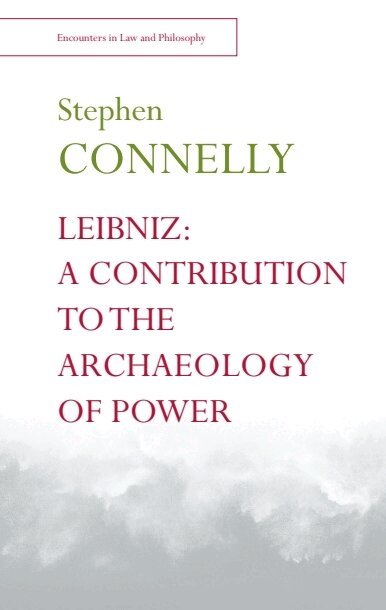
Connelly demonstrates how Leibniz's rearticulation of power and its associated concepts is motivated at least in part by the struggles that marked the terrain in which his ideas were rooted - the struggle between Reformed and Scholastic theology, between natural law and natural right, and between mechanistic natural philosophy and human freedom. He locates Leibniz within power's wider evolution, and shows how the universal jurisprudence which Leibniz developed between the 1660s and 1690s can be considered as a transformative encounter between power, activity and modality.Drawing on thinkers as diverse as Aristotle, Aquinas, Duns Scotus, Grotius, Husserl and Deleuze, Connelly traces Leibniz's conceptualisation of power through its applications in his legal texts, revealing that Leibniz in fact reconceptualises power under a new name: the state space. The move amounts to an internalisation of power as a moral world within each individual, submitting each practical agent to a universal set of obligations and prohibitions defined by that world. What though is at stake in bringing the objective world within each individual and submitting it to a public legal order? And what is the significance of this surgical intervention for any archaeology of power?
546 kr
Skickas inom 3-6 vardagar
A critical reading of Leibniz's legal theory, linking law, space and power Critically links Leibniz to legal theory and situates him with respect to thinkers such as Spinoza, Hobbes, Husserl, Deleuze, Foucault and BadiouBuilds on the French archaeology of power research programme of Agamben collaborator Gwena lle AubryExcavates a theory of law and spaceProvides an account of key tenets of medieval philosophy, such as power, reality, subjective activity, being-in-common, that inform the thought of continental philosophersThe concept of power has been a major feature of natural law theories. It evolved over the course of several centuries and was arguably the defining notion in both Hobbes' and Spinoza's doctrines of natural right. Yet Leibniz appears to effect a reversal in this millennium-long trajectory and demotes power to a derivative term of his philosophy. What was the rationale behind this radical change? And what does this reversal mean for the philosophy that follows?Connelly demonstrates how Leibniz's rearticulation of power and its associated concepts is motivated at least in part by the struggles that marked the terrain in which his ideas were rooted the struggle between Reformed and Scholastic theology, between natural law and natural right, and between mechanistic natural philosophy and human freedom. He locates Leibniz within power's wider evolution, and shows how the universal jurisprudence which Leibniz developed between the 1660s and 1690s can be considered as a transformative encounter between power, activity and modality.Drawing on thinkers as diverse as Aristotle, Aquinas, Duns Scotus, Grotius, Husserl and Deleuze, Connelly traces Leibniz's conceptualisation of power through its applications in his legal texts, revealing that Leibniz in fact reconceptualises power under a new name: the state space. The move amounts to an internalisation of power as a moral world within each individual, submitting each practical agent to a universal set of obligations and prohibitions defined by that world. What though is at stake in bringing the objective world within each individual and submitting it to a public legal order? And what is the significance of this surgical intervention for any archaeology of power?