Stephen D. Hancock - Böcker
Visar alla böcker från författaren Stephen D. Hancock. Handla med fri frakt och snabb leverans.
6 produkter
6 produkter
Autoethnography as a Lighthouse
Illuminating Race, Research, and the Politics of Schooling
Häftad, Engelska, 2015
520 kr
Skickas inom 7-10 vardagar
This work uses autoethnography as an enterprise to deconstruct barriers that support the invisibility of diverse epistemologies. The reality of invisibility and silence has plagued "unvalued others" in their attempt to make known the cultural significance found in the planning and execution of research. As a result, this book purposes to support the visibility and voice of marginalized scholars who conduct autoethnographic research from a racial, gendered, and critical theoretical framework. This work further supports authentic inquiry as it examines and reexamines culturally diverse epistemologies as a viable and valuable framework for conducting autoethnographic research. Specifically, this work highlights racialized epistemologies as an inescapable factor in auotethnographic research in the context of schools.
Autoethnography as a Lighthouse
Illuminating Race, Research, and the Politics of Schooling
Inbunden, Engelska, 2015
958 kr
Skickas inom 7-10 vardagar
This work uses autoethnography as an enterprise to deconstruct barriers that support the invisibility of diverse epistemologies. The reality of invisibility and silence has plagued "unvalued others" in their attempt to make known the cultural significance found in the planning and execution of research. As a result, this book purposes to support the visibility and voice of marginalized scholars who conduct autoethnographic research from a racial, gendered, and critical theoretical framework. This work further supports authentic inquiry as it examines and reexamines culturally diverse epistemologies as a viable and valuable framework for conducting autoethnographic research. Specifically, this work highlights racialized epistemologies as an inescapable factor in auotethnographic research in the context of schools.
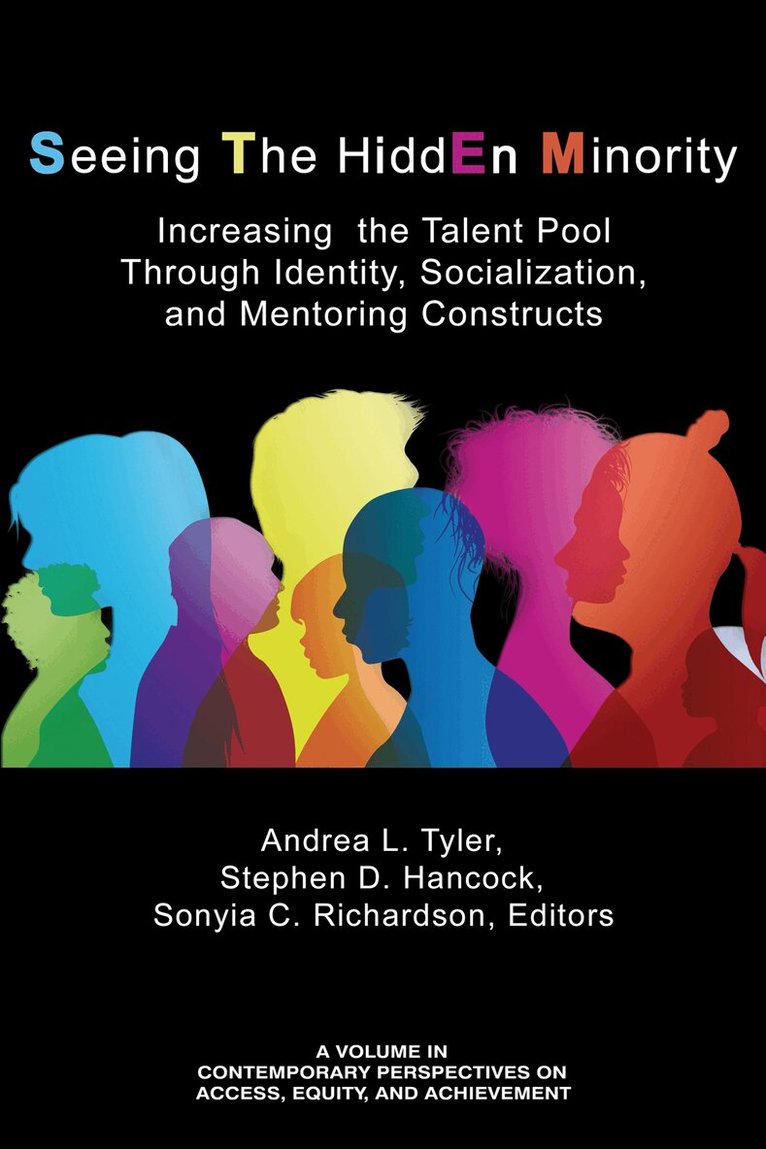
Seeing The HiddEn Minority
Increasing the Talent Pool through Identity, Socialization, and Mentoring Constructs
Häftad, Engelska, 2020
520 kr
Skickas inom 7-10 vardagar
The participation of Black students in science, technology, engineering, and mathematics (STEM) fields, is an issue of national concern. Educators and policymakers are seeking to promote STEM studies and eventual degree attainment, especially those from underrepresented groups, including Black students, women, economically disadvantaged, and students with disabilities. Literature shows that this has been of great interest to researchers, policymakers, and institutions for several years (Nettles & Millet, 2006; Council of Graduate School (CGS), 2009; National Science Foundation (NSF), 2006), therefore an extensive understanding of access, attrition, and degree completion for Black students in STEM is needed.According to Hussar and Bailey (2014), the Black and Latino postsecondary enrollment rates will increase by approximately 25% between 2011 and 2022. It is critical that this projected enrollment increase translates into an increase in Black student STEM enrollment, persistence and consequently STEM workforce. In view of the shifting demographic landscape, addressing access, equity and achievement for Black students in STEM is essential. Institutions, whether they are secondary or postsecondary, all have unique formal and informal academic structures that students must learn to navigate in order to become academically and socially acclimated to the institution (Tyler, Brothers, & Haynes, 2014). Therefore positive experience with the academic environment becomes critical to the success of a student persisting and graduating.Understanding and addressing the challenges faced by Black students in STEM begins with understanding the complexities they face at all levels of education. A sense of urgency is now needed to explore these complexities and how they impact students at all educational levels. This book will explore hidden figures and concerns of social connectedness, mentoring practices, and identity constructs that uncover unnoticed talent pools and encourage STEM matriculation among Black STEM students’ in preK-12 and post-secondary landscapes.
Seeing The HiddEn Minority
Increasing the Talent Pool through Identity, Socialization, and Mentoring Constructs
Inbunden, Engelska, 2020
958 kr
Skickas inom 7-10 vardagar
The participation of Black students in science, technology, engineering, and mathematics (STEM) fields, is an issue of national concern. Educators and policymakers are seeking to promote STEM studies and eventual degree attainment, especially those from underrepresented groups, including Black students, women, economically disadvantaged, and students with disabilities. Literature shows that this has been of great interest to researchers, policymakers, and institutions for several years (Nettles & Millet, 2006; Council of Graduate School (CGS), 2009; National Science Foundation (NSF), 2006), therefore an extensive understanding of access, attrition, and degree completion for Black students in STEM is needed.According to Hussar and Bailey (2014), the Black and Latino postsecondary enrollment rates will increase by approximately 25% between 2011 and 2022. It is critical that this projected enrollment increase translates into an increase in Black student STEM enrollment, persistence and consequently STEM workforce. In view of the shifting demographic landscape, addressing access, equity and achievement for Black students in STEM is essential. Institutions, whether they are secondary or postsecondary, all have unique formal and informal academic structures that students must learn to navigate in order to become academically and socially acclimated to the institution (Tyler, Brothers, & Haynes, 2014). Therefore positive experience with the academic environment becomes critical to the success of a student persisting and graduating.Understanding and addressing the challenges faced by Black students in STEM begins with understanding the complexities they face at all levels of education. A sense of urgency is now needed to explore these complexities and how they impact students at all educational levels. This book will explore hidden figures and concerns of social connectedness, mentoring practices, and identity constructs that uncover unnoticed talent pools and encourage STEM matriculation among Black STEM students’ in preK-12 and post-secondary landscapes.
White Women's Work
Examining the Intersectionality of Teaching, Identity, and Race
Häftad, Engelska, 2016
536 kr
Skickas inom 7-10 vardagar
Historically, white women have had a tremendous influence on establishing the ideological, political, and cultural scaffold of American public schools. Pedagogical orientations, school policies, and classroom practices are underwritten by white, cisgender, feminine, and middle to upper class social and cultural norms. Labor trends suggest that students of color are likely to sit in front of many more white women teachers than males or non-white teachers, thus making it imperative to better understand the nature of white women’s work in culturally diverse settings and the factors that most profoundly impact their effectiveness. This book examines how white women teacher dispositions (i.e. knowledge, beliefs, and skills) intersect (and/or interact) with their racial identity development, the concept of whiteness, institutional racism, and cultural perspectives of racial difference. All of which, as the authors in this volume argue, matter for nurturing a teaching practice that leads to more equitable schooling outcomes for youth of color.While it is imperative that the field of education recruits and retains more nonwhite teachers, it is equally important to identify research-supported professional development resources for a white woman-dominated profession. To that end, the book’s contributors present critical insight for creating cultural contexts for learning conducive to effective cross-cultural and cross-racial teaching. Chapters in the first section explore white women’s role in establishing and maintaining school environments that cater to Eurocentric sensibilities and white racial preferences for learning and social interaction. Authors in the second section discern the implications of white images, whiteness, and white racial identity formation for preparing and professionally developing white women teachers to be effective educators. Chapters in the third section of the book emphasize the centrality of race in negotiating academic interactions that demonstrate culturally responsive teaching. Each chapter in this book is written to investigate the intersectionality of race, cultural responsive pedagogies, and teaching identities as it relate to teaching in multiethnic environments. In addition, the book offers solution-oriented practices to equip white women (and any other reader) to respond appropriately and adequately to the needs of racially diverse students in American schools.
White Women's Work
Examining the Intersectionality of Teaching, Identity, and Race
Inbunden, Engelska, 2016
985 kr
Skickas inom 7-10 vardagar
Historically, white women have had a tremendous influence on establishing the ideological, political, and cultural scaffold of American public schools. Pedagogical orientations, school policies, and classroom practices are underwritten by white, cisgender, feminine, and middle to upper class social and cultural norms. Labor trends suggest that students of color are likely to sit in front of many more white women teachers than males or non-white teachers, thus making it imperative to better understand the nature of white women’s work in culturally diverse settings and the factors that most profoundly impact their effectiveness. This book examines how white women teacher dispositions (i.e. knowledge, beliefs, and skills) intersect (and/or interact) with their racial identity development, the concept of whiteness, institutional racism, and cultural perspectives of racial difference. All of which, as the authors in this volume argue, matter for nurturing a teaching practice that leads to more equitable schooling outcomes for youth of color.While it is imperative that the field of education recruits and retains more nonwhite teachers, it is equally important to identify research-supported professional development resources for a white woman-dominated profession. To that end, the book’s contributors present critical insight for creating cultural contexts for learning conducive to effective cross-cultural and cross-racial teaching. Chapters in the first section explore white women’s role in establishing and maintaining school environments that cater to Eurocentric sensibilities and white racial preferences for learning and social interaction. Authors in the second section discern the implications of white images, whiteness, and white racial identity formation for preparing and professionally developing white women teachers to be effective educators. Chapters in the third section of the book emphasize the centrality of race in negotiating academic interactions that demonstrate culturally responsive teaching. Each chapter in this book is written to investigate the intersectionality of race, cultural responsive pedagogies, and teaching identities as it relate to teaching in multiethnic environments. In addition, the book offers solution-oriented practices to equip white women (and any other reader) to respond appropriately and adequately to the needs of racially diverse students in American schools.