Stephen F. Kennedy - Böcker
Visar alla böcker från författaren Stephen F. Kennedy. Handla med fri frakt och snabb leverans.
2 produkter
2 produkter
743 kr
Skickas inom 7-10 vardagar
The MAA was founded in 1915 to serve as a home for The American Mathematical Monthly. The mission of the Association-to advance mathematics, especially at the collegiate level-has, however, always been larger than merely publishing world-class mathematical exposition. MAA members have explored more than just mathematics; we have, as this volume tries to make evident, investigated mathematical connections to pedagogy, history, the arts, technology, literature, every field of intellectual endeavor. Essays, all commissioned for this volume, include exposition by Bob Devaney, Robin Wilson, and Frank Morgan; history from Karen Parshall, Della Dumbaugh, and Bill Dunham; pedagogical discussion from Paul Zorn, Joe Gallian, and Michael Starbird, and cultural commentary from Bonnie Gold, Jon Borwein, and Steve Abbott.This volume contains 35 essays by all-star writers and expositors writing to celebrate an extraordinary century for mathematics-more mathematics has been created and published since 1915 than in all of previous recorded history. We've solved age-old mysteries, created entire new fields of study, and changed our conception of what mathematics is. Many of those stories are told in this volume as the contributors paint a portrait of the broad cultural sweep of mathematics during the MAA's first century. Mathematics is the most thrilling, the most human, area of intellectual inquiry; you will find in this volume compelling proof of that claim.
1 361 kr
Skickas inom 7-10 vardagar
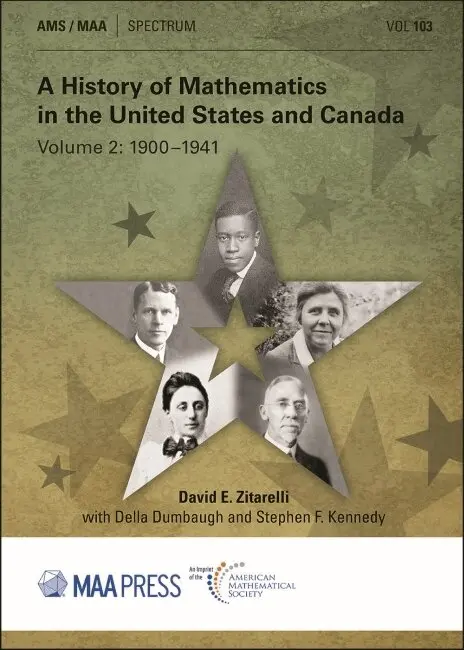
This is the first truly comprehensive and thorough history of the development of a mathematical community in the United States and Canada. This second volume starts at the turn of the twentieth century with a mathematical community that is firmly established and traces its growth over the next forty years, at the end of which the American mathematical community is pre-eminent in the world.In the preface to the first volume of this work Zitarelli reveals his animating philosophy, "I find that the human factor lends life and vitality to any subject." History of mathematics, in the Zitarelli conception, is not just a collection of abstract ideas and their development. It is a community of people and practices joining together to understand, perpetuate, and advance those ideas and each other. Telling the story of mathematics means telling the stories of these people: their accomplishments and triumphs; the institutions and structures they built; their interpersonal and scientific interactions; and their failures and shortcomings.One of the most hopeful developments of the period 1900–1941 in American mathematics was the opening of the community to previously excluded populations. Increasing numbers of women were welcomed into mathematics, many of whom—including Anna Pell Wheeler, Olive Hazlett, and Mayme Logsdon—are profiled in these pages. Black mathematicians were often systemically excluded during this period, but, in spite of the obstacles, Elbert Frank Cox, Dudley Woodard, David Blackwell, and others built careers of significant accomplishment that are described here. The effect on the substantial community of European immigrants is detailed through the stories of dozens of individuals.In clear and compelling prose Zitarelli, Dumbaugh, and Kennedy spin a tale accessible to experts, general readers, and anyone interested in the history of science in North America.