Stephen L. Esquith - Böcker
Visar alla böcker från författaren Stephen L. Esquith. Handla med fri frakt och snabb leverans.
6 produkter
6 produkter
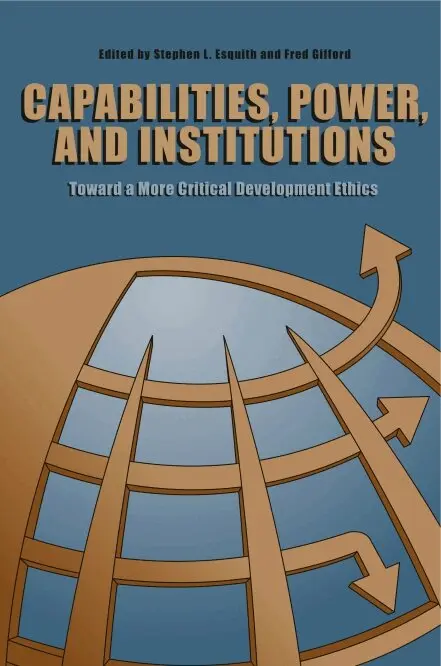
Capabilities, Power, and Institutions
Toward a More Critical Development Ethics
Inbunden, Engelska, 2010
712 kr
Skickas
Development economics, political theory, and ethics long carried on their own scholarly dialogues and investigations with almost no interaction among them. Only in the mid-1990s did this situation begin to change, primarily as a result of the pioneering work of an economist, Amartya Sen, and a philosopher who doubled as a classicist and legal scholar, Martha Nussbaum. Sen’s Development as Freedom (1999) and Nussbaum’s Women and Human Development (2000) together signaled the emergence of a powerful new paradigm that is commonly known as the “capabilities approach” to development ethics. Key to this approach is the recognition that citizens must have basic “capabilities” provided most crucially through health care and education if they are to function effectively as agents of economic development. Capabilities can be measured in terms of skills and abilities, opportunities and control over resources, and even moral virtues like the virtue of care and concern for others. The essays in this collection extend, criticize, and reformulate the capabilities approach to better understand the importance of power, especially institutional power. In addition to the editors, the contributors are Sabina Alkire, David Barkin, Nigel Dower, Shelley Feldman, Des Gasper, Daniel Little, Asunción Lera St. Clair, A. Allan Schmid, Paul B. Thompson, and Thanh-Dam Truong.
Capabilities, Power, and Institutions
Toward a More Critical Development Ethics
Häftad, Engelska, 2015
432 kr
Skickas inom 5-8 vardagar
Development economics, political theory, and ethics long carried on their own scholarly dialogues and investigations with almost no interaction among them. Only in the mid-1990s did this situation begin to change, primarily as a result of the pioneering work of an economist, Amartya Sen, and a philosopher who doubled as a classicist and legal scholar, Martha Nussbaum. Sen’s Development as Freedom (1999) and Nussbaum’s Women and Human Development (2000) together signaled the emergence of a powerful new paradigm that is commonly known as the “capabilities approach” to development ethics. Key to this approach is the recognition that citizens must have basic “capabilities” provided most crucially through health care and education if they are to function effectively as agents of economic development. Capabilities can be measured in terms of skills and abilities, opportunities and control over resources, and even moral virtues like the virtue of care and concern for others. The essays in this collection extend, criticize, and reformulate the capabilities approach to better understand the importance of power, especially institutional power. In addition to the editors, the contributors are Sabina Alkire, David Barkin, Nigel Dower, Shelley Feldman, Des Gasper, Daniel Little, Asunción Lera St. Clair, A. Allan Schmid, Paul B. Thompson, and Thanh-Dam Truong.
712 kr
Skickas
In a world where every person is exposed daily through the mass media to images of violence and suffering, as most dramatically exemplified in recent years by the ongoing tragedy in Darfur, the question naturally arises: What responsibilities do we, as bystanders to such social injustice, bear in holding accountable those who have created the conditions for this suffering? And what is our own complicity in the continuance of such violence—indeed, how do we contribute to and benefit from it? How is our responsibility as individuals connected to our collective responsibility as members of a society? Such questions underlie Stephen Esquith’s investigation in this book. For Esquith, being responsible means holding ourselves accountable as a people for the institutions we have built or tolerated and the choices we have made individually and collectively within these institutional constraints. It is thus more than just acknowledgment; it involves settling accounts as well as recognizing our own complicity even as bystanders.
484 kr
Skickas inom 5-8 vardagar
In a world where every person is exposed daily through the mass media to images of violence and suffering, as most dramatically exemplified in recent years by the ongoing tragedy in Darfur, the question naturally arises: What responsibilities do we, as bystanders to such social injustice, bear in holding accountable those who have created the conditions for this suffering? And what is our own complicity in the continuance of such violence—indeed, how do we contribute to and benefit from it? How is our responsibility as individuals connected to our collective responsibility as members of a society? Such questions underlie Stephen Esquith’s investigation in this book. For Esquith, being responsible means holding ourselves accountable as a people for the institutions we have built or tolerated and the choices we have made individually and collectively within these institutional constraints. It is thus more than just acknowledgment; it involves settling accounts as well as recognizing our own complicity even as bystanders.
Everyday Peacebuilding through Democratic Political Education
The Need for Radical Poise
Inbunden, Engelska, 2025
1 240 kr
Skickas inom 10-15 vardagar
Everyday peacebuilding through democratic political education is a necessary but not sufficient condition for limiting negative political emotions such as anger, fear, and resentment, and for cultivating the political virtues needed for an alternative, more democratic orientation towards power: one that values and exercises power with other members of emergent political communities, not power over them. These demotic political virtues include self-restraint, resistance, humility, respect for the civic dignity of others, non-violent protest, and the radical poise needed to cultivate and coordinate this constellation of political virtues. For those who have been forcibly displaced or are only dimly aware of their complicity in this type of political violence, to maintain a radically poised stance is a continuing process of democratic political education. This book demonstrates how this notion of Radical Poise in theory and practice can be developed through a hybrid process of political education in one country, Mali, to contest the growth of violence and fear there and elsewhere.
Del 46 - Poznań Studies in the Philosophy of the Sciences and the Humanities
Political Dialogue
Theories and Practices
Häftad, Engelska, 1996
647 kr
Skickas inom 5-8 vardagar