Steven Levine - Böcker
Visar alla böcker från författaren Steven Levine. Handla med fri frakt och snabb leverans.
7 produkter
7 produkter
2 306 kr
Skickas inom 10-15 vardagar
This book provides a wide-ranging, systematic, and comprehensive approach to the moral philosophy of John Dewey, one of the most important philosophers of the 20th century. It does so by focusing on his greatest achievement in this field: the Ethics he jointly published with James Hayden Tufts in 1908 and then republished in a heavily revised version in 1932.The essays in this volume are divided into two distinct parts. The first features essays that provide a running commentary on the chapters of the 1932 Ethics written by Dewey. Each chapter is introduced, situated within a historical perspective, and then its main achievements are highlighted and discussed. The second part of the book interprets the Ethics and demonstrates its contemporary relevance and vitality. The essays in this part situate the Ethics in the broader interpretive frameworks of Dewey’s philosophy, American pragmatism, and 20th-century moral theory at large. Taken together, these essays show that, far from being a mere survey of moral theories, the 1932 Ethics presents the theoretical highpoint in Dewey’s thinking about moral philosophy.This book features contributions by some of the most influential Dewey scholars from North America and Europe. It will be of keen interest to scholars and students of American pragmatism, ethics and moral philosophy, and the history of 20th-century philosophy.
629 kr
Skickas inom 10-15 vardagar
This book provides a wide-ranging, systematic, and comprehensive approach to the moral philosophy of John Dewey, one of the most important philosophers of the 20th century. It does so by focusing on his greatest achievement in this field: the Ethics he jointly published with James Hayden Tufts in 1908 and then republished in a heavily revised version in 1932.The essays in this volume are divided into two distinct parts. The first features essays that provide a running commentary on the chapters of the 1932 Ethics written by Dewey. Each chapter is introduced, situated within a historical perspective, and then its main achievements are highlighted and discussed. The second part of the book interprets the Ethics and demonstrates its contemporary relevance and vitality. The essays in this part situate the Ethics in the broader interpretive frameworks of Dewey’s philosophy, American pragmatism, and 20th-century moral theory at large. Taken together, these essays show that, far from being a mere survey of moral theories, the 1932 Ethics presents the theoretical highpoint in Dewey’s thinking about moral philosophy.This book features contributions by some of the most influential Dewey scholars from North America and Europe. It will be of keen interest to scholars and students of American pragmatism, ethics and moral philosophy, and the history of 20th-century philosophy.
2 238 kr
Skickas inom 10-15 vardagar
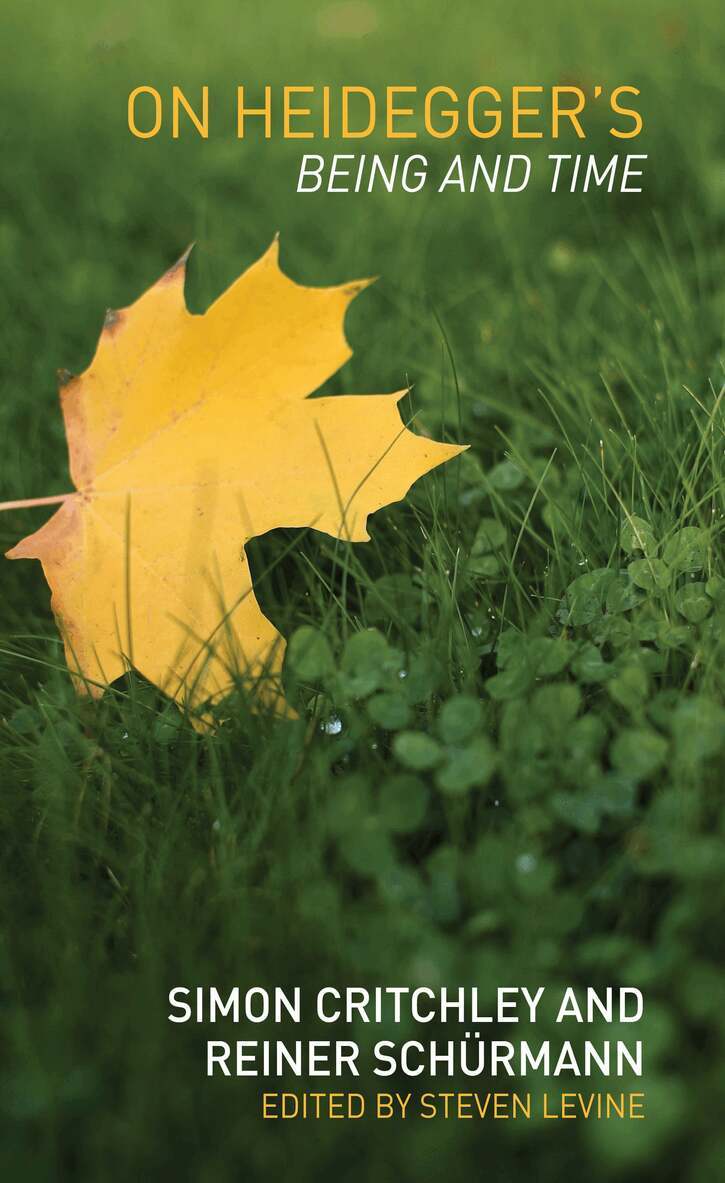
On Heidegger's Being and Time is an outstanding exploration of Heidegger's most important work by two major philosophers. Simon Critchley argues that we must see Being and Time as a radicalization of Husserl's phenomenology, particularly his theories of intentionality, categorial intuition, and the phenomenological concept of the a priori. This leads to a reappraisal and defense of Heidegger's conception of phenomenology. In contrast, Reiner Schürmann urges us to read Heidegger 'backward', arguing that his later work is the key to unravelling Being and Time. Through a close reading of Being and Time Schürmann demonstrates that this work is ultimately aporetic because the notion of Being elaborated in his later work is already at play within it. This is the first time that Schürmann's renowned lectures on Heidegger have been published.The book concludes with Critchley's reinterpretation of the importance of authenticity in Being and Time. Arguing for what he calls an 'originary inauthenticity', Critchley proposes a relational understanding of the key concepts of the second part of Being and Time: death, conscience and temporality.
629 kr
Skickas inom 10-15 vardagar
On Heidegger's Being and Time is an outstanding exploration of Heidegger's most important work by two major philosophers. Simon Critchley argues that we must see Being and Time as a radicalization of Husserl's phenomenology, particularly his theories of intentionality, categorial intuition, and the phenomenological concept of the a priori. This leads to a reappraisal and defense of Heidegger's conception of phenomenology. In contrast, Reiner Schürmann urges us to read Heidegger 'backward', arguing that his later work is the key to unravelling Being and Time. Through a close reading of Being and Time Schürmann demonstrates that this work is ultimately aporetic because the notion of Being elaborated in his later work is already at play within it. This is the first time that Schürmann's renowned lectures on Heidegger have been published.The book concludes with Critchley's reinterpretation of the importance of authenticity in Being and Time. Arguing for what he calls an 'originary inauthenticity', Critchley proposes a relational understanding of the key concepts of the second part of Being and Time: death, conscience and temporality.
260 kr
Skickas inom 5-8 vardagar
1 245 kr
Skickas inom 7-10 vardagar
In this book Steven Levine explores the relation between objectivity and experience from a pragmatic point of view. Like many new pragmatists he aims to rehabilitate objectivity in the wake of Richard Rorty's rejection of the concept. But he challenges the idea, put forward by pragmatists like Robert Brandom, that objectivity is best rehabilitated in communicative-theoretic terms - namely, in terms that can be cashed out by capacities that agents gain through linguistic communication. Levine proposes instead that objectivity is best understood in experiential-theoretic terms. He explains how, in order to meet the aims of the new pragmatists, we need to do more than see objectivity as a norm of rationality embedded in our social-linguistic practices; we also need to see it as emergent from our experiential interaction with the world. Innovative and carefully argued, this book redeems and re-actualizes for contemporary philosophy a key insight developed by the classical pragmatists.
428 kr
Skickas inom 7-10 vardagar
In this book Steven Levine explores the relation between objectivity and experience from a pragmatic point of view. Like many new pragmatists he aims to rehabilitate objectivity in the wake of Richard Rorty's rejection of the concept. But he challenges the idea, put forward by pragmatists like Robert Brandom, that objectivity is best rehabilitated in communicative-theoretic terms - namely, in terms that can be cashed out by capacities that agents gain through linguistic communication. Levine proposes instead that objectivity is best understood in experiential-theoretic terms. He explains how, in order to meet the aims of the new pragmatists, we need to do more than see objectivity as a norm of rationality embedded in our social-linguistic practices; we also need to see it as emergent from our experiential interaction with the world. Innovative and carefully argued, this book redeems and re-actualizes for contemporary philosophy a key insight developed by the classical pragmatists.