
Susan Ariel Aaronson - Böcker
Visar alla böcker från författaren Susan Ariel Aaronson. Handla med fri frakt och snabb leverans.
4 produkter
4 produkter
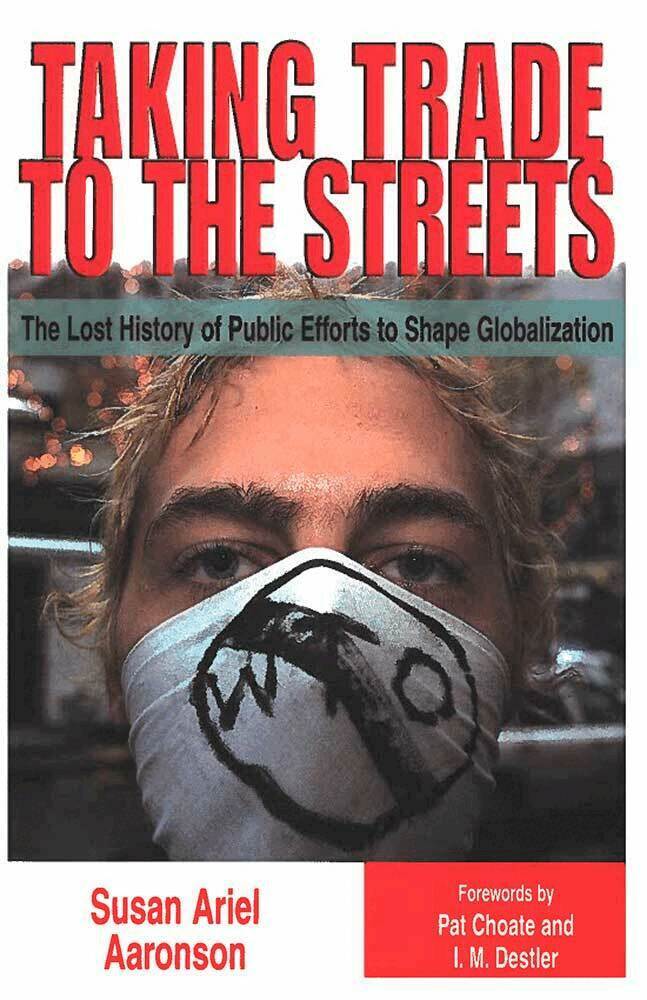
Taking Trade to the Streets
The Lost History of Public Efforts to Shape Globalization
Häftad, Engelska, 2002
370 kr
Skickas inom 7-10 vardagar
In the wake of civil protest in Seattle during the 1999 World Trade Organization meeting, many issues raised by globalization and increasingly free trade have been in the forefront of the news. But these issues are not necessarily new. Taking Trade to the Streets describes how so many individuals and nongovernmental organizations came over time to see trade agreements as threatening national systems of social and environmental regulations. Using the United States as a case study, Susan Ariel Aaronson examines the history of trade agreement critics, focusing particular attention on NAFTA (the North American Free Trade Agreement between Canada, Mexico, and the United States) and the Tokyo and Uruguay Rounds of trade liberalization under the GATT. She also considers the question of whether such trade agreement critics are truly protectionist.The book explores how trade agreement critics built a fluid global movement to redefine the terms of trade agreements (the international system of rules governing trade) and to redefine how citizens talk about trade. (The "terms of trade" is a relationship between the prices of exports and of imports.) That movement, which has been growing since the 1980s, transcends borders as well as longstanding views about the role of government in the economy. While many trade agreement critics on the left say they want government policies to make markets more equitable, they find themselves allied with activists on the right who want to reduce the role of government in the economy. Aaronson highlights three hot-button social issues--food safety, the environment, and labor standards--to illustrate how conflicts arise between trade and other types of regulation. And finally she calls for a careful evaluation of the terms of trade from which an honest debate over regulating the global economy might emerge.Ultimately, this book links the history of trade policy to the history of social regulation. It is a social, political, and economic history that will be of interest to policymakers and students of history, economics, political science, government, trade, sociology, and international affairs.Susan Ariel Aaronson is Senior Fellow at the National Policy Institute and occasional commentator on National Public Radio's "Morning Edition."
Trade Imbalance
The Struggle to Weigh Human Rights Concerns in Trade Policymaking
Häftad, Engelska, 2007
503 kr
Skickas inom 7-10 vardagar
In many countries, citizens allege that trade policies undermine specific rights such as labor rights, the right to health, or the right to political participation. However, in some countries, policy makers use trade policies to promote human rights. Although scholars, policy makers and activists have long debated this relationship, in truth we know very little about it. This book enters this murky territory with three goals. First, it aims to provide readers with greater insights into the relationship between human rights and trade. Second, it includes the first study of how South Africa, Brazil, the United States, and the European Union coordinate trade and human rights objectives and resolve conflicts. It also looks at how human rights issues are seeping into the WTO. Finally, it provides suggestions to policy makers for making their trade and human rights policies more coherent.
Trade Imbalance
The Struggle to Weigh Human Rights Concerns in Trade Policymaking
Inbunden, Engelska, 2007
1 218 kr
Skickas inom 7-10 vardagar
In many countries, citizens allege that trade policies undermine specific rights such as labor rights, the right to health, or the right to political participation. However, in some countries, policy makers use trade policies to promote human rights. Although scholars, policy makers and activists have long debated this relationship, in truth we know very little about it. This book enters this murky territory with three goals. First, it aims to provide readers with greater insights into the relationship between human rights and trade. Second, it includes the first study of how South Africa, Brazil, the United States, and the European Union coordinate trade and human rights objectives and resolve conflicts. It also looks at how human rights issues are seeping into the WTO. Finally, it provides suggestions to policy makers for making their trade and human rights policies more coherent.
440 kr
Skickas inom 3-6 vardagar
Every hour of every day Americans see, smell, taste, or hear goods and services traded between the United States and other nations. Trade issues are front-page news but most Americans know little about the potential impact of global economic interdependence on their jobs, standard of living, and quality of life.In Trade and the American Dream, Susan Aaronson highlights a previously ignored dimension of the United States trade policy: public understanding. Focusing on the debate over the three mechanisms designed to govern world trade -- the International Trade Organization (ITO), the General Agreement on Tarriffs and Trade (GATT), and the World Trade Organization (WTO) -- she examines how policymakers communicate and how the public comprehends trade policy.Since 1947 the U.S. has led global efforts to free trade, and support for freer trade policies and for an international organization to govern world trade has become dogma among policymakers, business leaders, and economists. Relaying on archival research, polling data, public documents, interviews, and Congressional testimony, Aaronson shows that the public also matters in trade policy decisions. If concerns about the implications of economic interdependence remain unaddressed, American trade policy and an international trade organization are vulnerable to a surge of populism and isolationism.While Americans became addicted to imported cars, radios, computers, and appliances, a growing number saw the costs of freer trade policies in the nation's slums, poverty statistics, crime rate, and unemployment figures. Concerns about freer trade policies reached a crescendo in the mid-1990s, especially as Congress debated U.S. participation in the North American Free Trade Agreement (NAFTA). Aaronson suggests ways to create greater public understanding for the GATT/WTO and international trade. If national trade policy is to play in Peoria, Americans must first understand it.