Susan J. Lamon - Böcker
Visar alla böcker från författaren Susan J. Lamon. Handla med fri frakt och snabb leverans.
7 produkter
7 produkter
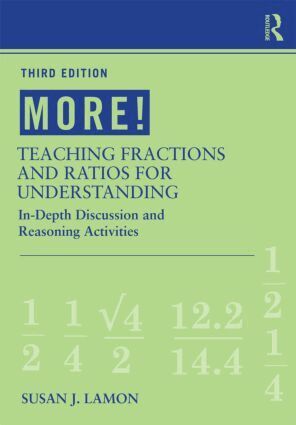
MORE! Teaching Fractions and Ratios for Understanding
In-Depth Discussion and Reasoning Activities
Häftad, Engelska, 2011
638 kr
Skickas inom 10-15 vardagar
More is not an answer key but a resource that provides the scaffolding for the groundbreaking approach to fraction and ratio instruction presented in its companion text, Teaching Fractions and Ratios. Keeping the focus on the reasoning needed to properly understand and teach rational numbers, More shows teachers how to engage in powerful ways of thinking so that they can, in turn, enhance the mathematical education of their students. Like its companion text, More has been heavily expanded and reorganized, including even more student work, templates for key manipulatives, and an emphasis on applications to everyday life. Based on the content chapters in Teaching Fractions and Ratios, each chapter includes: In-depth Discussions of selected problems and their solutions. Supplementary Activities and a collection of challenging problems involving fractions. Praxis Preparation Questions geared to the content of each chapter.
382 kr
Tillfälligt slut
During the last decade there were significant advances in the study of students' learning and problem solving in mathematics, and in the study of classroom instruction. Because these two research programs usually have been conducted individually, it is generally agreed now that there is an increasing need for an integrated research program. This book represents initial discussions and development of a unified paradigm for studying teaching in mathematics that builds upon both cognitive as well as instructional research.
1 251 kr
Skickas inom 10-15 vardagar
This book is the result of a conference sponsored by the Educational Testing Service and the University of Wisconsin's National Center for Research in Mathematical Sciences Education. The purpose of the conference was to facilitate the work of a group of scholars whose interests included the assessment of higher-order understandings and processes in foundation-level (pre-high school) mathematics. Discussions focused on such issues as the purposes of assessment, guidelines for producing and scoring "real-life" assessment activities, and the meanings of such terms as "deeper and higher-order understanding," "cognitive objectives," and "authentic mathematical activities." Assessment was viewed as a critical component of complex, dynamic, and continually adapting educational systems. During the time that the chapters in this book were being written, sweeping changes in mathematics education were being initiated in response to powerful recent advances in technology, cognitive psychology, and mathematics, as well as to numerous public demands for educational reform. These changes have already resulted in significant reappraisals of what it means to understand mathematics, of the nature of mathematics teaching and learning, and of the real-life situations in which mathematics is useful. The challenge was to pursue assessment-related initiatives that are systematically valid, in the sense that they work to complement and enhance other improvements in the educational system rather than act as an impediment to badly needed curriculum reforms.To address these issues, most chapters in this book focus on clarifying and articulating the goals of assessment and instruction, and they stress the content of assessment above its mode of delivery. Computer- or portfolio-based assessments are interpreted as means to ends, not as ends in themselves. Assessment is conceived as an ongoing documentation process, seamless with instruction, whose quality hinges upon its ability to provide complete and appropriate information as needed to inform priorities in instructional decision making. This book tackles some of the most complicated issues related to assessment, and it offers fresh perspectives from leaders in the field--with the hope that the ultimate consumer in the instruction/assessment enterprise, the individual student, will reclaim his or her potential for self-directed mathematics learning.
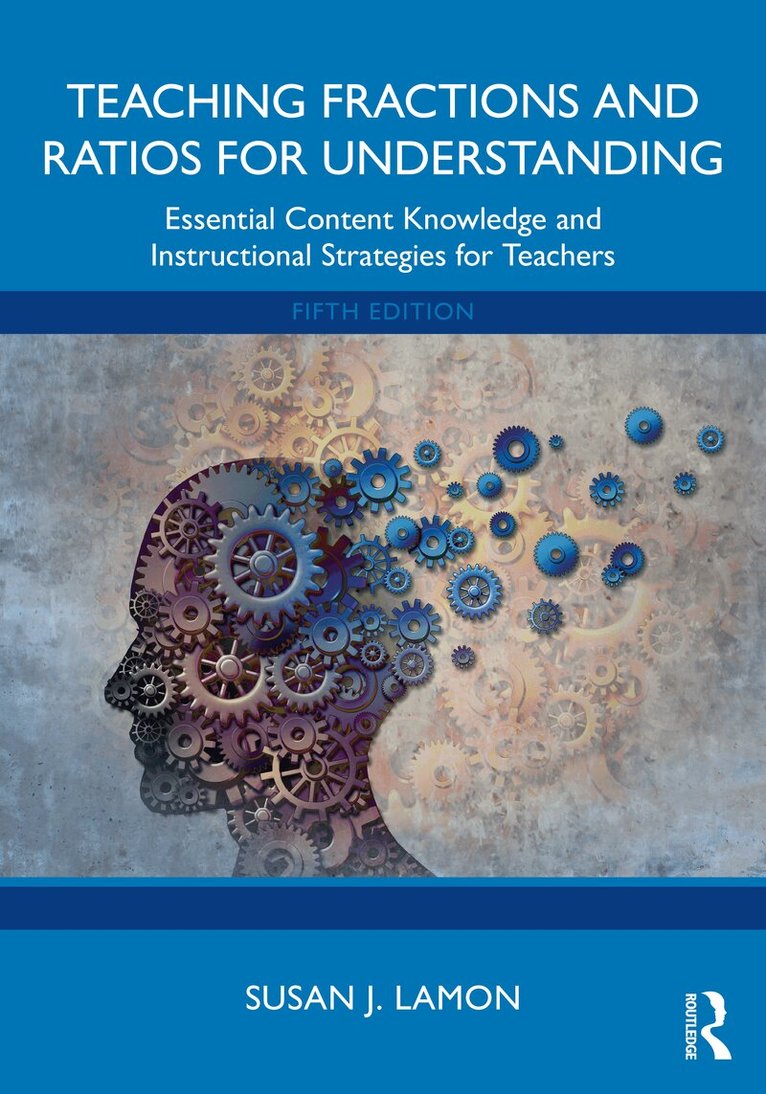
Teaching Fractions and Ratios for Understanding
Essential Content Knowledge and Instructional Strategies for Teachers
Häftad, Engelska, 2025
874 kr
Skickas inom 10-15 vardagar
The fifth edition of this user-friendly textbook helps mathematics educators explore and explain the complex world of rational numbers. It translates research into usable ideas for the classroom, including reasoning strategies, models, and questioning techniques that promote deep understanding that cannot be achieved by merely practicing fraction computation.Updated throughout with new examples and models from research, each chapter in the new edition incorporates samples of student work for teacher analysis, as well as activities for practicing each thinking strategy, designed to be solved without rules or algorithms, using reasoning alone. All content has been used with students and is presented with the learner in mind, acknowledging the brilliance of students' insights as well as the issues that challenge their understanding. It covers a broad range of topics in the progression from relative thinking to proportional reasoning, including fractions, ratios, rates, operators, measures, percents, and more.For over two decades, Teaching Fractions and Ratios for Understanding has helped elementary and middle school teachers expand their understanding and teaching strategies for rational number topics. The fifth edition is essential reading for mathematics courses, teacher preparation courses, graduate courses preparing researchers in mathematics education, and parents engaged in home schooling.
Teaching Fractions and Ratios for Understanding
Essential Content Knowledge and Instructional Strategies for Teachers
Inbunden, Engelska, 2025
2 044 kr
Skickas inom 10-15 vardagar
The fifth edition of this user-friendly textbook helps mathematics educators explore and explain the complex world of rational numbers. It translates research into usable ideas for the classroom, including reasoning strategies, models, and questioning techniques that promote deep understanding that cannot be achieved by merely practicing fraction computation.Updated throughout with new examples and models from research, each chapter in the new edition incorporates samples of student work for teacher analysis, as well as activities for practicing each thinking strategy, designed to be solved without rules or algorithms, using reasoning alone. All content has been used with students and is presented with the learner in mind, acknowledging the brilliance of students' insights as well as the issues that challenge their understanding. It covers a broad range of topics in the progression from relative thinking to proportional reasoning, including fractions, ratios, rates, operators, measures, percents, and more.For over two decades, Teaching Fractions and Ratios for Understanding has helped elementary and middle school teachers expand their understanding and teaching strategies for rational number topics. The fifth edition is essential reading for mathematics courses, teacher preparation courses, graduate courses preparing researchers in mathematics education, and parents engaged in home schooling.
MORE! Teaching Fractions and Ratios for Understanding
In-Depth Discussion and Reasoning Activities
Inbunden, Engelska, 2017
2 635 kr
Skickas inom 10-15 vardagar
More is not an answer key but a resource that provides the scaffolding for the groundbreaking approach to fraction and ratio instruction presented in its companion text, Teaching Fractions and Ratios. Keeping the focus on the reasoning needed to properly understand and teach rational numbers, More shows teachers how to engage in powerful ways of thinking so that they can, in turn, enhance the mathematical education of their students. Like its companion text, More has been heavily expanded and reorganized, including even more student work, templates for key manipulatives, and an emphasis on applications to everyday life. Based on the content chapters in Teaching Fractions and Ratios, each chapter includes:In-depth Discussions of selected problems and their solutions.Supplementary Activities and a collection of challenging problems involving fractions.Praxis Preparation Questions geared to the content of each chapter.
454 kr
Skickas inom 10-15 vardagar
This book is the result of a conference sponsored by the Educational Testing Service and the University of Wisconsin's National Center for Research in Mathematical Sciences Education. The purpose of the conference was to facilitate the work of a group of scholars whose interests included the assessment of higher-order understandings and processes in foundation-level (pre-high school) mathematics. Discussions focused on such issues as the purposes of assessment, guidelines for producing and scoring "real-life" assessment activities, and the meanings of such terms as "deeper and higher-order understanding," "cognitive objectives," and "authentic mathematical activities." Assessment was viewed as a critical component of complex, dynamic, and continually adapting educational systems. During the time that the chapters in this book were being written, sweeping changes in mathematics education were being initiated in response to powerful recent advances in technology, cognitive psychology, and mathematics, as well as to numerous public demands for educational reform. These changes have already resulted in significant reappraisals of what it means to understand mathematics, of the nature of mathematics teaching and learning, and of the real-life situations in which mathematics is useful. The challenge was to pursue assessment-related initiatives that are systematically valid, in the sense that they work to complement and enhance other improvements in the educational system rather than act as an impediment to badly needed curriculum reforms.To address these issues, most chapters in this book focus on clarifying and articulating the goals of assessment and instruction, and they stress the content of assessment above its mode of delivery. Computer- or portfolio-based assessments are interpreted as means to ends, not as ends in themselves. Assessment is conceived as an ongoing documentation process, seamless with instruction, whose quality hinges upon its ability to provide complete and appropriate information as needed to inform priorities in instructional decision making. This book tackles some of the most complicated issues related to assessment, and it offers fresh perspectives from leaders in the field--with the hope that the ultimate consumer in the instruction/assessment enterprise, the individual student, will reclaim his or her potential for self-directed mathematics learning.