Susan L Burns – författare
Visar alla böcker från författaren Susan L Burns. Handla med fri frakt och snabb leverans.
7 produkter
7 produkter
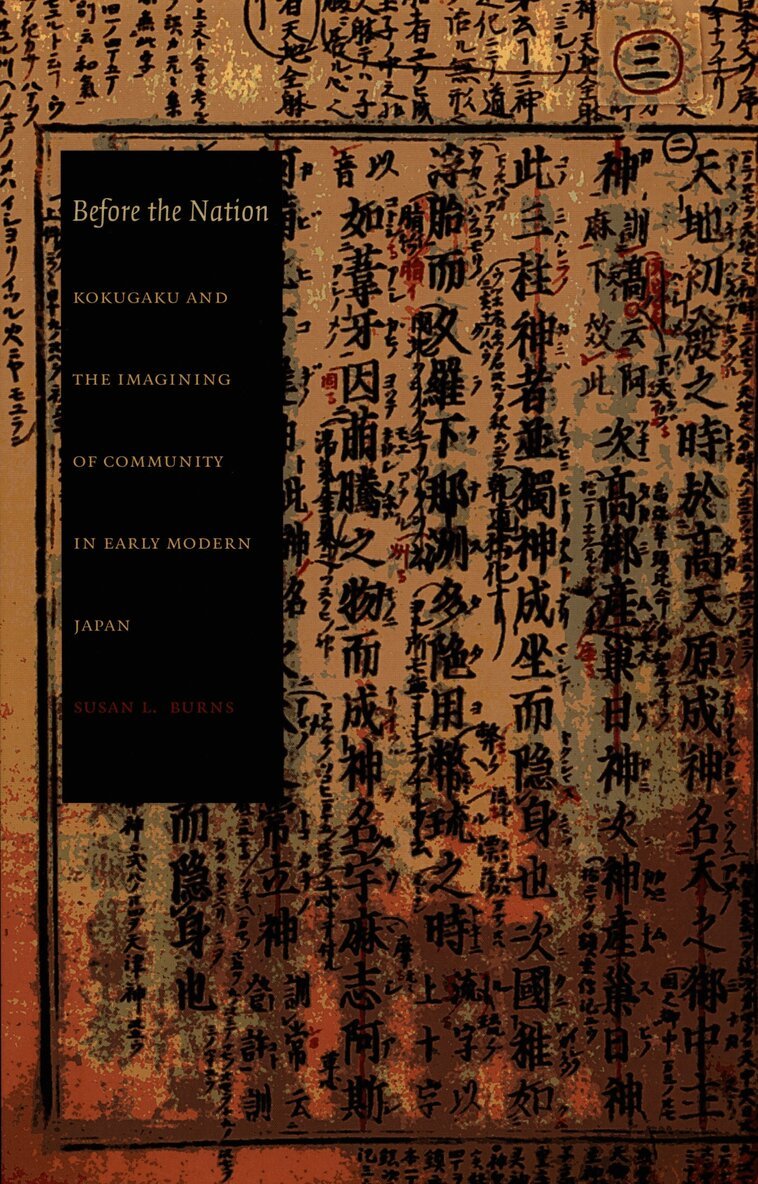
Before the Nation
Kokugaku and the Imagining of Community in Early Modern Japan
Häftad, Engelska, 2003
363 kr
Skickas inom 7-10 vardagar
Exploring the emergence and evolution of theories of nationhood that continue to be evoked in present-day Japan, Susan L. Burns provides a close examination of the late-eighteenth-century intellectual movement kokugaku, which means "the study of our country.” Departing from earlier studies of kokugaku that focused on intellectuals whose work has been valorized by modern scholars, Burns seeks to recover the multiple ways "Japan" as social and cultural identity began to be imagined before modernity.Central to Burns's analysis is Motoori Norinaga’s Kojikiden, arguably the most important intellectual work of Japan's early modern period. Burns situates the Kojikiden as one in a series of attempts to analyze and interpret the mythohistories dating from the early eighth century, the Kojiki and Nihon shoki. Norinaga saw these texts as keys to an original, authentic, and idyllic Japan that existed before being tainted by "flawed" foreign influences, notably Confucianism and Buddhism. Hailed in the nineteenth century as the begetter of a new national consciousness, Norinaga's Kojikiden was later condemned by some as a source of Japan's twentieth-century descent into militarism, war, and defeat. Burns looks in depth at three kokugaku writers-Ueda Akinari, Fujitani Mitsue, and Tachibana Moribe-who contested Norinaga's interpretations and produced competing readings of the mythohistories that offered new theories of community as the basis for Japanese social and cultural identity. Though relegated to the footnotes by a later generation of scholars, these writers were quite influential in their day, and by recovering their arguments, Burns reveals kokugaku as a complex debate-involving history, language, and subjectivity-with repercussions extending well into the modern era.
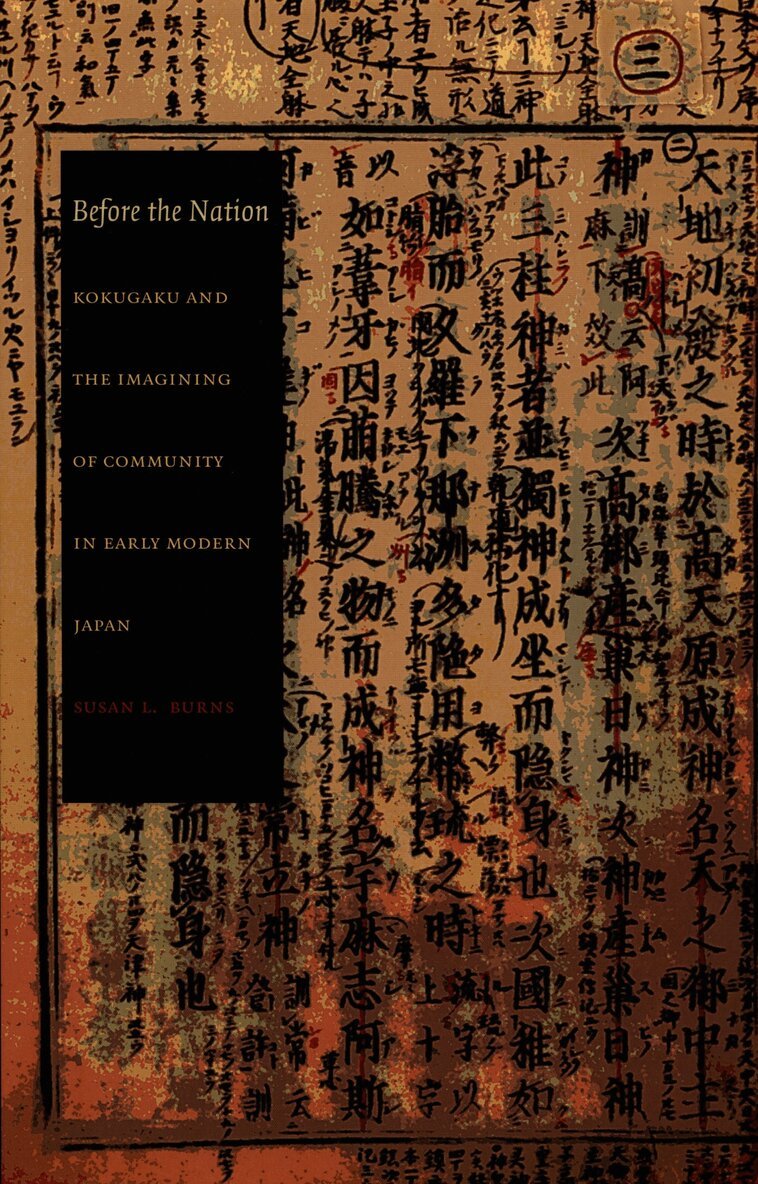
Before the Nation
Kokugaku and the Imagining of Community in Early Modern Japan
Inbunden, Engelska, 2003
1 193 kr
Skickas inom 7-10 vardagar
Exploring the emergence and evolution of theories of nationhood that continue to be evoked in present-day Japan, Susan L. Burns provides a close examination of the late-eighteenth-century intellectual movement kokugaku, which means "the study of our country.” Departing from earlier studies of kokugaku that focused on intellectuals whose work has been valorized by modern scholars, Burns seeks to recover the multiple ways "Japan" as social and cultural identity began to be imagined before modernity.Central to Burns's analysis is Motoori Norinaga’s Kojikiden, arguably the most important intellectual work of Japan's early modern period. Burns situates the Kojikiden as one in a series of attempts to analyze and interpret the mythohistories dating from the early eighth century, the Kojiki and Nihon shoki. Norinaga saw these texts as keys to an original, authentic, and idyllic Japan that existed before being tainted by "flawed" foreign influences, notably Confucianism and Buddhism. Hailed in the nineteenth century as the begetter of a new national consciousness, Norinaga's Kojikiden was later condemned by some as a source of Japan's twentieth-century descent into militarism, war, and defeat. Burns looks in depth at three kokugaku writers-Ueda Akinari, Fujitani Mitsue, and Tachibana Moribe-who contested Norinaga's interpretations and produced competing readings of the mythohistories that offered new theories of community as the basis for Japanese social and cultural identity. Though relegated to the footnotes by a later generation of scholars, these writers were quite influential in their day, and by recovering their arguments, Burns reveals kokugaku as a complex debate-involving history, language, and subjectivity-with repercussions extending well into the modern era.
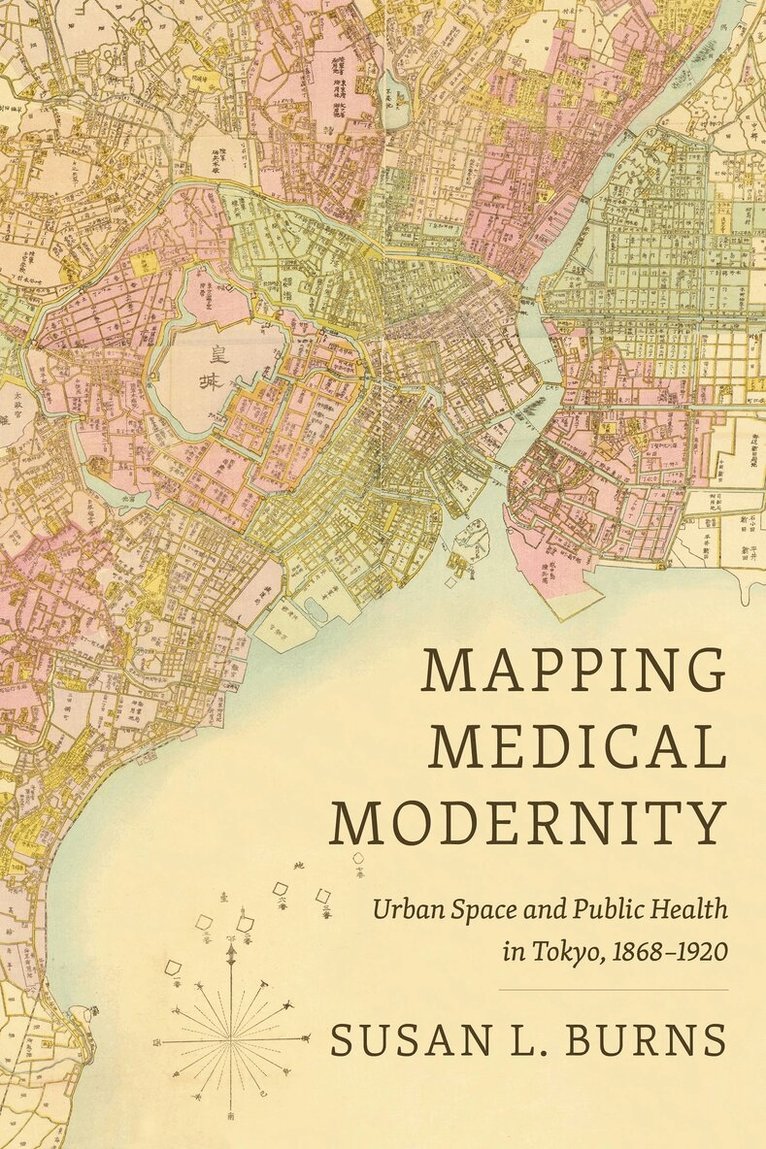
Cartographies of Care
Medical Modernization and Public Health in Tokyo, 1868-1912
Inbunden, Engelska, 2026
1 844 kr
Kommande
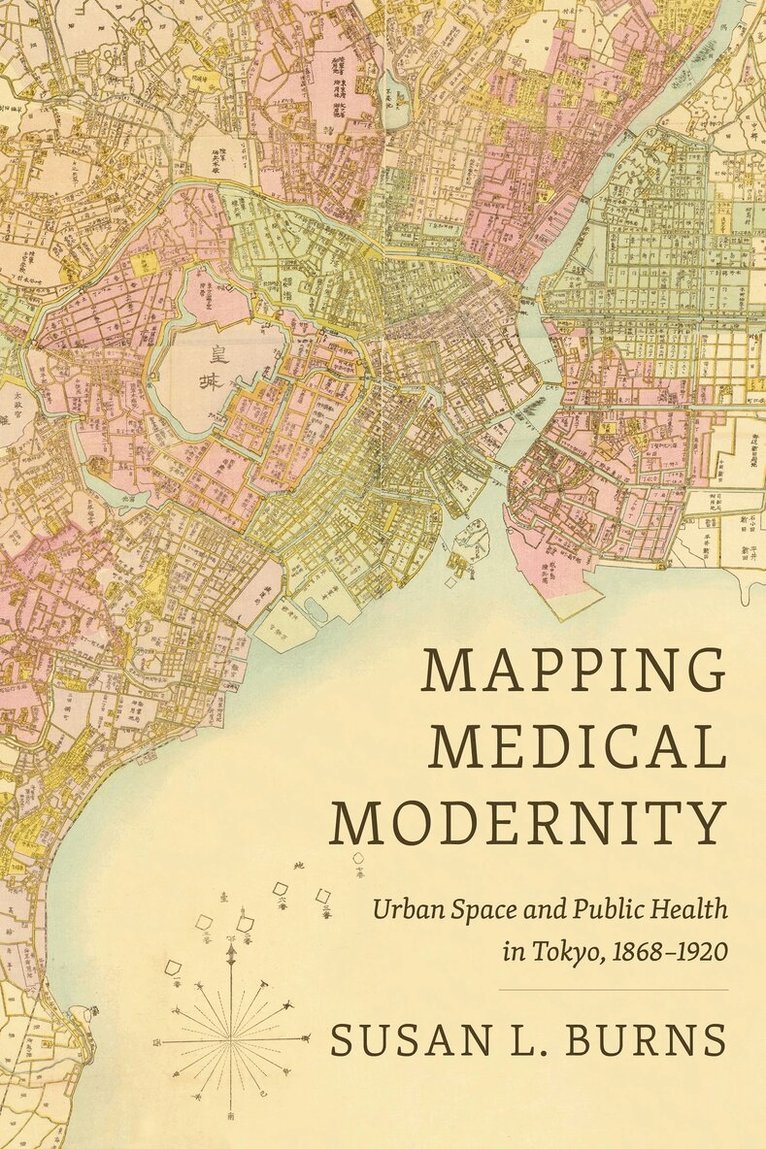
Mapping Medical Modernity explores the history of medical modernization and public health in late nineteenth- and early twentieth-century Tokyo, a city undergoing rapid transformation from the seat of power of the Tokugawa shoguns of the Edo period to the capital of a modern nation-state and its expanding empire in the Meiji period. Tracing the development of institutions and policies designed to improve medical care and public health in a dense urban environment, Susan L. Burns examines tensions between the involved parties—including doctors and policymakers, police and civil officials, residents and those who governed them—and provides case studies focused on three of the city’s major challenges in public health: syphilis, cholera, and mental illness. Drawing upon a wide range of archival materials and contemporary accounts, Burns also employs geographic information system analysis in mapping the complicated relationships interlinking aspects of the urban environment, social life, public policy, and commercialized medical culture to demonstrate visually how policy decisions and medical capitalism gradually reshaped existing spatial arrangements in the city as well as the social relations that unfolded within them.
533 kr
Kommande
Mapping Medical Modernity explores the history of medical modernization and public health in late nineteenth- and early twentieth-century Tokyo, a city undergoing rapid transformation from the seat of power of the Tokugawa shoguns of the Edo period to the capital of a modern nation-state and its expanding empire in the Meiji period. Tracing the development of institutions and policies designed to improve medical care and public health in a dense urban environment, Susan L. Burns examines tensions between the involved parties—including doctors and policymakers, police and civil officials, residents and those who governed them—and provides case studies focused on three of the city’s major challenges in public health: syphilis, cholera, and mental illness. Drawing upon a wide range of archival materials and contemporary accounts, Burns also employs geographic information system analysis in mapping the complicated relationships interlinking aspects of the urban environment, social life, public policy, and commercialized medical culture to demonstrate visually how policy decisions and medical capitalism gradually reshaped existing spatial arrangements in the city as well as the social relations that unfolded within them.
496 kr
Skickas inom 7-10 vardagar
Beginning in the nineteenth century, law as practice, discourse, and ideology became a powerful means of reordering gender relations in modern nation-states and their colonies around the world. This volume puts developments in Japan and its empire in dialogue with this global phenomenon. Arguing against the popular stereotype of Japan as a non-litigious society, an international group of contributors from Japan, Taiwan, Germany, and the U.S., explores how in Japan and its colonies, as elsewhere in the modern world, law became a fundamental means of creating and regulating gendered subjects and social norms in the period from the 1870s to the 1950s. Rather than viewing legal discourse and the courts merely as technologies of state control, the authors suggest that they were subject to negotiation, interpretation, and contestation at every level of their formulation and deployment. With this as a shared starting point, they explore key issues such reproductive and human rights, sexuality, prostitution, gender and criminality, and the formation of the modern conceptions of family and conjugality, and use these issues to complicate our understanding of the impact of civil, criminal, and administrative laws upon the lives of both Japanese citizens and colonial subjects. The result is a powerful rethinking of not only gender and law, but also the relationships between the state and civil society, the metropole and the colonies, and Japan and the West. Collectively, the essays offer a new framework for the history of gender in modern Japan and revise our understanding of both law and gender in an era shaped by modernization, nation and empire-building, war, occupation, and decolonization. With its broad chronological time span and compelling and yet accessible writing, Gender and Law in the Japanese Imperium will be a powerful addition to any course on modern Japanese history and of interest to readers concerned with gender, society, and law in other parts of the world.
754 kr
Skickas inom 7-10 vardagar
In this groundbreaking work, Susan L. Burns examines the history of leprosy in Japan from medieval times until the present. At the center of Kingdom of the Sick is the rise of Japan's system of national leprosy sanitaria, which today continue to house more than 1,500 former patients, many of whom have spent five or more decades within them. Burns argues that long before the modern Japanese government began to define a policy toward leprosy, the disease was already profoundly marked by ethical and political concerns and associated with sin, pollution, heredity, and outcast status. Beginning in the 1870s, new anxieties about race and civilization that emanated from a variety of civic actors, including journalists, doctors, patent medicine producers, and Christian missionaries transformed leprosy into a national issue. After 1900, a clamor of voices called for the quarantine of all sufferers of the disease, and in the decades that followed bureaucrats, politicians, physicians, journalists, local communities, and leprosy sufferers themselves grappled with the place of the biologically vulnerable within the body politic. At stake in this “citizenship project” were still evolving conceptions of individual rights, government responsibility for social welfare, and the delicate balance between care and control.Refusing to treat leprosy patients as simply victims of state power, Burns recovers their voices in the debates that surrounded the most controversial aspects of sanitarium policy, including the use of sterilization, segregation, and the continuation of confinement long after leprosy had become a curable disease. Richly documented with both visual and textual sources and interweaving medical, political, social, and cultural history, Kingdom of the Sick tells an important story for readers interested in Japan, the history of medicine and public health, social welfare, gender and sexuality, and human rights.
319 kr
Skickas inom 7-10 vardagar
In this groundbreaking work, Susan L. Burns examines the history of leprosy in Japan from medieval times until the present. At the center of Kingdom of the Sick is the rise of Japan’s system of national leprosy sanitaria, which today continue to house more than 1,500 former patients, many of whom have spent five or more decades within them. Burns argues that long before the modern Japanese government began to define a policy toward leprosy, the disease was already profoundly marked by ethical and political concerns and associated with sin, pollution, heredity, and outcast status. Beginning in the 1870s, new anxieties about race and civilization that emanated from a variety of civic actors, including journalists, doctors, patent medicine producers, and Christian missionaries transformed leprosy into a national issue. After 1900, a clamor of voices called for the quarantine of all sufferers of the disease, and in the decades that followed bureaucrats, politicians, physicians, journalists, local communities, and leprosy sufferers themselves grappled with the place of the biologically vulnerable within the body politic. At stake in this "citizenship project" were still evolving conceptions of individual rights, government responsibility for social welfare, and the delicate balance between care and control.Refusing to treat leprosy patients as simply victims of state power, Burns recovers their voices in the debates that surrounded the most controversial aspects of sanitarium policy, including the use of sterilization, segregation, and the continuation of confinement long after leprosy had become a curable disease. Richly documented with both visual and textual sources and interweaving medical, political, social, and cultural history, Kingdom of the Sick tells an important story for readers interested in Japan, the history of medicine and public health, social welfare, gender and sexuality, and human rights.