Susan Leigh Star - Böcker
Visar alla böcker från författaren Susan Leigh Star. Handla med fri frakt och snabb leverans.
6 produkter
6 produkter
446 kr
Skickas
608 kr
Skickas inom 3-6 vardagar
This collection of articles provides a comprehensive overview of personal and public issues related to social change and how they shape scientific and technical knowledge.Ecologies of Knowledge provides a comprehensive overview of issues relating to work, politics, and the latest perspectives on the role of materials, feminism, "nonhumans," and work practices as shaping scientific and technical knowledge. In addition to theoretical contributions, the authors cover biotechnology, computing, representations and space, aerospace engineering, and a variety of ethical perspectives and controversies in these domains.
Standards and Their Stories
How Quantifying, Classifying, and Formalizing Practices Shape Everyday Life
Inbunden, Engelska, 2008
1 518 kr
Skickas inom 10-15 vardagar
Standardization is one of the defining aspects of modern life, its presence so pervasive that it is usually taken for granted. However cumbersome, onerous, or simply puzzling certain standards may be, their fundamental purpose in streamlining procedures, regulating behaviors, and predicting results is rarely questioned. Indeed, the invisibility of infrastructure and the imperative of standardizing processes signify their absolute necessity. Increasingly, however, social scientists are beginning to examine the origins and effects of the standards that underpin the technology and practices of everyday life.Standards and Their Stories explores how we interact with the network of standards that shape our lives in ways both obvious and invisible. The main chapters analyze standardization in biomedical research, government bureaucracies, the insurance industry, labor markets, and computer technology, providing detailed accounts of the invention of "standard humans" for medical testing and life insurance actuarial tables, the imposition of chronological age as a biographical determinant, the accepted means of determining labor productivity, the creation of international standards for the preservation and access of metadata, and the global consequences of "ASCII imperialism" and the use of English as the lingua franca of the Internet.Accompanying these in-depth critiques are a series of examples that depict an almost infinite variety of standards, from the controversies surrounding the European Union's supposed regulation of banana curvature to the minimum health requirements for immigrants at Ellis Island, conflicting (and ever-increasing) food portion sizes, and the impact of standardized punishment metrics like "Three Strikes" laws. The volume begins with a pioneering essay from Susan Leigh Star and Martha Lampland on the nature of standards in everyday life that brings together strands from the several fields represented in the book. In an appendix, the editors provide a guide for teaching courses in this emerging interdisciplinary field, which they term "infrastructure studies," making Standards and Their Stories ideal for scholars, students, and those curious about why coffins are becoming wider, for instance, or why the Financial Accounting Standards Board refused to classify September 11 as an "extraordinary" event.
Standards and Their Stories
How Quantifying, Classifying, and Formalizing Practices Shape Everyday Life
Häftad, Engelska, 2008
274 kr
Skickas inom 10-15 vardagar
Standardization is one of the defining aspects of modern life, its presence so pervasive that it is usually taken for granted. However cumbersome, onerous, or simply puzzling certain standards may be, their fundamental purpose in streamlining procedures, regulating behaviors, and predicting results is rarely questioned. Indeed, the invisibility of infrastructure and the imperative of standardizing processes signify their absolute necessity. Increasingly, however, social scientists are beginning to examine the origins and effects of the standards that underpin the technology and practices of everyday life.Standards and Their Stories explores how we interact with the network of standards that shape our lives in ways both obvious and invisible. The main chapters analyze standardization in biomedical research, government bureaucracies, the insurance industry, labor markets, and computer technology, providing detailed accounts of the invention of "standard humans" for medical testing and life insurance actuarial tables, the imposition of chronological age as a biographical determinant, the accepted means of determining labor productivity, the creation of international standards for the preservation and access of metadata, and the global consequences of "ASCII imperialism" and the use of English as the lingua franca of the Internet.Accompanying these in-depth critiques are a series of examples that depict an almost infinite variety of standards, from the controversies surrounding the European Union's supposed regulation of banana curvature to the minimum health requirements for immigrants at Ellis Island, conflicting (and ever-increasing) food portion sizes, and the impact of standardized punishment metrics like "Three Strikes" laws. The volume begins with a pioneering essay from Susan Leigh Star and Martha Lampland on the nature of standards in everyday life that brings together strands from the several fields represented in the book. In an appendix, the editors provide a guide for teaching courses in this emerging interdisciplinary field, which they term "infrastructure studies," making Standards and Their Stories ideal for scholars, students, and those curious about why coffins are becoming wider, for instance, or why the Financial Accounting Standards Board refused to classify September 11 as an "extraordinary" event.
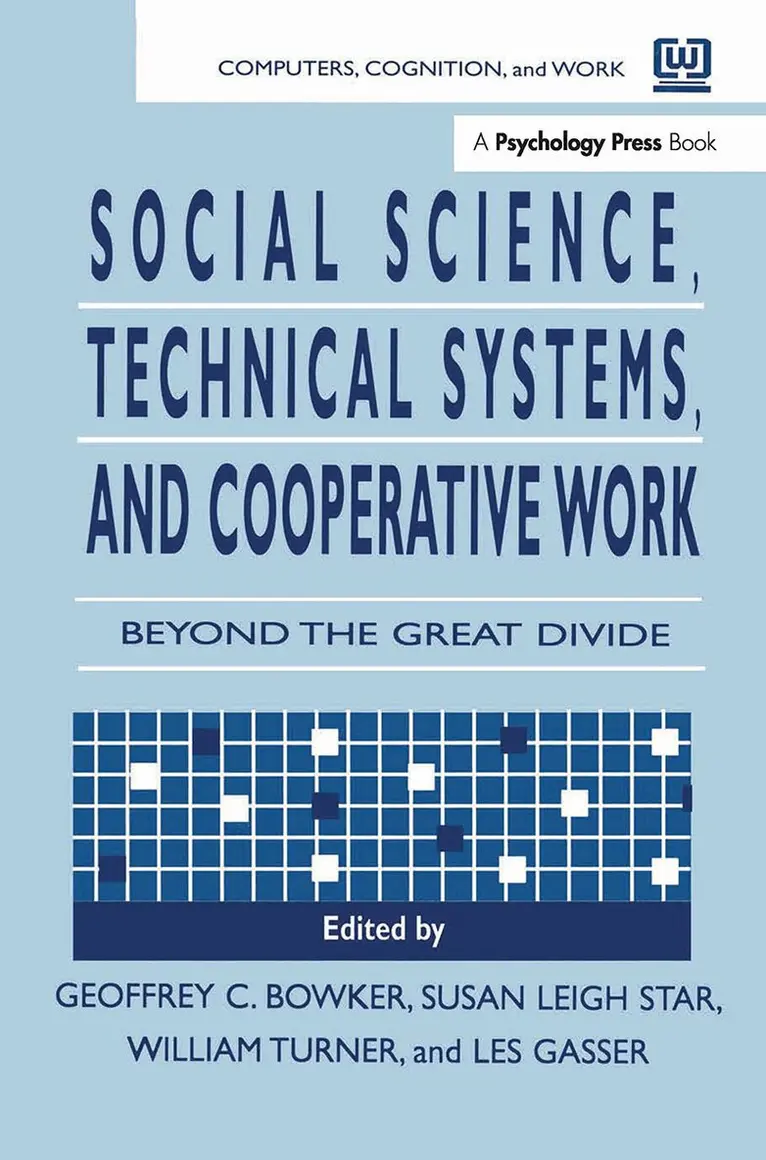
Social Science, Technical Systems, and Cooperative Work
Beyond the Great Divide
Inbunden, Engelska, 1997
2 490 kr
Skickas inom 10-15 vardagar
This book is the first to directly address the question of how to bridge what has been termed the "great divide" between the approaches of systems developers and those of social scientists to computer supported cooperative work--a question that has been vigorously debated in the systems development literature. Traditionally, developers have been trained in formal methods and oriented to engineering and formal theoretical problems; many social scientists in the CSCW field come from humanistic traditions in which results are reported in a narrative mode. In spite of their differences in style, the two groups have been cooperating more and more in the last decade, as the "people problems" associated with computing become increasingly evident to everyone.The authors have been encouraged to examine, rigorously and in depth, the theoretical basis of CSCW. With contributions from field leaders in the United Kingdom, France, Scandinavia, Mexico, and the United States, this volume offers an exciting overview of the cutting edge of research and theory. It constitutes a solid foundation for the rapidly coalescing field of social informatics. Divided into three parts, this volume covers social theory, design theory, and the sociotechnical system with respect to CSCW. The first set of chapters looks at ways of rethinking basic social categories with the development of distributed collaborative computing technology--concepts of the group, technology, information, user, and text. The next section concentrates more on the lessons that can be learned at the design stage given that one wants to build a CSCW system incorporating these insights--what kind of work does one need to do and how is understanding of design affected? The final part looks at the integration of social and technical in the operation of working sociotechnical systems. Collectively the contributors make the argument that the social and technical are irremediably linked in practice and so the "great divide" not only should be a thing of the past, it should never have existed in the first place.
Social Science, Technical Systems, and Cooperative Work
Beyond the Great Divide
Häftad, Engelska, 1997
1 200 kr
Skickas inom 10-15 vardagar
This book is the first to directly address the question of how to bridge what has been termed the "great divide" between the approaches of systems developers and those of social scientists to computer supported cooperative work--a question that has been vigorously debated in the systems development literature. Traditionally, developers have been trained in formal methods and oriented to engineering and formal theoretical problems; many social scientists in the CSCW field come from humanistic traditions in which results are reported in a narrative mode. In spite of their differences in style, the two groups have been cooperating more and more in the last decade, as the "people problems" associated with computing become increasingly evident to everyone.The authors have been encouraged to examine, rigorously and in depth, the theoretical basis of CSCW. With contributions from field leaders in the United Kingdom, France, Scandinavia, Mexico, and the United States, this volume offers an exciting overview of the cutting edge of research and theory. It constitutes a solid foundation for the rapidly coalescing field of social informatics. Divided into three parts, this volume covers social theory, design theory, and the sociotechnical system with respect to CSCW. The first set of chapters looks at ways of rethinking basic social categories with the development of distributed collaborative computing technology--concepts of the group, technology, information, user, and text. The next section concentrates more on the lessons that can be learned at the design stage given that one wants to build a CSCW system incorporating these insights--what kind of work does one need to do and how is understanding of design affected? The final part looks at the integration of social and technical in the operation of working sociotechnical systems. Collectively the contributors make the argument that the social and technical are irremediably linked in practice and so the "great divide" not only should be a thing of the past, it should never have existed in the first place.