Susanna Hoe – Författare
Visar alla böcker från författaren Susanna Hoe. Handla med fri frakt och snabb leverans.
10 produkter
10 produkter
2 315 kr
Skickas inom 10-15 vardagar
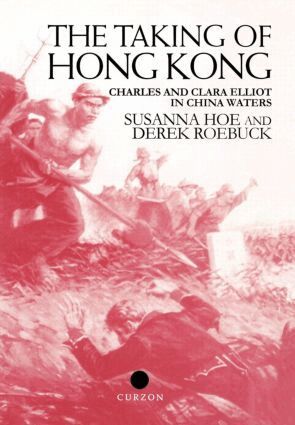
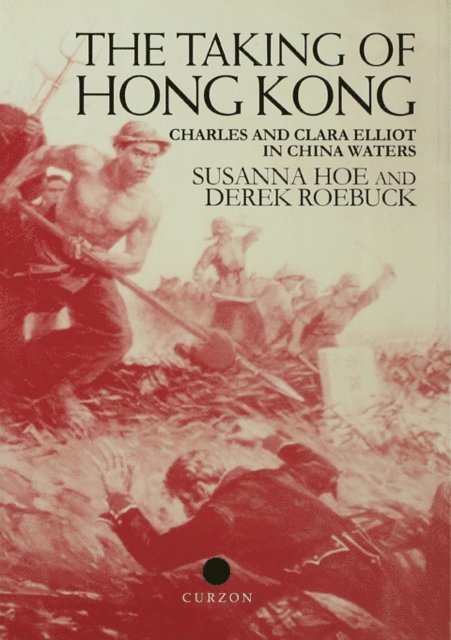
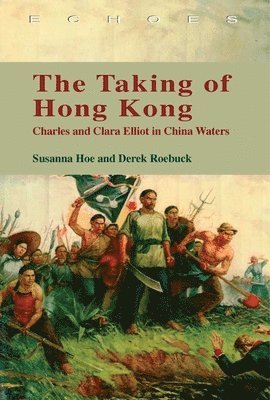
Relations between Britain and China have, for over 150 years, been inextricably bound up with the taking of Hong Kong Island on 26 January 1841. The man responsible, Britain's plenipotentiary Captain Charles Elliot, was recalled by his government in disgrace and has been vilified ever since by China. This book describes the taking of Hong Kong from Elliot's point of view for the first time '- through the personal letters of himself and his wife Clara '- and shows a man of intelligence, conscience and humanitarian instincts. The book gives new insights into Sino-British relations of the period. Because these are now being re-assessed both historically and for the future, revelations about Elliot's role, intentions and analysis are significant and could make an important difference to our understanding of the dynamics of these relations. On a different level, the book explores how Charles the private man, with his wife by his side, experienced events, rather than how Elliot the public figure reported them to the British government. The work is therefore of great historiographical interest.
187 kr
Skickas
On 20 June 1900, Baron von Ketteler, the German Minister, was assassinated in a Peking street. By 4pm the first shots were fired into the legation quarter and the siege of foreigners by Boxers and imperial troops had begun. Among the besieged were 148 women from America, Europe, Russia and Japan and Maud, the Baron's American widow. What were their experiences? How did they cope with their 79 children for two months, without enough to eat, often under fire? This book tells their story - of courage, grief, humour, friendship, ill-health, and hard work - mostly through their own accounts. It identifies the women for the first time as individuals: missionary teachers and doctors, "globe trotters", and the wives of diplomats, officials, railway engineers, merchants, bankers and the owner of the Peking Hotel.
123 kr
Skickas inom 11-20 vardagar
This livret links legend and archaeology by writing and place, but does not neglect Crete's other women. Over the centuries they were subject to numerous violent changes of overlord - Mycenean, Roman, Byzantine, Saracen, Venetian, Ottoman - but somehow have emerged as Cretans.
168 kr
Skickas inom 11-20 vardagar
A diary of a stay in Papua New Guinea. The author introduces the reader to the family cleaner - Margaret - her extended family, her unreliable husbands and her independent spirit. Then there is Kaman, the gardener, who has to be prised away from his creation so that his employers can enjoy it.
187 kr
Tillfälligt slut
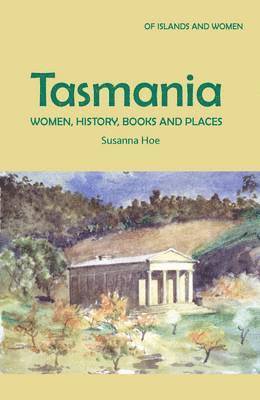
In 1792 Louise Girardin - disguised as a French sailor - was the first white woman to visit Van Diemen's Land (Tasmania). She was followed by Martha Hayes who stepped ashore in 1803 among the first women settlers and convicts; she was the pregnant 16 year-old mistress of their leader. But Aboriginal women had already lived on the island for perhaps 40,000 years. The first to be named in exploration literature is Ouray-Ouray; the best known is Trukanini, erroneously called the last Tasmanian when she died in 1876. In the 1970s, Aboriginal rights became a live issue, often with women in the forefront, as they were, too, in environmentalism. This book gathers together these strands, and that of a vibrant women's literature, linking them to place - an island of still unspoilt beauty and unique flora and fauna.
247 kr
Skickas
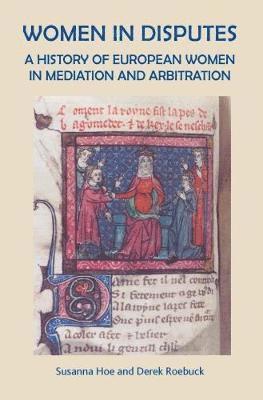
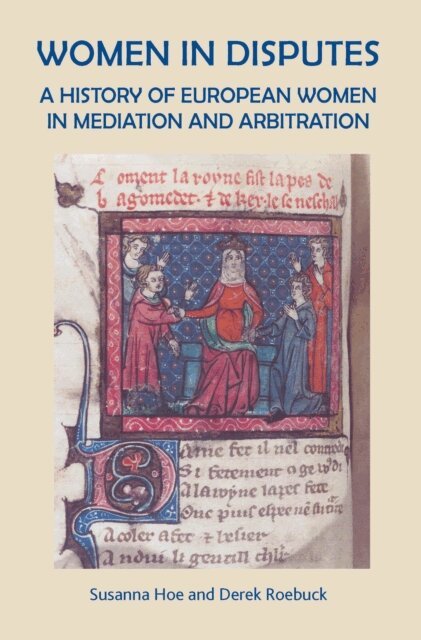
From Homer to Jane Austen, storytellers have entertained their audiences with tales of women in disputes, as parties and peacemakers. This is our attempt to write their history, relying as far as possible on primary sources, documents which have survived by chance, never intended for our eyes by those who created and preserved them.In 534AD, the Roman emperor Justinian expressly forbade women to act as arbitrators. In the thirteenth century Saint Thomas Aquinas stated that 'woman is naturally subject to man, because in man the discretion of reason predominates'.Many have assumed that what was laid down as law or proclaimed as authority represented the reality. But women do not always do what men tell them they should. We have set out to find what has happened in practice over four thousand years, at least in Europe, beginning in the Bible and Ancient Greece and Rome, but thereafter concentrating on England, with regular references to the Continent.A chapter on Anglo-Saxon England shows the inextricable ties with the Continent among women of the highest rank, as do two of the four chapters that follow on the Middle Ages. Those women often mediated and arbitrated, but they also resolved disputes by a number of other ways. Then we show how common it was for titled women in England to resolve disputes. A chapter on 'untitled women' provides plenty of evidence of the regular resolution of their disputes. There is a digression then to Malta, to the records of a fifteenth-century notary, which tell the stories of women of every station and their disputes.England's greatest monarch, Elizabeth I supported women with free legal aid and her own personal intervention, in ways never since matched. The practice of submitting women's disputes to mediation and arbitration survived through the seventeenth century, dispite revolution, regicide, fire and plague. A tailpiece tells how a dispute concerning the will of Temperance Flowerdew, one of the earliest European settlers in the 'New World', was resolved by the English Privy Council. A chapter on the eighteenth century emphasises the English government's encouragement of mediation and arbitration. ending with how Mary Musgrove's mediation helped to establish the colony of Georgia, and two sections on France, one Pre-Revolutionary, one Revolutionary. They challenge others to explore developments in the North American colonies and France. The Conclusion widens that challenge.Lady Anne Clifford, a woman of infinite strength of will, has demanded the last word. She simply refused a royal command to submit to an arbitration which would have robbed her of the vast landholdings she held in her own right.
247 kr
Skickas
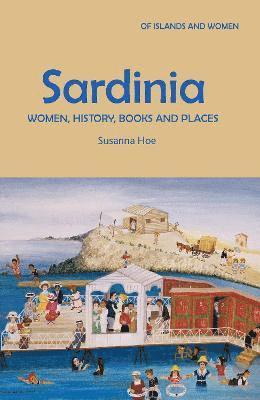
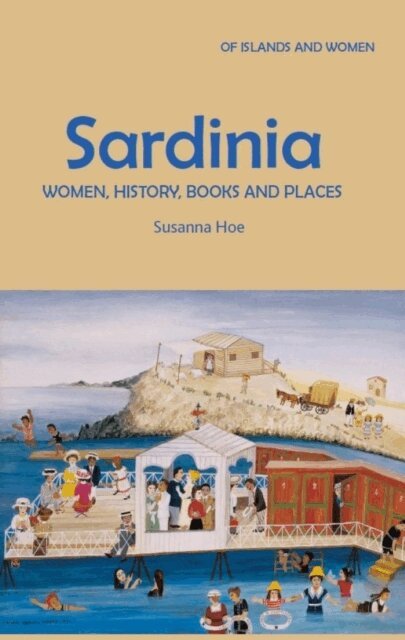
Marianna Bussalai, the poet and anti-Fascist activist of the Barbagia region, wrote that she felt humiliated at school 'wondering why, in the history of Italy, Sardinia was never mentioned. I deduced that Sardinia was not Italty and had to have a separate history'. It is not surprising that islands tend to be different from the country to which they are in some way attached. But Sardinia's personality differs even more from that of Italy than one might expect. This book explores that difference through the island's women.Sardinia has been inhabited for longer than many European countries; of its earlier peoples, the best-known are the pre-historic Nuraghic. The hundreds of tall and mysterious megalithic towers which still grace the landscape are the most outward distinctive remnants of their civilisation. But it is from the myriad and tantalising clay statuettes found in ritual wells that it is possible to suggest aspects of women's lives. These are now in archaeological museums, such as that of Cagliari; many of the wells still exist.There followed invasions, colonisations and settlements - often bringing women exiles or landowners - by phoenicians, Carthaginians, Romans, Muslims, Catalans, Genoese, Pisans, Spaniards and Savoyards, until finally the island became part of a united Italy, But, as the Swede Amelie Posse-Brazdova, sentenced to exile in Alghero during the First World War, was to write, 'For many centuries the Sardinians had been so fooled and exploited by the Italians, especially the Genoese merchants, that in the end they began to look upon them as their worst enemies.'However much that enmity is now little evident, Sardinia is still very much its own place, with its own languages. This is true of Alghero with its distinctive aura of Catalan occupation, of Marianna Bussalai's always intransigent Barbagia, and of Oristano where perhaps Sardinia's only well-known historical woman, Eleanora d'Arborea, ruled as Giudicessa in the fourteenth century. Although still particularly revered, she epitomised the strong and advanced women, from peasants to poitical activists, who emerge here from those often turbulent centuries.
247 kr
Skickas
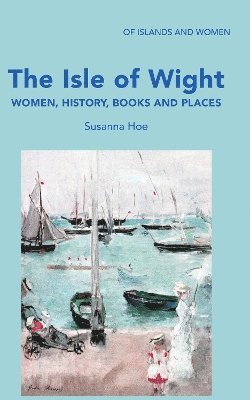
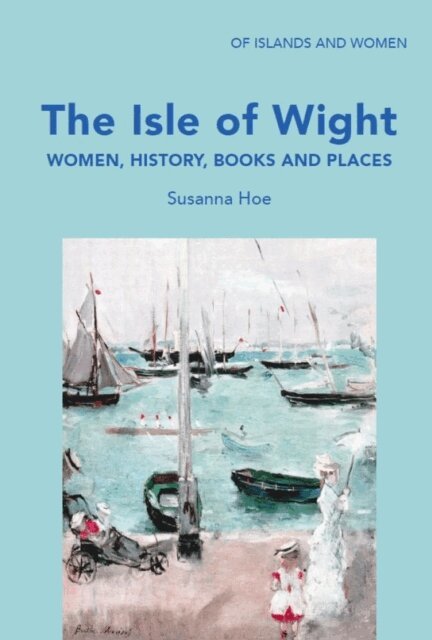
The Isle of Wight:Women, History, Books and Places does not contain a chapter about QueenVictoria and Osborne House, which are, perhaps, all some know about the Island. But somehow she sneaks into several chapters. Ifher daughter, Princess Beatrice, is known as her mother's companion, she may beless familiar as Governor of the Island, living in Carisbrooke Castle andresponsible for the foundation of the Carisbrooke Castle Museum, one of theIsland's jewels. She has her place in its history, as does her sister, artistand rebel Princess Louise. Given more space is Isabella de Fortibus, known as 'Ladyof the Isle'. She was the last Lord of the Island, ruling almost as a queenfrom Carisbrooke Castlein the 13th century, in defiance of the king the other side of the Solent. Before her was 9th century Queen Osburga, ofArreton Manor, mother of Alfred the Great. But the book is not only aboutroyalty, even though it includes visits from Russian, Austro- Hungarian, andFrench Empresses. The Island had earlierwithstood French invasions, following Romans who left their villas, two of themnow excavated and open to the public. The Island is sometimesknown as 'Dinosaur Isle', and that chapter begins the book, not so much aboutthe creatures, but those who hunted for, and found, their fossils. It has alsobeen called 'GhostIsland', and there areplenty of those, and of witches burnt at the stake, and smugglers - all aptlynamed 'Outsiders'. There is a chapter on 'Irregular Relations' which includes asmuggler who climbed her way to the top of French society via a royal Comte, andthe delightfully-named, fast-living, 16th century Dowsabel Mills, who also openeda girls school. Nuns and philanthropists find their place, as does a notable pioneerphotographer and a now recognised marine engineer, powerboat racers,aviatrixes, sailors, those campaigning for women's suffrage, and a spy or two,one of whom was nearly hanged. That is not to forget writers and artists suchas the French Impressionist Berthe Morisot. Her delicate and evocative watercolouris not only a memento of her 1875 Coweshoneymoon, but also adorns the book's cover.
370 kr
Tillfälligt slut
The First Opium War and the Taking of Hong Kong have tended to underpin relations between Britain and China. Here those events are described through the eyes of Britain's plenipotentiary Captain Charles Elliot and his wife Clara. Revelations about Elliot's role, intentions and analysis are important in clarifying the past. The couple's personal views and relations with each other also contribute to a fresh writing of history.
198 kr
Skickas inom 11-20 vardagar
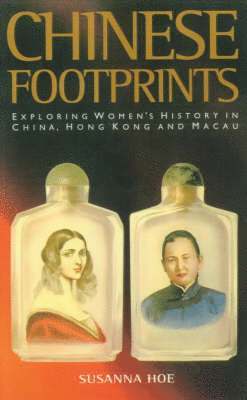
The writing of history used to concentrate on narrative, analysis or theory. The historian stayed out of sight. This book is part of a more recent trend. Here, Susanna Hoe discusses her relationship to her material, the processes of research and writing, and her characters. She does so by exploring and sometimes comparing, the lives of Chinese and western women who have lived in China, Hong Kong and Macau, and links them not only to herself but also to contemporary women's issues, human rights and colonialism. "Chinese Footprints" is about the practice of history. The approach and style make it both accessible and teachable. The characters include 1930's civil and women rights campaigners Shi Liang, China's Minister of Justice 1949 to 1959, Agnes Smedley and Stella Benson, autobiographical writer Xiao Hong, revolutionary Soong Ching Ling, traveller Ella Maillart, philanthropist Clara Ho Tung, and Clara Elliot, who was part of the story of Hong Kong's cession to Britain in 1841.