Suzanne Pinckney Stetkevych - Böcker
Visar alla böcker från författaren Suzanne Pinckney Stetkevych. Handla med fri frakt och snabb leverans.
10 produkter
10 produkter
Poetics of Islamic Legitimacy
Myth, Gender, and Ceremony in the Classical Arabic Ode
Häftad, Engelska, 2002
375 kr
Skickas inom 10-15 vardagar
" . . . transcends the realm of literature and poetic criticism to include virtually every field of Arabic and Islamic studies." —Roger AllenThroughout the classical Arabic literary tradition, from its roots in pre-Islamic Arabia until the end of the Golden Age in the 10th century, the courtly ode, or qasida, dominated other poetic forms. In The Poetics of Islamic Legitimacy, Suzanne Stetkevych explores how this poetry relates to ceremony and political authority and how the classical Arabic ode encoded and promoted a myth and ideology of legitimate Arabo-Islamic rule. Beginning with praise poems to pre-Islamic Arab kings, Stetkevych takes up poetry in praise of the Prophet Mohammed and odes addressed to Arabo-Islamic rulers. She explores the rich tradition of Arabic praise poems in light of ancient Near Eastern rites and ceremonies, gender, and political culture. Stetkevych's superb English translations capture the immediacy and vitality of classical Arabic poetry while opening up a multifaceted literary tradition for readers everywhere.
355 kr
Skickas inom 7-10 vardagar
Three of the most renowned praise poems to the Prophet, the mantle odes span the arc of Islamic history from Muhammad's lifetime, to the medieval Mamluk period, to the modern colonial era. Over the centuries, they have informed the poetic and religious life of the Arab and Islamic worlds. Suzanne Pinckney Stetkevych places her original translations of the poems within the odes' broader cultural context. By highlighting their transformative power as speech acts and their ritual function as gift exchanges, this book not only demonstrates the relevance of these poems to contemporary scholarship but also reveals their power and beauty to the modern reader.
375 kr
Skickas inom 10-15 vardagar
"Quite simply: these are seminal essays. . . . Distinguished scholarship, erudite, and full of innovative ways of interpreting Arabic and Persian poetry." —Omar Pound"[This book] reads Arabic and Persian poetry in a refreshingly new and significant way. . . . raises our understanding . . . to a new level." —James T. MonroeInnovative methodologies reorient critical readings of classical Middle Eastern literature.
3 818 kr
Skickas inom 10-15 vardagar
Comprised of contributions from leading international scholars, The Routledge Handbook of Arabic Poetry incorporates political, cultural, and theoretical paradigms that help place poetic projects in their socio-political contexts as well as illuminate connections across the continuum of the Arabic tradition. This volume grounds itself in the present moment and, from it, examines the transformations of the fifteen-century Arabic poetic tradition through readings, re-readings, translations, reformulations, and co-optations. Furthermore, this collection aims to deconstruct the artificial modern/pre-modern divide and to present the Arabic poetic practice as live and urgent, shaped by the experiences and challenges of the twenty-first century and at the same time in constant conversation with its long tradition. The Routledge Handbook of Arabic Poetry actively seeks to destabilize binaries such as that of East-West in contributions that shed light on the interactions of the Arabic tradition with other Middle Eastern traditions, such as Persian, Turkish, and Hebrew, and on South-South ideological and poetic networks of solidarity that have informed poetic currents across the modern Middle East. This volume will be ideal for scholars and students of Arabic, Middle Eastern, and comparative literature, as well as non-specialists interested in poetry and in the present moment of the study of Arabic poetry.
801 kr
Skickas inom 10-15 vardagar
Comprised of contributions from leading international scholars, The Routledge Handbook of Arabic Poetry incorporates political, cultural, and theoretical paradigms that help place poetic projects in their socio-political contexts as well as illuminate connections across the continuum of the Arabic tradition. This volume grounds itself in the present moment and, from it, examines the transformations of the fifteen-century Arabic poetic tradition through readings, re-readings, translations, reformulations, and co-optations. Furthermore, this collection aims to deconstruct the artificial modern/pre-modern divide and to present the Arabic poetic practice as live and urgent, shaped by the experiences and challenges of the twenty-first century and at the same time in constant conversation with its long tradition. The Routledge Handbook of Arabic Poetry actively seeks to destabilize binaries such as that of East-West in contributions that shed light on the interactions of the Arabic tradition with other Middle Eastern traditions, such as Persian, Turkish, and Hebrew, and on South-South ideological and poetic networks of solidarity that have informed poetic currents across the modern Middle East. This volume will be ideal for scholars and students of Arabic, Middle Eastern, and comparative literature, as well as non-specialists interested in poetry and in the present moment of the study of Arabic poetry.
773 kr
Skickas inom 10-15 vardagar
A body of Bedouin oral poetry which was collected in the second or third Islamic century, the pre-Islamic qasidah, or ode, stands with the Qur'an as a twin foundation of Arabo-Islamic literary culture. Throughout the rich fifteen-hundred-year history of classical Arabic literature, the qasidah served as profane anti-text to the sacred text of the Qur'an. While recognizing the esteem in which Arabs have traditionally held this poetry of the pagan past, modern critics in both East and West have yet to formulate a poetics that would provide the means to analyze and evaluate the qasidah. Suzanne Pinckney Stetkevych here offers the first aesthetics appropriate for this orally composed Arabic verse, an aesthetics that is built on—and tested on—close readings of a number of the poems.Drawing on the insights of contemporary literary theory, anthropology, and the history of religions, Stetkevych maintains that the poetry of the qasidah is ritualized in both form and function. She brings to bear an extensive body of lore, legend, and myth as she interprets individual themes and images with references to rites of passage and rituals of sacrifice. Her English translations of the poems under discussion convey the power and beauty of the originals, as well as a sense of their complex intertextuality and distinctive lexicon.The Mute Immortals Speak will be important for students and scholars in the fields of Middle Eastern literatures, Islamic studies, folklore, oral literature, and literary theory, and by anthropologists, comparatists, historians of religion, and medievalists.
544 kr
Skickas inom 10-15 vardagar
A body of Bedouin oral poetry which was collected in the second or third Islamic century, the pre-Islamic qasidah, or ode, stands with the Qur'an as a twin foundation of Arabo-Islamic literary culture. Throughout the rich fifteen-hundred-year history of classical Arabic literature, the qasidah served as profane anti-text to the sacred text of the Qur'an. While recognizing the esteem in which Arabs have traditionally held this poetry of the pagan past, modern critics in both East and West have yet to formulate a poetics that would provide the means to analyze and evaluate the qasidah. Suzanne Pinckney Stetkevych here offers the first aesthetics appropriate for this orally composed Arabic verse, an aesthetics that is built on—and tested on—close readings of a number of the poems.Drawing on the insights of contemporary literary theory, anthropology, and the history of religions, Stetkevych maintains that the poetry of the qasidah is ritualized in both form and function. She brings to bear an extensive body of lore, legend, and myth as she interprets individual themes and images with references to rites of passage and rituals of sacrifice. Her English translations of the poems under discussion convey the power and beauty of the originals, as well as a sense of their complex intertextuality and distinctive lexicon.The Mute Immortals Speak will be important for students and scholars in the fields of Middle Eastern literatures, Islamic studies, folklore, oral literature, and literary theory, and by anthropologists, comparatists, historians of religion, and medievalists.
4 265 kr
Skickas inom 7-10 vardagar
This volume brings together a set of key studies on classical Arabic poetry (ca. 500-1000 C.E.), published over the last thirty-five years; the individual articles each deal with a different approach, period, genre, or theme. The major focus is on new interpretations of the form and function of the pre-eminent classical poetic genre, the polythematic qasida, or Arabic ode, particularly explorations of its ritual, ceremonial and performance dimensions. Other articles present the typology and genre characteristics of the short monothematic forms, especially the lyrical ghazal and the wine-poem. After thus setting out the full poetic genres and their structures, the volume turns in the remaining studies to the philological, rhetorical, stylistic and motival elements of classical Arabic poetry, in their etymological, symbolic, historical and comparatist dimensions. Suzanne Pinckney Stetkevych's Introduction places the articles within the context of the major critical and methodological trajectories of the field and in doing so demonstrates the increasing integration of Arabic literary studies into contemporary humanistic scholarship. The Selected Bibliography complements the Introduction and the Articles to offer the reader a full overview of the past generation of Western literary and critical scholarship on classical Arabic poetry.
947 kr
Skickas inom 5-8 vardagar
Foremost among the poetic accomplishments of the ʿAbbāsid age was the sudden flowering of a highly rhetorical and strikingly modern style of poetry, termed "badīʿ." It found its most radical and controversial exponent in the celebrated panegyrist to the courts of al-Maʾmūn and al-Muʿtaṣim, Abū Tammām Ḥabīb ibn Aws al-Ṭāʾī.The present study offers a reevaluation of the Arabic literary dispute over Abū Tammām and badīʿ. It then proposes a redefinition of his diwan and of his major anthology, the Ḥamāsah, as a metapoesis that served to decode the poetic tradition of the pre-Islamic desert for the Islamic ʿAbbāsid caliph and his urbane and urban courtiers and subjects, and conversely, to encode contemporary Arab-Islamic political experiences in classical form.This book is extensively illustrated with original translations.
423 kr
Skickas
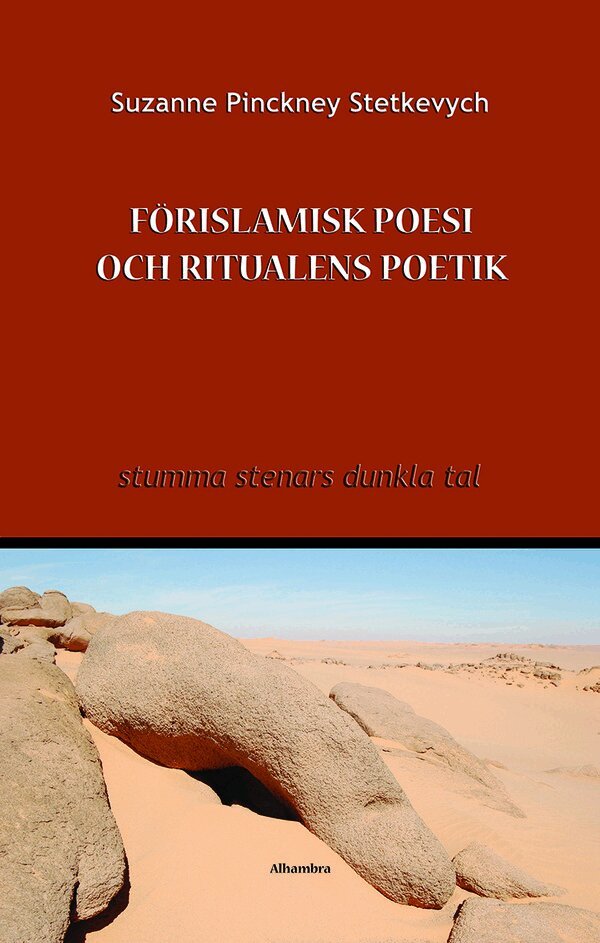
Som ett exempel på muntlig, beduinsk poesi, nedtecknad och hopsamlad under det andra och tredje islamiska århundradet, utgör det förislamiska odet tillsammans med Koranen tvillingfundamentet till den arabisk-islamiska litterära kulturen. Genom den lödiga, femtonhundra år långa historien av klassisk arabisk litteratur, tjänade qasídan (odet) som en profan motsvarighet till Koranens heliga text. Det återstår dock att formulera en poetik som hjälper oss att analysera och värdera dessa dikter. Suzanne Pinckney Stetkevych presenterar här en första estetik för den muntliga poesin i allmänhet och för den förislamiska i synnerhet. Hennes forskning bygger på en närläsning av en omfattande diktkorpus som omfattar flera genrer, från odet till stråtrövardiktningen och kvinnoelegier. Förislamisk poesi och ritualens poetik utforskar samspelet mellan myt och ritual i traditionella samhällens poesi. Genom att kombinera olika betraktelsesätt, hämtade från antropologi och litteraturvetenskap, undersöker författaren en av de svåraste och mest fängslande genrerna i den arabiska litteraturen. Författarens tillämpning av olika tolkningsteorier på detta område har gjort det möjligt för både specialister och icke-specialister att sätta sig in i den arabiska diktningens mytiska dimension – en dimension som i stor utsträckning förbisetts i tidigare lärda arbeten. Och vad mera är, författaren lyckas påvisa betydelsen av den arabiska qasída-traditionen för komparativ forskning om lyrikens natur. Boken innehåller dessutom 550 förislamiska verser ur ett trettiotal dikter i översättning, varav två är de mest kända odena, av Labíd och Imru’ al-Qays. Suzanne Pinckney Stetkevych är professor i Mellanösterns språk och komparativ litteraturvetenskap vid Indiana University i USA. Hon har publicerat bl.a. “The Mantle Odes: Arabic Praise Poems to the Prophet Muhammad”, “The Poetics of Islamic Legitimacy: Myth, Gender and Ceremony in the Classical Arabic Ode” och “Early Islamic Poetry and Poetics: The Formation of the Classical Islamic World”.