Sven A. Brueckner - Böcker
Visar alla böcker från författaren Sven A. Brueckner. Handla med fri frakt och snabb leverans.
3 produkter
3 produkter
554 kr
Skickas inom 10-15 vardagar
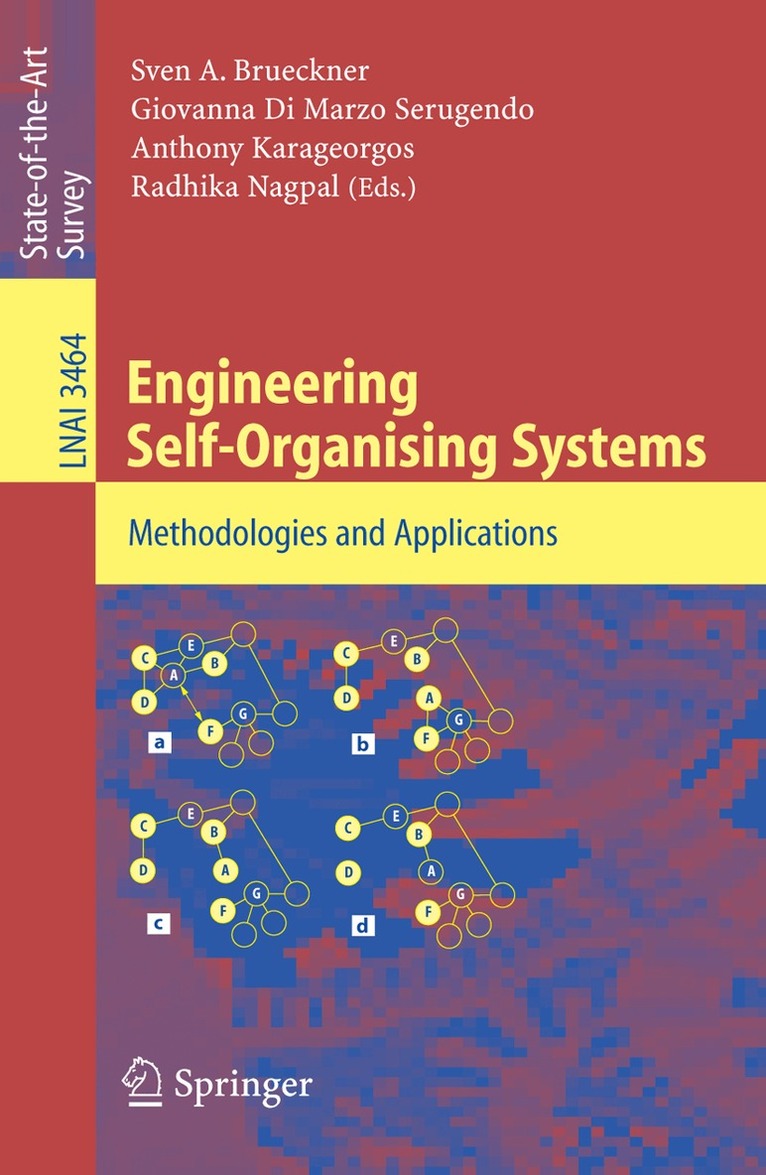
Self-organisation, self-regulation, self-repair, and self-maintenance are promising conceptual approaches to deal with the ever increasing complexity of distributed interacting software and information handling systems. Self-organising applications are able to dynamically change their functionality and structure without direct user intervention to respond to changes in requirements and the environment. This book comprises revised and extended papers presented at the International Workshop on Engineering Self-Organising Applications, ESOA 2004, held in New York, NY, USA in July 2004 at AAMAS as well as invited papers from leading researchers. The papers are organized in topical sections on state of the art, synthesis and design methods, self-assembly and robots, stigmergy and related topics, and industrial applications.
Engineering Self-Organising Systems
Third International Workshop, ESOA 2005, Utrecht, The Netherlands, July 25, 2005, Revised Selected Papers
Häftad, Engelska, 2006
554 kr
Skickas inom 10-15 vardagar
The idea that self-organisation and emergence can be harnessed for the purpose of solving tricky engineering problems is becoming increasingly accepted. - searchers working in many diverse ?elds (such as networks, distributed systems, operating systems and agent systems) are beginning to apply this new approach. This book contains recent work from a broad range of areas with the common theme of utilising self-organisation productively. As distributed information infrastructures continue to spread (such as the Internet, wireless and mobile systems), new challenges have arisen demanding robust and scalable solutions. In these new challenging environments the - signers and engineers of global applications and services can seldom rely on centralised control or management, high reliability of devices, or secure en- ronments. At the other end of the scale, ad-hoc sensor networks and ubiquitous computing devices are making it possible to embed millions of smart computing agents into the local environment. Here too systems need to adapt to constant failures and replacement of agents and changes in the environment, without human intervention or centralised management.
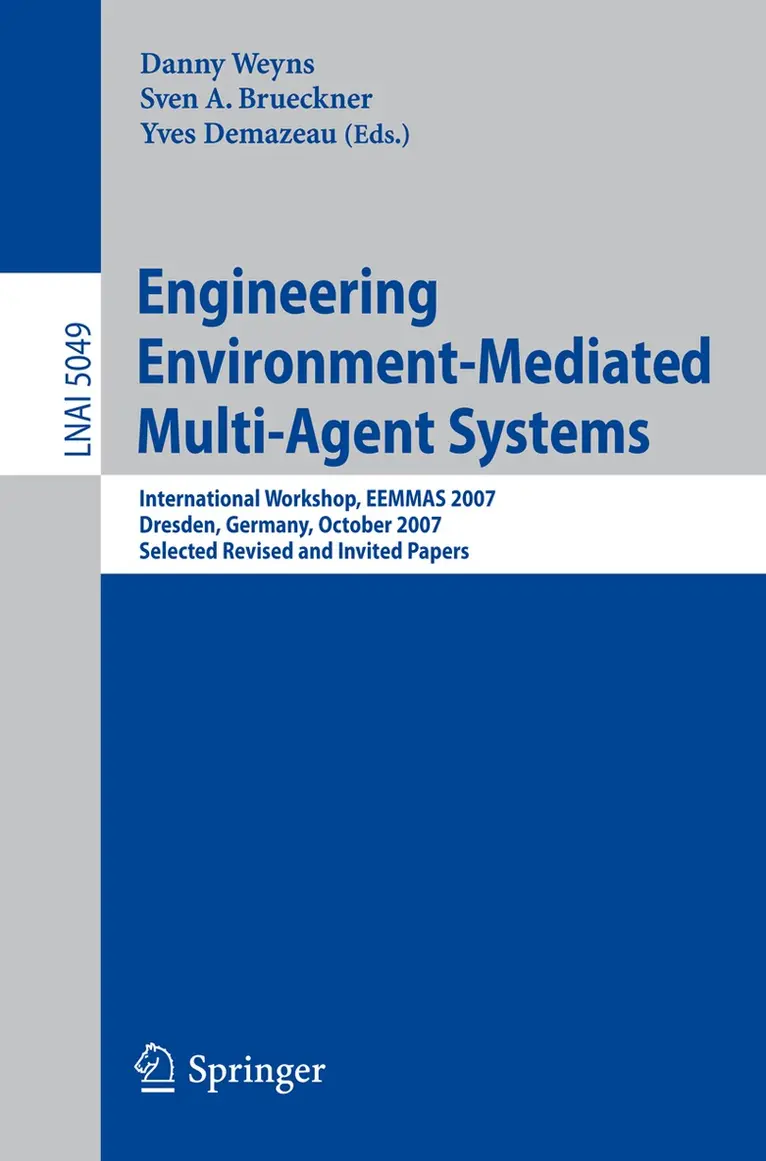
Engineering Environment-Mediated Multi-Agent Systems
International Workshop, EEMMAS 2007, Dresden, Germany, October 5, 2007, Selected Revised and Invited Papers
Häftad, Engelska, 2008
554 kr
Skickas inom 10-15 vardagar
Software intensive systems are increasingly expected to deal with changing user needs and dynamic operating conditions at run time. Examples are the need for life recon?gurations, management of resource variability, and dealing with p- ticular failure modes. Endowing systems with these kinds of capabilities poses severe challenges to software engineers and necessitates the development of new techniques, practices, and tools that build upon sound engineering principles. The ?eld of multi-agent systems focuses on the foundations and engineering of systems that consists of a network of autonomous entities (agents) that int- act to achieve the system goals. One line of research in multi-agent systems, inspired by biological, physical and other naturally occurring systems, concerns multi-agent systems in which agents share information and coordinate their - havior througha shared medium called an agentenvironment. Typical examples are gradient ?elds and digital pheromones that guide agents in their local c- text and as such facilitate the coordination of a community of agents. Since environment-mediation in multi-agent systems has shown to result in mana- able solutions with very adaptable qualities, it is a promising paradigm to deal with the increasing complexity and dynamism of distributed applications. Control in environment-mediated multi-agent systems is decentralized, i. e. , noneofthecomponentshasfullaccessorcontroloverthesystem. Self-organization isanapproachtoengineerdecentralized,distributedandresource-limitedsystems thatarecapableofdynamicallyadaptingtochangingconditionsandrequirements without external intervention. This useful system property is often re?ected in functionssuchasself-con?guration,self-optimization,andself-healing. Engine- ing approachesto self-organizing systems often rely on global functionality to emerge from localand autonomous decisions of individual agents that commu- catethroughasharedagentenvironment.