SWATI CHATTOPADHYAY - Böcker
Visar alla böcker från författaren SWATI CHATTOPADHYAY. Handla med fri frakt och snabb leverans.
9 produkter
9 produkter
583 kr
Skickas inom 11-20 vardagar
Modernity Nationalism and the Colonial Uncanny. This major new postcolonial study addresses the questions of modernity and space that haunt our perception of Calcutta. It explores the politics of representation and the cultural changes that occurred in the city as its residents negotiated the idea of being modern.
2 150 kr
Skickas inom 10-15 vardagar
Representing Calcutta is a spatial history of the colonial city, and addresses the question of modernity that haunts our perception of Calcutta. The book responds to two inter-related concerns about the city. First is the image of Calcutta as the worst case scenario of a Third World city -- the proverbial 'city of dreadful nights.' Second is the changing nature of the city’s public spaces -- the demise of certain forms of urban sociality that has been mourned in recent literature as the passing of Bengali modernity. By examining architecture, city plans, paintings, literature, and official reports through the lens of postcolonial, feminist, and spatial theory, the book explores the conditions of colonialism and anti-colonial nationalism that produced the city as a modern artefact. At the centre of this exploration resides the problem of 'representing' the city, representation understood as description and narration, as well as political representation. In doing so, Chattopadhyay questions the very idea of colonial cities as creations of the colonizers, and the model of colonial cities as dual cities, split in black and white areas, in favour of a more complicated view of the topography.
691 kr
Skickas inom 10-15 vardagar
Representing Calcutta: Modernity, Nationalism, and the Colonial Uncanny is a spatial history of colonial Calcutta, addressing the question of modernity that haunts our perception of Calcutta. The book responds to two interrelated concerns about the city. The first is the image of Calcutta as the worst case scenario of a Third World city - the proverbial "city of dreadful nights." The second is the changing nature of the city’s public spaces - the demise of certain forms of urban sociality that have been mourned in recent literature as the passing of Bengali modernity. This book explores the history of the city, focusing in particular on its emergence from colonialism into postcolonial modernity. Drawing on postcolonial and spatial theory, the author analyzes the city under British colonial rule and in its later incarnations, and also examines such issues as gender, identity, and nationalism. It is a an essential text for scholars with an interest in colonialism, South Asia, and urban development.
City Halls and Civic Materialism
Towards a Global History of Urban Public Space
Inbunden, Engelska, 2014
2 150 kr
Skickas inom 10-15 vardagar
The town hall or city hall as a place of local governance is historically related to the founding of cities in medieval Europe. As the space of representative civic authority it aimed to set the terms of public space and engagement with the citizenry. In subsequent centuries, as the idea and built form travelled beyond Europe to become an established institution across the globe, the parameters of civic representation changed and the town hall was forced to negotiate new notions of urbanism and public space. City Halls and Civic Materialism: Towards a Global History of Urban Public Space utilizes the town hall in its global historical incarnations as bases to probe these changing ideas of urban public space. The essays in this volume provide an analysis of the architecture, iconography, and spatial relations that constitute the town hall to explore its historical ability to accommodate the "public" in different political and social contexts, in Europe, Asia, Australia, Africa and the Americas, as the relation between citizens and civic authority had to be revisited with the universal franchise, under fascism, after the devastation of the world wars, decolonization, and most recently, with the neo-liberal restructuring of cities.As a global phenomenon, the town hall challenges the idea that nationalism, imperialism, democracy, the idea of citizenship – concepts that frame the relation between the individual and the body politic -- travel the globe in modular forms, or in predictable trajectories from the West to East, North to South. Collectively the essays argue that if the town hall has historically been connected with the articulation of bourgeois civil society, then the town hall as a global spatial type -- architectural space, urban monument, and space of governance -- holds a mirror to the promise and limits of civil society.
305 kr
Skickas inom 11-20 vardagar
Cities are more than concrete and steel infrastructure. But modern urban theory does not have the language to describe and debate the vital component of urban life that is lived on the streets of cities and towns. Swati Chattopadhyay has written a nuanced argument for a new vocabulary of the city in Unlearning the City, proposing a way of analyzing the materiality of the urban that captures the ever-changing element of human experience.Urban life is intrinsically messy and usually refuses to conform to the rigid views laid down in much of urban studies theory. Chattopadhyay looks at urban life in India with a fresh perspective that incorporates the everyday and the unstructured. As the first to apply the theories of subalternity for an understanding of urban history, Chattopadhyay provides an in-depth study of vehicular art, street cricket, political wall writing, and religious festivities that link the visual and spatial attributes of these popular cultural forms with the imagination and practices of urban life. She contends that these practices have a direct impact on the configuration and knowledge of public space, and the political potential of the people inhabiting cities.Unlearning the City uses the popular culture of Indian cities to question the dominant conception of urban infrastructure and encourage a conceptual realignment in how the city is seen, discussed, and even experienced.
691 kr
Skickas inom 10-15 vardagar
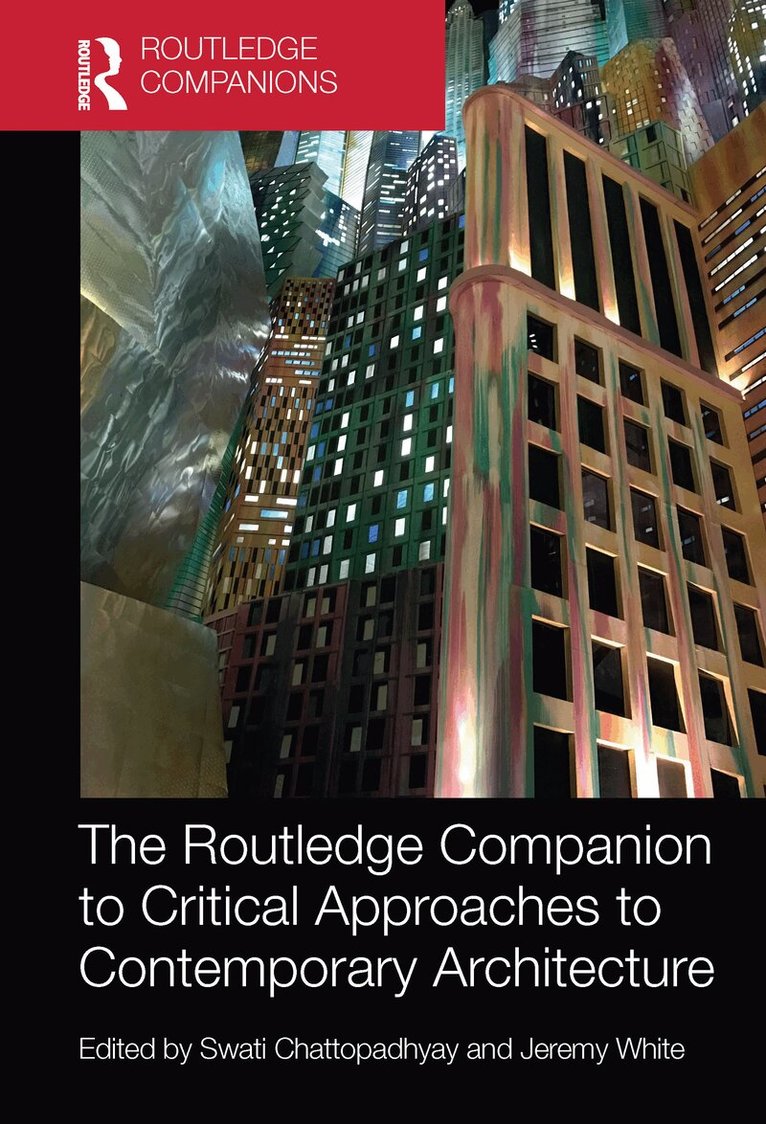
The Routledge Companion to Critical Approaches to Contemporary Architecture convenes a wide array of critical voices from architecture, art history, urbanism, geography, anthropology, media and performance studies, computer science, bio-engineering, environmental studies, and sociology that help us understand the meaning and significance of global architecture of the twenty-first century. New chapters by 36 contributors illustrated with over 140 black-and-white images are assembled in six parts concerning both real and virtual spaces: design, materiality, alterity, technologies, cityscapes, and practice.
3 256 kr
Skickas inom 10-15 vardagar
The Routledge Companion to Critical Approaches to Contemporary Architecture convenes a wide array of critical voices from architecture, art history, urbanism, geography, anthropology, media and performance studies, computer science, bio-engineering, environmental studies, and sociology that help us understand the meaning and significance of global architecture of the twenty-first century. New chapters by 36 contributors illustrated with over 140 black-and-white images are assembled in six parts concerning both real and virtual spaces: design, materiality, alterity, technologies, cityscapes, and practice.
359 kr
Skickas inom 7-10 vardagar
WINNER Alice Davis Hitchcock Book Award 2025, Society of Architectural HistoriansWINNER Historians of British Art Book Award 2025 for Exemplary Scholarship on the Period between 1800-1960Small Spaces recasts the history of the British empire by focusing on the small spaces that made the empire possible. It takes as its subject a series of small architectural spaces, objects, and landscapes and uses them to narrate the untold stories of the marginalized people—the servants, women, children, subalterns, and racialized minorities—who held up the infrastructure of empire. In so doing it opens up an important new approach to architectural history: an invitation to shift our attention from the large to the small scale.Taking the British empire in India as its primary focus, this book presents eighteen short, readable chapters to explore an array of overlooked places and spaces. From cook rooms and slave quarters to outhouses, go-downs, and medicine cupboards, each chapter reveals how and why these kinds of minor spaces are so important to understanding colonialism. With the focus of history so often on the large scale - global trade networks, vast regions, and architectures of power and domination - Small Spaces shows instead how we need to rethink this aura of magnitude so that our reading is not beholden such imperialist optics. With chapters which can be read separately as individual accounts of objects, spaces, and buildings, and introductions showing how this critical methodology can challenge the methods and theories of urban and architectural history, Small Spaces is a must-read for anyone wishing to decolonize disciplinary practices in the field of architectural, urban, and colonial history. Altogether, it provides a paradigm-breaking account of how to ‘unlearn empire’, whether in British India or elsewhere.
1 090 kr
Skickas inom 7-10 vardagar
WINNER Alice Davis Hitchcock Book Award 2025, Society of Architectural HistoriansWINNER Historians of British Art Book Award 2025 for Exemplary Scholarship on the Period between 1800-1960Small Spaces recasts the history of the British empire by focusing on the small spaces that made the empire possible. It takes as its subject a series of small architectural spaces, objects, and landscapes and uses them to narrate the untold stories of the marginalized people—the servants, women, children, subalterns, and racialized minorities—who held up the infrastructure of empire. In so doing it opens up an important new approach to architectural history: an invitation to shift our attention from the large to the small scale.Taking the British empire in India as its primary focus, this book presents eighteen short, readable chapters to explore an array of overlooked places and spaces. From cook rooms and slave quarters to outhouses, go-downs, and medicine cupboards, each chapter reveals how and why these kinds of minor spaces are so important to understanding colonialism. With the focus of history so often on the large scale - global trade networks, vast regions, and architectures of power and domination - Small Spaces shows instead how we need to rethink this aura of magnitude so that our reading is not beholden such imperialist optics. With chapters which can be read separately as individual accounts of objects, spaces, and buildings, and introductions showing how this critical methodology can challenge the methods and theories of urban and architectural history, Small Spaces is a must-read for anyone wishing to decolonize disciplinary practices in the field of architectural, urban, and colonial history. Altogether, it provides a paradigm-breaking account of how to ‘unlearn empire’, whether in British India or elsewhere.