Sylvia Sztern - Böcker
Visar alla böcker från författaren Sylvia Sztern. Handla med fri frakt och snabb leverans.
3 produkter
3 produkter
Russia on the Move
Railroads and the Exodus from Compulsory Collectivism, 1861–1914
Inbunden, Engelska, 2022
1 202 kr
Skickas inom 10-15 vardagar
This book explores the impact of railroads on 19thcentury Russian peasant collectivism. The mutual-insurance mechanism in a precarious agricultural environment, provided bya structured communal-village system predicated on the reputation and authorityof community norms,is exposed to rationalist exchange—occasioning an institutional adaptation process:the individualization of property rights in land. Spatial-mobility technology animated market integration, specialization, literacy,and human-capital acquisition among peasant wage workers who commuted from their villages.Temporarily rising transaction costs forced the Tsar to concede household property rights in land in the so-called Stolypin reform of 1906.This challenge to the imperial patrimony, powered by the railroads, steered late imperial Russia toward constitutional governance.The spatial-mobility technology gave peasants access to centers of agglomeration of knowledge, changedcognitive perceptions of distance, and reduced the uncertainty and opportunity costs of travel. The empirical findings in this monograph corroborate the conclusion that the railroads occasioned a cultural revolution in late imperial Russia and made Stalin unnecessary for the modernization of the Euro-asian giant.This book highlights the profound effect that the development of the railroads had on Russian economic and political institutions and practices. It will be of indispensable valueto students and researchers interested in transitional economics and economic history.
Russia on the Move
Railroads and the Exodus from Compulsory Collectivism, 1861–1914
Häftad, Engelska, 2023
1 202 kr
Skickas inom 10-15 vardagar
This book explores the impact of railroads on 19thcentury Russian peasant collectivism. The mutual-insurance mechanism in a precarious agricultural environment, provided bya structured communal-village system predicated on the reputation and authorityof community norms,is exposed to rationalist exchange—occasioning an institutional adaptation process:the individualization of property rights in land. Spatial-mobility technology animated market integration, specialization, literacy,and human-capital acquisition among peasant wage workers who commuted from their villages.Temporarily rising transaction costs forced the Tsar to concede household property rights in land in the so-called Stolypin reform of 1906.This challenge to the imperial patrimony, powered by the railroads, steered late imperial Russia toward constitutional governance.The spatial-mobility technology gave peasants access to centers of agglomeration of knowledge, changedcognitive perceptions of distance, and reduced the uncertainty and opportunity costs of travel. The empirical findings in this monograph corroborate the conclusion that the railroads occasioned a cultural revolution in late imperial Russia and made Stalin unnecessary for the modernization of the Euro-asian giant.This book highlights the profound effect that the development of the railroads had on Russian economic and political institutions and practices. It will be of indispensable valueto students and researchers interested in transitional economics and economic history.
472 kr
Skickas inom 5-8 vardagar
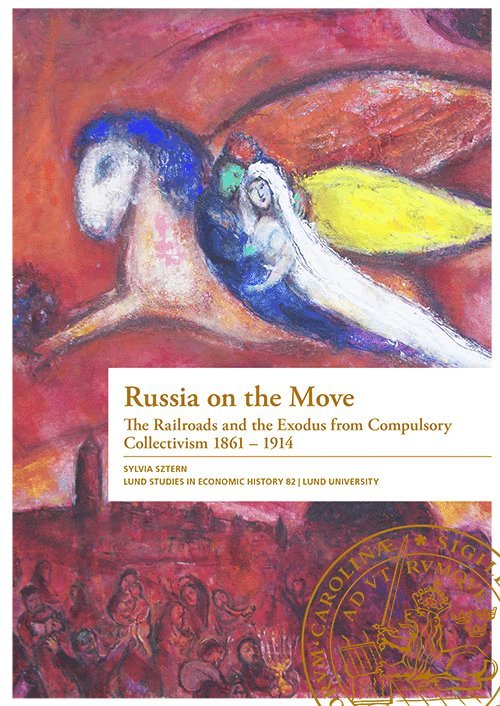
Western scholars of Tsarist Russia emphasize the continuity of collectivism on the Russian plain. Numerous endogenous factors explain the human clustering that occurred as kinship structures evolved into territorial agrarian communal patterns. In my dissertation, combining the Westernizers’ and the Slavophiles’ conceptualization of the mir—the village commune—it is argued that precarious climatic conditions, uncertain yields, and the high frequency of famines and other calamities caused peasant mutual-insurance strategies to take shape, resulting in krugovaya poruka (mutual responsibility). Tsarist rulers exploited this practice to enhance tax extraction, impose social control, and reduce surveillance costs. The ensuing degradation of labor explains Tsarist Russia’s perennial status as a technology importer and a debtor. The Imperial rulers’ territorial aspirations that entailed the strategic import of railroads, however, incentivized the peasantry to accumulate literacy and other skills that, by investing them with growing subversive and bargaining power, compelled modernizing reforms. By inducing a culturally revolutionizing reduction of temporal-cognitive distances, the railroads linked the peasants of European Russia to urban industrial economies and to customary (volost) and formal Imperial court systems, cumulatively reducing the costs of property and individual-dignity lawsuits while increasing the predictability of outcomes favorable to them. The railroads also dramatically mitigated the uncertainties and mortal perils of peasant life while introducing peasants to a plethora of institutions allowing rational choice, specialization, and, from 1903 onward, gradual delegation of property rights by the rulers. Challenging Gerschenkron, I posit that the nature of collectivism changed after the emancipation. The iron arms of the Tsarist state—the railroads that steered peasants to seasonal wage labor as well as permanent migration—paved the way to a modernizing transition from authoritarian obedience to rational utility maximization. The compulsory collectivism of the serfdom era gave way to rationalist cooperation and individualism. The delegation of household-head property rights in land, catalyzed by the railroads and codified in Stolypin’s reform, portended Russia’s transition to a constitutional monarchy. As an epilogue, the empirical and concluding chapter of the dissertation reveals a positive correlation between a commune’s distance from the nearest railroad stations and the proportion of peasant land cultivated in the traditional collectivist repartitioning manner of the obshchina, and a negative correlation between distance from the railroad and the proportion of individualistic modes of land cultivation. This empirical chapter, co-authored by my advisor, Professor Michael Keren, suggests that the modernization of Russia was occasioned by the railroads and occurred three decades before the advent of Stalinism.