T. E. Rihll - Böcker
Visar alla böcker från författaren T. E. Rihll. Handla med fri frakt och snabb leverans.
2 produkter
2 produkter
3 556 kr
Skickas inom 7-10 vardagar
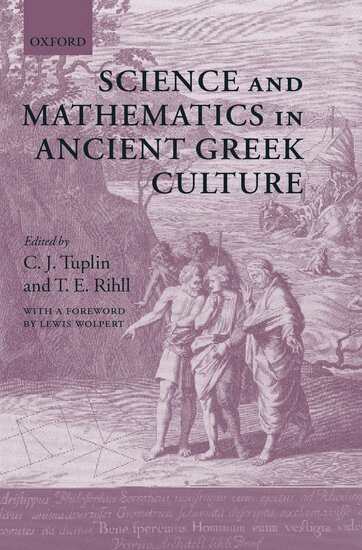
Ancient Greece was the birthplace of science, which developed in the Hellenized culture of ancient Rome. This volume locates science within ancient Greek society and culture, investigates its impact upon that society, and identifies it as a cultural phenomenon deserving no less attention than literary or artistic creativity.Chapters by seventeen international experts examine the role and achievement of science and mathematics in Greek antiquity through discussion of the linguistic, literary, political, religious, sociological, and technological factors which influenced scientific thought and practice. Greek science was both motivated and constrained by wholly 'unscientific' cultural interests, and by ideas and biases arising from the language and the paradigms of the day. For example, it is here argued that the prediction of eclipses was not a concern of ancient astronomers until after 'non-scientific' authors such as the historian Livy, elaborating on a good story with a moral, suggested that it should be.Familiar classical authors, such as Homer, Polybius, Cicero, and Pliny are here seen in a new light. Less-studied classical authors, such as Euclid, Hero, Galen, and Ptolemy, are also considered, and attention is drawn to areas where there is potential for new research and where editions and translations are still needed.
280 kr
Skickas inom 7-10 vardagar
Greek Science, first published in 1999, is written for scientists, classicists, historians of science, and anyone with an interest in the beginnings of science. It surveys the range and scope of ancient work on topics now called science, at a lively pace and with colourful examples. It encompasses ancient empirical studies as well as theoretical works, the life sciences and the exact sciences, and is written by one of the foremost authorities on ancient science and technology. No knowledge of Greek, Latin, or ancient history is assumed.