T. Kariya - Böcker
Visar alla böcker från författaren T. Kariya. Handla med fri frakt och snabb leverans.
3 produkter
3 produkter
1 096 kr
Skickas inom 10-15 vardagar
The theory of asset pricing has grown markedly more sophisticated since the early 1980s, with the application of powerful mathematical tools such as probability theory, stochastic processes and numerical analysis. The main goal of this text is to provide a systematic exposition, with practical applications, of the no-arbitrage theory for asset pricing in financial engineering in the framework of a discrete time approach. Useful as a textbook on financial asset pricing, the book should also appeal to practitioners in financial and related industries, as well as to students in MBA or graduate/advanced undergraduate programs in finance, financial engineering, financial econometrics, or financial information science.
1 096 kr
Skickas inom 10-15 vardagar
1. Main Goals The theory of asset pricing has grown markedly more sophisticated in the last two decades, with the application of powerful mathematical tools such as probability theory, stochastic processes and numerical analysis. The main goal of this book is to provide a systematic exposition, with practical appli cations, of the no-arbitrage theory for asset pricing in financial engineering in the framework of a discrete time approach. The book should also serve well as a textbook on financial asset pricing. It should be accessible to a broad audi ence, in particular to practitioners in financial and related industries, as well as to students in MBA or graduate/advanced undergraduate programs in finance, financial engineering, financial econometrics, or financial information science. The no-arbitrage asset pricing theory is based on the simple and well ac cepted principle that financial asset prices are instantly adjusted at each mo ment in time in order not to allow an arbitrage opportunity. Here an arbitrage opportunity is an opportunity to have a portfolio of value aat an initial time lead to a positive terminal value with probability 1 (equivalently, at no risk), with money neither added nor subtracted from the portfolio in rebalancing dur ing the investment period. It is necessary for a portfolio of valueato include a short-sell position as well as a long-buy position of some assets.
Del 23 - Theory and Decision Library B
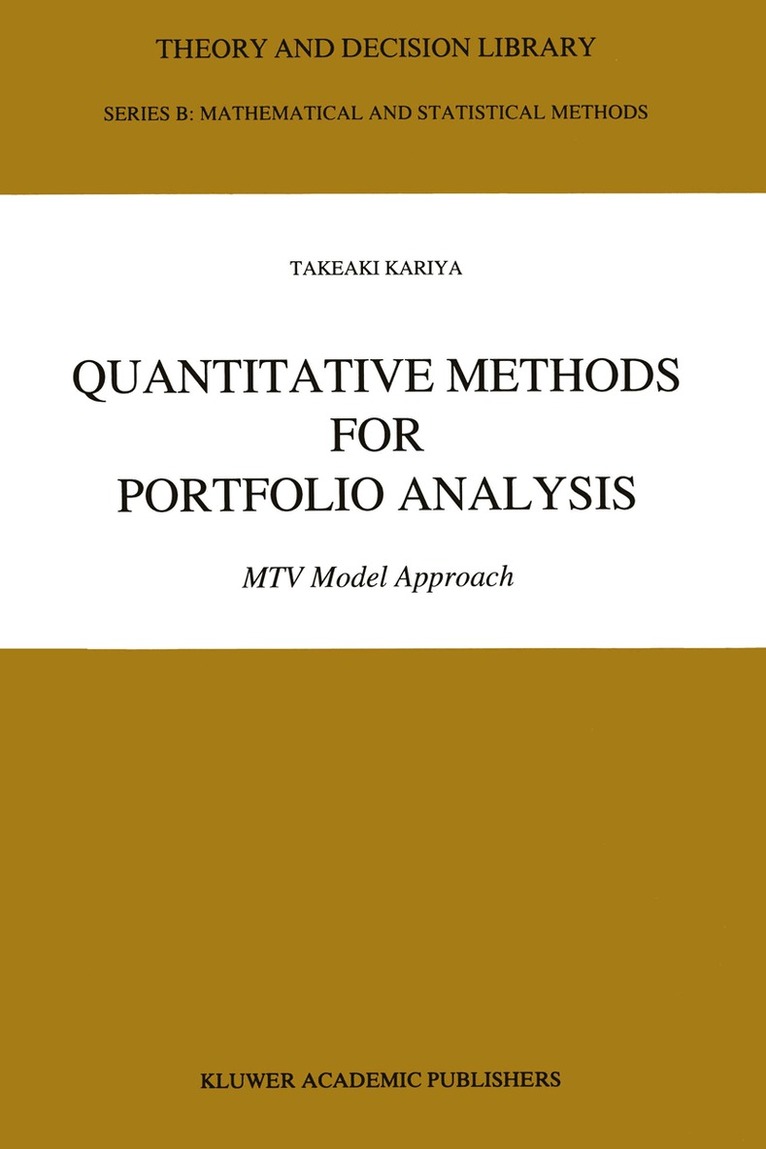
Quantitative Methods for Portfolio Analysis
MTV Model Approach
Häftad, Engelska, 2012
536 kr
Skickas inom 10-15 vardagar
Quantitative Methods for Portfolio Analysis provides practical models and methods for the quantitative analysis of financial asset prices, construction of various portfolios, and computer-assisted trading systems. In particular, this book is required reading for:(1) `Quants' (quantitatively-inclined analysts) in financial industries;(2) financial engineers in investment banks, securities companies, derivative-trading companies, software houses, etc., who are developing portfolio trading systems;(3) graduate students and specialists in the areas of finance, business, economics, statistics, financial engineering; and(4) investors who are interested in Japanese financial markets.Throughout the book the emphasis is placed on the originality and usefulness of models and methods for the construction of portfolios and investment decision making, and examples are provided to demonstrate, with practical analysis, models for Japanese financial markets.