Tadeusz M. Peryt – författare
Visar alla böcker från författaren Tadeusz M. Peryt. Handla med fri frakt och snabb leverans.
6 produkter
Zechstein Facies in Europe
Häftad, 1987
1098 kr
Lägg i varukorg
This book reports new developments in research on the Zechstein basin which is one of the classical saline giants. Recently much information was gathered which changes earlier ideas on the deposition and diagenesis of the Zechstein basin.
Evaporite Basins
Häftad, 1987
552 kr
Lägg i varukorg
Characteristic examples of evaporite basins, mostly of moderate size, are discussed in terms of type (playas, continental sabkhas, barred basins), deposits, fossils, relics and pseudomorphs of gypsum found, and complex of diagenesis, e.g. in the Red Sea Miocene where reef complexes predate the …
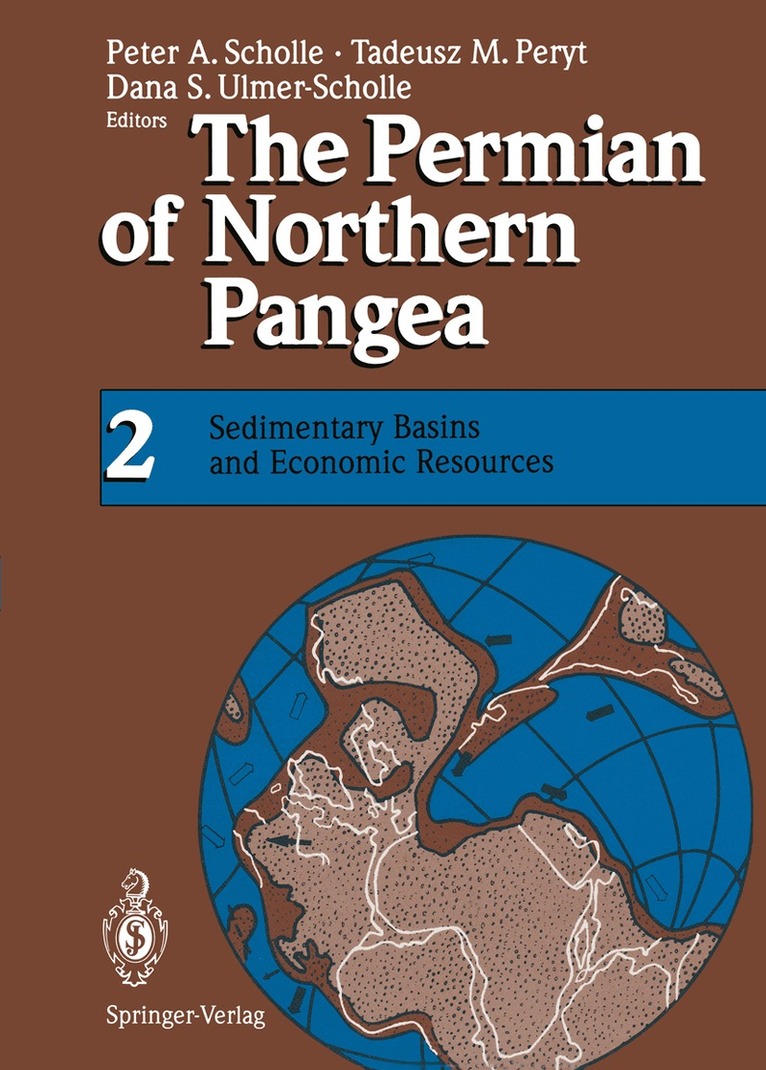
Permian of Northern Pangea
Volume 2: Sedimentary Basins and Economic Resources
Av Dana S. Ulmer-Scholle, Tadeusz M. Peryt m. fl.
E-bok, 2012
1459 kr
Lägg i varukorg
The Permian was a remarkable time period. It represents the maximum stage of Pangean continental assembly, includes a major global climatic shift from glacial to nonglacial conditions (icehouse-greenhouse transition), and is ter minated by one of the most profound faunal/floral extinction events …
Permian of Northern Pangea
Volume 2: Sedimentary Basins and Economic Resources
Av Peter A. Scholle, Tadeusz M. Peryt m. fl.
Häftad, 2011
1098 kr
Lägg i varukorg
The Permian was a remarkable time period. It represents the maximum stage of Pangean continental assembly, includes a major global climatic shift from glacial to nonglacial conditions (icehouse-greenhouse transition), and is ter minated by one of the most profound faunal/floral extinction events …
Permian of Northern Pangea
Volume 1: Paleogeography, Paleoclimates, Stratigraphy
Av Dana S. Ulmer-Scholle, Tadeusz M. Peryt m. fl.
E-bok, 2012
1459 kr
Lägg i varukorg
The Permian was a remarkable time period. It represents the maximum stage of Pangean continental assembly, includes a major global climatic shift from glacial to nonglacial conditions (icehouse-greenhouse transition), and is ter minated by one of the most profound faunal/floral extinction events …
Permian of Northern Pangea
Volume 1: Paleogeography, Paleoclimates, Stratigraphy
Av Peter A. Scholle, Tadeusz M. Peryt m. fl.
Häftad, 2012
1098 kr
Lägg i varukorg
The Permian was a remarkable time period. It represents the maximum stage of Pangean continental assembly, includes a major global climatic shift from glacial to nonglacial conditions (icehouse-greenhouse transition), and is ter minated by one of the most profound faunal/floral extinction events …