Takafusa Nakamura - Böcker
Visar alla böcker från författaren Takafusa Nakamura. Handla med fri frakt och snabb leverans.
3 produkter
3 produkter
Del 3 - Economic History of Japan 1660-1990
The Economic History of Japan: 1600-1990
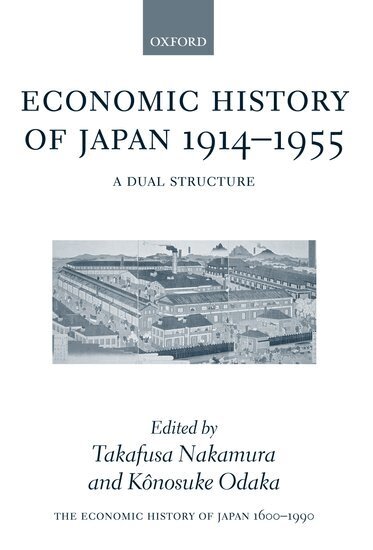
Volume 3: Economic History of Japan, 1914-1955
Inbunden, Engelska, 2003
3 111 kr
Skickas inom 5-8 vardagar
This multi-volume series covers the whole of modern Japanese economic history. The series encompasses both the institutional aspects of Japanese economic development, and the results of econometric and cliometric research to place the key moments of Japanese economic history in a more general context.Volume three, A Dual Structure, covers the first half of the twentieth century when Japan's economic modernization brought the country into the circle of world powers between the two world wars; the economic system established in the Second World War transformed the economy; and postwar reconstruction provided the foundations for an extraordinary economic dynamism. Where appropriate the book looks back to the nineteenth century and forward to the 1960s.Thematic in its approach, A Dual Structure explores how it was that during a prolonged period of hardship for the world economy, particularly during the deflation of the 1920s and the worldwide depression in the early 1930s, Japan's economy managed to overcome these crises and turbulence, before entering into a period of remarkable high-speed economic growth. Issues examined in particular include the development and transformation of Japan's financial system and monetary policy, the emergence of big business as an economic power, the Japanese empire and its colonies, wartime controls, and the economic democratization, reconstruction, and high-speed growth that followed. At the centre of this study is a consideration of the 'dual structure' of the Japanese economy which emerges in this inter-war period, of small-scale companies on the one hand, large industrial firms on the other, and the increasing flow of labor into the cities which resulted. Written by leading Japanese scholars, and available for the first time in English-translation, the contributions have been abridged and re-written for a non-Japanese readership.
549 kr
Skickas inom 10-15 vardagar
It is hardly possible to overrate the Pacific Basin in its economic and political importance. Currently, it is one of the economic regions with the highest dynamic growth throughout the world. Economically this region is sometimes considered to be the future centre of the world econom- often with reference to well-known authors such as Arnold Toynbee and Herman Kahn who predicted the inevitable approach of a Pacific century. The economic development of the Pacific Basin has proceeded far already following Japan's ascent into the position of an economic superpower. Considering the concentration of East and South-East Asian dynamic developing countries the Pacific Basin has meanwhile developed into a regional centre of economic activities. Furthermore the ambitions and in terests of three nuclear powers - the USA, the Soviet Union and China - collide in this region. Obviously these countries increasingly perceive and take into account the political and strategic importance of this region.
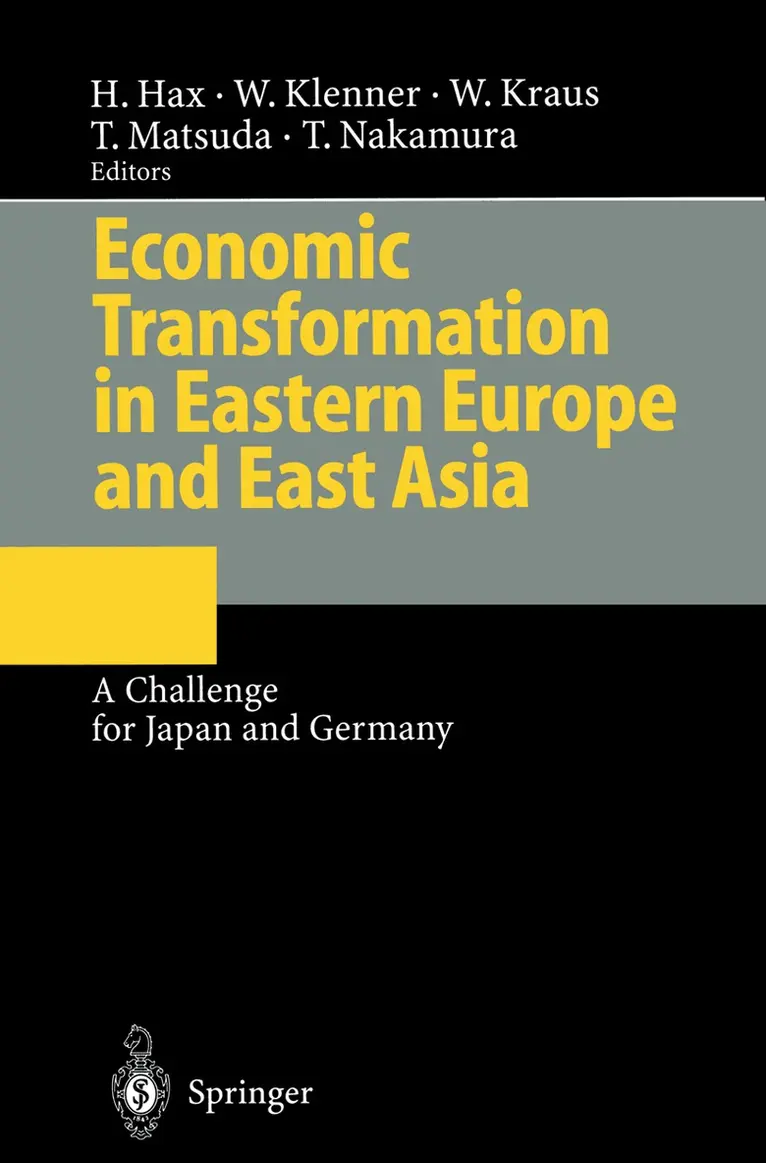
Economic Transformation in Eastern Europe and East Asia
A Challenge for Japan and Germany
Häftad, Engelska, 2011
1 091 kr
Skickas inom 10-15 vardagar
The economic transfonnation taking place in Eastern Europe and Asia is in particular a challenge for Japan and Gennany, because these two states as the immediate neighbors of the developing regions are directly affected and also because they are the strongest economic powers in their regions and have the necessary potential to influence developments there. Japan and Gennany are affected in many ways, both positively and negatively. Should the economic and social transformation run into difficulties, leading to economic and political chaos, perhaps even to armed conflicts, then economy and social fabric of the prosperous neighbors would doubtlessly suffer. In the past, Japan and the South-East Asian region have already experienced how economic problems in China caused millions of Chinese to seek their fortunes in other countries. An economic and political destabilization of China would today probably have even greater effects on migration flows. Similar effects can be expected in Europe, if the transfonnation process in Eastern Europe should fail. But even less dramatic developments in Eastern Europe and East Asia can have deleterious consequences for Gennany and Japan. Both nations are linked closely to the transfonning economies near them, though at a fairly low level. A reduction in trade with them, a refusal to service debts and other economic frictions ensuing out of economic and political troubles would of necessity hamper the prosperity of Japan and Gennany. A successful transfonnation process would without doubt benefit all economic partners to a considerable extent.