Tamar Diana Wilson - Böcker
Visar alla böcker från författaren Tamar Diana Wilson. Handla med fri frakt och snabb leverans.
8 produkter
8 produkter
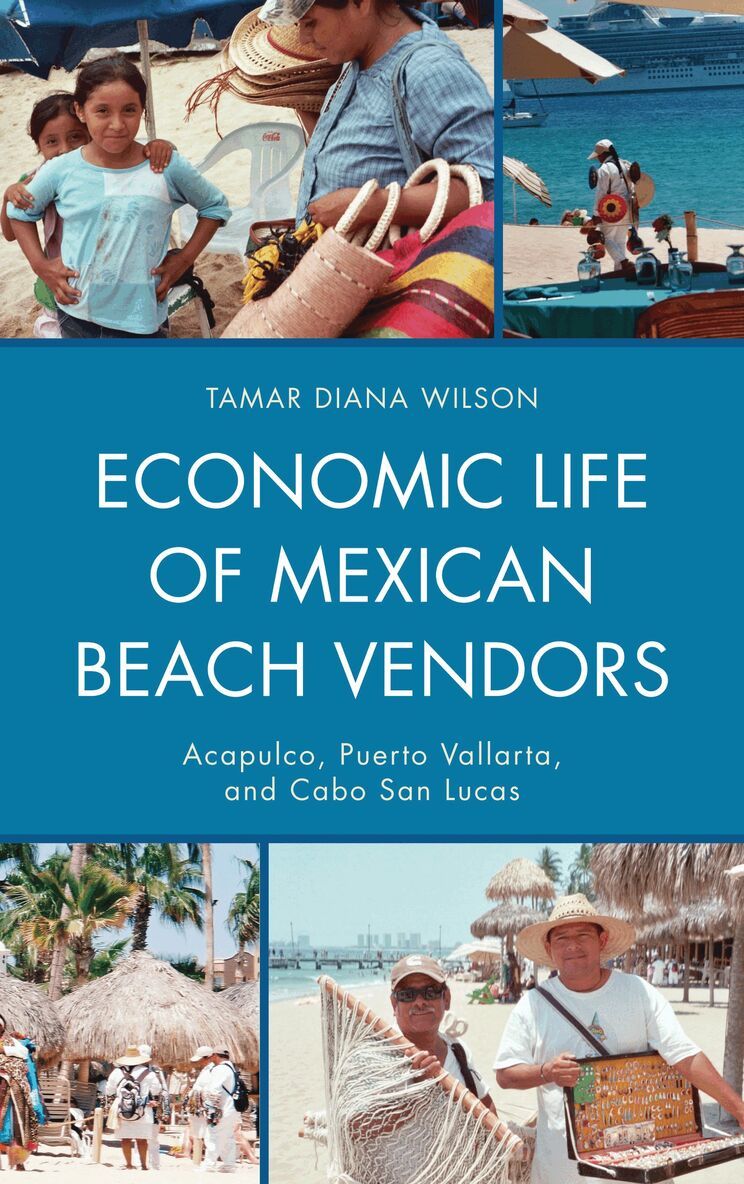
Economic Life of Mexican Beach Vendors
Acapulco, Puerto Vallarta, and Cabo San Lucas
Inbunden, Engelska, 2012
1 276 kr
Skickas inom 10-15 vardagar
Economic Life of Mexican Beach Vendors: Acapulco, Puerto Vallarta, and Cabo San Lucas is based on interviews with 82 men and 84 women who vend their wares on beaches in three Mexican tourist centers. Assuming that some people may actively choose self-employment in the informal or semi-informal economy, the employment and educational aspirations of the vendors and their levels of satisfaction with their work are explored. Most of the vendors had other family members who were also vendors, and 75 (45.2 percent) had 5 or more family members who vended, most usually on Mexican beaches. The vendors are aware of the forces of globalization (though they do not express these forces in those words), as revealed by their responses to questions as to how the current world economic recession has affected them. The beach vendors live in essentially segregated neighborhoods that can be considered apartheid-like, far from the tourist zones.Most of the vendors or their parents are rural-to-urban migrants and cross ethnic, linguistic, and economic borders as they migrate to and work in what have been called transnational social spaces. Of the vendors interviewed, 82 (49.4 percent) speak an indigenous language, and of these, 60 (73.2 percent) speak Nahuatl. The majority are from the state of Guerrero, but there were also Zapotec-speakers from Oaxaca. Both indigenous and non-indigenous women take part in beach vending. They are often wives, daughters, or sisters of male beach vendors, and they may be single, married, living in free union, or widowed. Their income is often of central importance to the household economy. This monograph aims to bring their stories to tourists and to scholars and students of tourism development and /or the informal or semi-informal economy in Mexican tourist centers.
1 057 kr
Tillfälligt slut
Examines the economic activities of self-employed brickmakers and the unpaid family members and others who assist them in Mexico.In Mexico, self-employed brickmakers support capitalist enterprise by providing bricks to build hotels, factories, office buildings, and shopping malls at costs lower than those based on profit-making principles. Combining Chayanovian and neo-Marxist approaches, Subsidizing Capitalism asserts that the economic activities of these self-employed brickmakers may be considered counterhegemonic because they avoid proletarianization in the formal sector. Tamar Diana Wilson discusses the similarities between peasants and brickmakers, the structural position of garbage pickers in relation to brickmakers, the trajectory from piece worker to petty commodity producer to petty capitalist, the economic value of women's and children's work as part of the family labor force, and how the neopatriarchal household is intrinsic to petty commodity production. Interspersed throughout are short stories and poems that offer the brickmakers' perspectives and provide a rarely seen look into their lives.
382 kr
Tillfälligt slut
Examines the economic activities of self-employed brickmakers and the unpaid family members and others who assist them in Mexico.In Mexico, self-employed brickmakers support capitalist enterprise by providing bricks to build hotels, factories, office buildings, and shopping malls at costs lower than those based on profit-making principles. Combining Chayanovian and neo-Marxist approaches, Subsidizing Capitalism asserts that the economic activities of these self-employed brickmakers may be considered counterhegemonic because they avoid proletarianization in the formal sector. Tamar Diana Wilson discusses the similarities between peasants and brickmakers, the structural position of garbage pickers in relation to brickmakers, the trajectory from piece worker to petty commodity producer to petty capitalist, the economic value of women's and children's work as part of the family labor force, and how the neopatriarchal household is intrinsic to petty commodity production. Interspersed throughout are short stories and poems that offer the brickmakers' perspectives and provide a rarely seen look into their lives.
518 kr
Skickas inom 3-6 vardagar
Despite their presence in migration streams since the mid-nineteenth century, research on Mexican women's migration has a significantly shorter history than that which focuses on Mexican men. In this contemporary anthropological study, Tamar Diana Wilson couples an analytical migratory network analysis with an intimate ethnography and oral history to explore the characteristics, development, and dynamics of migration networks for Mexican women. Centering on the story of dona Consuelo, a woman Wilson met in a Mexicali squatter settlement in 1988, as well as on the stories of her two daughters in the United States, this study examines the vital role that women's networks play, both within Mexico and transnationally, not only in assisting other women to migrate, but in providing support for male family members as well. Following a summary of the history of Mexican migration and women's increasing participation in the migration stream to the United States, Wilson provides a brief history of women's labor in Mexico and changes in gender relations during the last few decades. She then introduces key concepts in migration theory, such as network mediation, social capital formation, and transnational migration, which are revisited throughout the book. Subsequent chapters are dedicated to the migration and adaptation experiences of dona Consuelo and her family members as expressed through conversations, interviews, and the author's observations.
1 129 kr
Skickas inom 7-10 vardagar
While animal suffering and abuse have taken place throughout history, the alienation of humanity from nature caused by the development of capitalism - by the logic of capital and its system of generalized commodity production - accelerated and increased the depredations in scope and scale.The capitalist commodification of animals is extensive. It includes, but is not limited to:livestock production in concentrated animal feeding operationsleather and fur productionthe ivory trade in which tusks are used for 'traditional medicines; or carved into decorative objectsentertainment such as in zoos, marine parks, and circuseslaboratory experimentation to test medicines, beauty products, pesticides, and other chemicalsthe pursuit of trophy hunting, sometimes on canned farms and sometimes in the wildbioengineering of livestock and of animals used in laboratoriesThe contributors to this special issue of Research in Political Economy provide insightful analyses that address the historical transformations in the material conditions and ideological conceptions of nonhuman animals, alienated speciesism, the larger ecological crisis that is undermining the conditions of life for all species, and the capitalist commodification of animals that results in widespread suffering, death, and profits. This book is a must-read not only for political economists, but also for researchers interested in animal studies, environmentalism, and sustainability.
157 kr
Skickas inom 5-8 vardagar
167 kr
Skickas inom 5-8 vardagar
181 kr
Skickas inom 5-8 vardagar