Tamara Chaplin - Böcker
Visar alla böcker från författaren Tamara Chaplin. Handla med fri frakt och snabb leverans.
6 produkter
6 produkter
785 kr
Skickas inom 7-10 vardagar
In 1951, the eight o'clock nightly news reported on Jean-Paul Sartre for the first time. By the end of the twentieth century, more than 3,500 programs dealing with philosophy and its practitioners had aired on French television. According to Tamara Chaplin, this enduring commitment to bringing the most abstract and least visual of disciplines to the French public challenges our very assumptions about the incompatibility of elite culture and mass media. Indeed, it belies the conviction that television is inevitably anti-intellectual and the quintessential archenemy of the book. Chaplin argues that the history of televising philosophy is crucial to understanding the struggle over French national identity in the postwar period. Linking this history to decolonization, modernization, and globalization, "Turning On the Mind" claims that we can understand neither the markedly public role that philosophy came to play in French society during the late twentieth century nor the renewed interest in ethics and political philosophy in the early twenty-first unless we acknowledge the work of television.Throughout, Chaplin insists that we jettison presumptions about the anti-intellectual nature of the visual field, engages critical questions about the survival of national cultures in a globalizing world, and encourages us to rethink philosophy itself, ultimately asserting that the content of the discipline is indivisible from the new media forms in which it has found expression.
298 kr
Skickas inom 7-10 vardagar
In 1951, the eight o'clock nightly news reported on Jean-Paul Sartre for the first time. By the end of the twentieth century, more than 3,500 programs dealing with philosophy and its practitioners had aired on French television. According to Tamara Chaplin, this enduring commitment to bringing the most abstract and least visual of disciplines to the French public challenges our very assumptions about the incompatibility of elite culture and mass media. Indeed, it belies the conviction that television is inevitably anti-intellectual and the quintessential archenemy of the book. Chaplin argues that the history of televising philosophy is crucial to understanding the struggle over French national identity in the postwar period. Linking this history to decolonization, modernization, and globalization, "Turning On the Mind" claims that we can understand neither the markedly public role that philosophy came to play in French society during the late twentieth century nor the renewed interest in ethics and political philosophy in the early twenty-first unless we acknowledge the work of television.Throughout, Chaplin insists that we jettison presumptions about the anti-intellectual nature of the visual field, engages critical questions about the survival of national cultures in a globalizing world, and encourages us to rethink philosophy itself, ultimately asserting that the content of the discipline is indivisible from the new media forms in which it has found expression.
938 kr
Skickas inom 7-10 vardagar
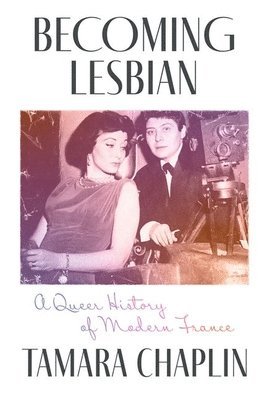
A landmark analysis of how a marginalized subculture used modern media to transform public attitudes toward sexual desire. In Becoming Lesbian, historian Tamara Chaplin argues that the history of female same-sex intimacy is central to understanding the struggle to control the public sphere. This monumental study draws on undiscovered sources culled from cabaret culture, sexology, police files, radio, TV, photography, the Minitel (an early form of internet), and private letters, as well as over one hundred interviews filmed by the author. Becoming Lesbian demonstrates how women of diverse classes and races came to define themselves as lesbian and used public spaces and public media to exert claims on the world around them in ways that made possible new forms of gendered and sexual citizenship. Chaplin begins in the sapphic cabarets of interwar Paris. These venues, she shows, exploited female same-sex desire for profit while simultaneously launching an incipient queer female counterpublic. Refuting claims that World War II destroyed this female world, Chaplin reveals instead how prewar sapphic subcultures flourished in the postwar period, laying crucial groundwork for the politicization of lesbian identity into the twenty-first century. Becoming Lesbian is filled with colorful vignettes about female cabaret owners, singers, TV personalities, writers, and activists, all brought to life to make larger points about rights, belonging, and citizenship. As a history of lesbianism, this book represents a major contribution to modern French history, queer studies, and genealogies of the media and its publics.
290 kr
Skickas inom 7-10 vardagar
A landmark analysis of how a marginalized subculture used modern media to transform public attitudes toward sexual desire. In Becoming Lesbian, historian Tamara Chaplin argues that the history of female same-sex intimacy is central to understanding the struggle to control the public sphere. This monumental study draws on undiscovered sources culled from cabaret culture, sexology, police files, radio, TV, photography, the Minitel (an early form of internet), and private letters, as well as over one hundred interviews filmed by the author. Becoming Lesbian demonstrates how women of diverse classes and races came to define themselves as lesbian and used public spaces and public media to exert claims on the world around them in ways that made possible new forms of gendered and sexual citizenship. Chaplin begins in the sapphic cabarets of interwar Paris. These venues, she shows, exploited female same-sex desire for profit while simultaneously launching an incipient queer female counterpublic. Refuting claims that World War II destroyed this female world, Chaplin reveals instead how prewar sapphic subcultures flourished in the postwar period, laying crucial groundwork for the politicization of lesbian identity into the twenty-first century. Becoming Lesbian is filled with colorful vignettes about female cabaret owners, singers, TV personalities, writers, and activists, all brought to life to make larger points about rights, belonging, and citizenship. As a history of lesbianism, this book represents a major contribution to modern French history, queer studies, and genealogies of the media and its publics.
2 162 kr
Skickas inom 10-15 vardagar
The Global 1960s presents compelling narratives from around the world in order to de-center the roles played by the United States and Europe in both scholarship on, and popular memories of, the sixties. Geographically and chronologically broad, this volume scrutinizes the concept of "the sixties" as defined in both Western and non-Western contexts. It provides scope for a set of analyses that together span the late 1950s to the early 1970s. Written by a diverse and international group of contributors, chapters address topics ranging from the socialist scramble for Africa, to the Naxalite movement in West Bengal, the Troubles in Northern Ireland, global media coverage of Israel, Cold War politics in Hong Kong cinema, sexual revolution in France, and cultural imperialism in Latin America. The Global 1960s explores the contest between convention and counter-culture that shaped this iconic decade, emphasizing that while the sixties are well-known for liberation, activism, and protest against the establishment, traditional hierarchies and social norms remained remarkably entrenched. Multi-faceted and transnational in approach, this book is valuable reading for all students and scholars of twentieth-century global history.
591 kr
Skickas inom 10-15 vardagar
The Global 1960s presents compelling narratives from around the world in order to de-center the roles played by the United States and Europe in both scholarship on, and popular memories of, the sixties. Geographically and chronologically broad, this volume scrutinizes the concept of "the sixties" as defined in both Western and non-Western contexts. It provides scope for a set of analyses that together span the late 1950s to the early 1970s. Written by a diverse and international group of contributors, chapters address topics ranging from the socialist scramble for Africa, to the Naxalite movement in West Bengal, the Troubles in Northern Ireland, global media coverage of Israel, Cold War politics in Hong Kong cinema, sexual revolution in France, and cultural imperialism in Latin America. The Global 1960s explores the contest between convention and counter-culture that shaped this iconic decade, emphasizing that while the sixties are well-known for liberation, activism, and protest against the establishment, traditional hierarchies and social norms remained remarkably entrenched. Multi-faceted and transnational in approach, this book is valuable reading for all students and scholars of twentieth-century global history.