
Tamara T Chin – författare
Visar alla böcker från författaren . Handla med fri frakt och snabb leverans.
4 produkter
4 produkter

Inbunden, Engelska, 2026
1 409 kr
Kommande
Traces the rise and fall of a set of modern disciplinary fields devoted to premodern historical contact that drew on intellectual currents across and beyond China and Europe.In The Silk Road Idea, Tamara T. Chin examines the rise of interest in “the connected past” and its impact on key disciplines, focusing on the period from 1870 to 1970. Against the predominance of national studies, Chin argues that historical contact gradually came to be regarded as an object of inquiry over a century spanning imperialism, decolonization, and the Cold War. Interest in connected histories emerged from all corners: the colonialist and the anticolonial; the capitalist and the communist; the antiquarian and the activist.During the ascent of academic specialization, Chin contends, geography, history, philology, and linguistics domesticated contact through distinct frameworks and units of analysis, making it into something geographers mapped, historians narrated, philologists read, and linguists heard. But this also brought disruption. To historically connect Afro-Eurasia, disciplinary paradigms were questioned, and, in some cases, transformed. Intellectual debates in East Asia and Europe became entangled with those in South Asia and East Africa. Chin uses the concept of the “Silk Road” to capture the epistemological challenge of including China in a globally connected past, from the pursuit of civilizational origins to that of entangled empires. The Silk Road Idea revisits the stakes of premodern contact for the histories of colonialism, capitalism, and knowledge, showing how the connecting and reconfiguring of the modern world enabled and was enabled by a reimagination of antiquity.

Häftad, Engelska, 2026
435 kr
Kommande
Traces the rise and fall of a set of modern disciplinary fields devoted to premodern historical contact that drew on intellectual currents across and beyond China and Europe.In The Silk Road Idea, Tamara T. Chin examines the rise of interest in “the connected past” and its impact on key disciplines, focusing on the period from 1870 to 1970. Against the predominance of national studies, Chin argues that historical contact gradually came to be regarded as an object of inquiry over a century spanning imperialism, decolonization, and the Cold War. Interest in connected histories emerged from all corners: the colonialist and the anticolonial; the capitalist and the communist; the antiquarian and the activist.During the ascent of academic specialization, Chin contends, geography, history, philology, and linguistics domesticated contact through distinct frameworks and units of analysis, making it into something geographers mapped, historians narrated, philologists read, and linguists heard. But this also brought disruption. To historically connect Afro-Eurasia, disciplinary paradigms were questioned, and, in some cases, transformed. Intellectual debates in East Asia and Europe became entangled with those in South Asia and East Africa. Chin uses the concept of the “Silk Road” to capture the epistemological challenge of including China in a globally connected past, from the pursuit of civilizational origins to that of entangled empires. The Silk Road Idea revisits the stakes of premodern contact for the histories of colonialism, capitalism, and knowledge, showing how the connecting and reconfiguring of the modern world enabled and was enabled by a reimagination of antiquity.
Del 94 - Harvard-Yenching Institute Monograph Series
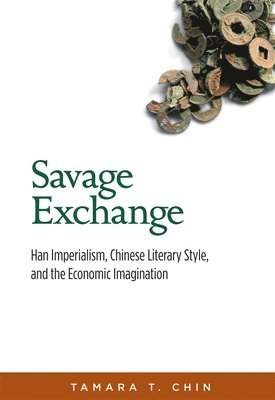
Savage Exchange
Han Imperialism, Chinese Literary Style, and the Economic Imagination
Häftad, Engelska, 2020
270 kr
Skickas inom 5-8 vardagar
Savage Exchange explores the politics of representation during the Han dynasty (206 BCE–220 CE) at a pivotal moment when China was asserting imperialist power on the Eurasian continent and expanding its local and long-distance (“Silk Road”) markets. Tamara T. Chin explains why rival political groups introduced new literary forms with which to represent these expanded markets. To promote a radically quantitative approach to the market, some thinkers developed innovative forms of fiction and genre. In opposition, traditionalists reasserted the authority of classical texts and advocated a return to the historical, ethics-centered, marriage-based, agricultural economy that these texts described. The discussion of frontiers and markets thus became part of a larger debate over the relationship between the world and the written word. These Han debates helped to shape the ways in which we now define and appreciate early Chinese literature and produced the foundational texts of Chinese economic thought. Each chapter in the book examines a key genre or symbolic practice (philosophy, fu-rhapsody, historiography, money, kinship) through which different groups sought to reshape the political economy. By juxtaposing well-known texts with recently excavated literary and visual materials, Chin elaborates a new literary and cultural approach to Chinese economic thought.
Del 94 - Harvard-Yenching Institute Monograph Series
Savage Exchange
Han Imperialism, Chinese Literary Style, and the Economic Imagination
Inbunden, Engelska, 2014
476 kr
Skickas inom 5-8 vardagar
Savage Exchange explores the politics of representation during the Han dynasty (206 BCE–220 CE) at a pivotal moment when China was asserting imperialist power on the Eurasian continent and expanding its local and long-distance (“Silk Road”) markets. Tamara T. Chin explains why rival political groups introduced new literary forms with which to represent these expanded markets. To promote a radically quantitative approach to the market, some thinkers developed innovative forms of fiction and genre. In opposition, traditionalists reasserted the authority of classical texts and advocated a return to the historical, ethics-centered, marriage-based, agricultural economy that these texts described. The discussion of frontiers and markets thus became part of a larger debate over the relationship between the world and the written word. These Han debates helped to shape the ways in which we now define and appreciate early Chinese literature and produced the foundational texts of Chinese economic thought. Each chapter in the book examines a key genre or symbolic practice (philosophy, fu-rhapsody, historiography, money, kinship) through which different groups sought to reshape the political economy. By juxtaposing well-known texts with recently excavated literary and visual materials, Chin elaborates a new literary and cultural approach to Chinese economic thought.