Thomas A. Durkin - Böcker
Visar alla böcker från författaren Thomas A. Durkin. Handla med fri frakt och snabb leverans.
4 produkter
4 produkter
1 072 kr
Skickas inom 5-8 vardagar
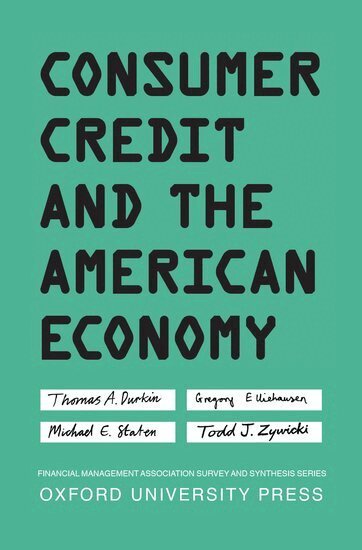
Consumer Credit and the American Economy examines the economics, behavioral science, sociology, history, institutions, law, and regulation of consumer credit in the United States. After discussing the origins and various kinds of consumer credit available in today's marketplace, this book reviews at some length the long run growth of consumer credit to explore the widely held belief that somehow consumer credit has risen "too fast for too long. " It then turns to demand and supply with chapters discussing neoclassical theories of demand, new behavioral economics, and evidence on production costs and why consumer credit might seem expensive compared to some other kinds of credit like government finance. This discussion includes review of the economics of risk management and funding sources, as well discussion of the economic theory of why some people might be limited in their credit search, the phenomenon of credit rationing. This examination includes review of issues of risk management through mathematical methods of borrower screening known as credit scoring and financial market sources of funding for offerings of consumer credit.The book then discusses technological change in credit granting. It examines how modern automated information systems called credit reporting agencies, or more popularly "credit bureaus, " reduce the costs of information acquisition and permit greater credit availability at less cost. This discussion is followed by examination of the logical offspring of technology, the ubiquitous credit card that permits consumers access to both payments and credit services worldwide virtually instantly.After a chapter on institutions that have arisen to supply credit to individuals for whom mainstream credit is often unavailable, including "payday loans " and other small dollar sources of loans, discussion turns to legal structure and the regulation of consumer credit. There are separate chapters on the theories behind the two main thrusts of federal regulation to this point, fairness for all and financial disclosure. Following these chapters, there is another on state regulation that has long focused on marketplace access and pricing. Before a final concluding chapter, another chapter focuses on two noncredit marketplace products that are closely related to credit. The first of them, debt protection including credit insurance and other forms of credit protection, is economically a complement. The second product, consumer leasing, is a substitute for credit use in many situations, especially involving acquisition of automobiles. This chapter is followed by a full review of consumer bankruptcy, what happens in the worst of cases when consumers find themselves unable to repay their loans.Because of the importance of consumer credit in consumers' financial affairs, the intended audience includes anyone interested in these issues, not only specialists who spend much of their time focused on them. For this reason, the authors have carefully avoided academic jargon and the mathematics that is the modern language of economics. It also examines the psychological, sociological, historical, and especially legal traditions that go into fully understanding what has led to the demand for consumer credit and to what the markets and institutions that provide these products have become today.
1 152 kr
Skickas inom 5-8 vardagar
This book is a guide to the purposes, strengths, and weaknesses of disclosures as consumer protections in financial transactions such as loans, deposits, and consumer leases. It focuses on the federal Truth in Lending Act but also covers a variety of other federal disclosure statutes designed to protect consumers in their financial relationships. It comes at a time when federal financial consumer protection policy in the financial area is again a matter of intense public scrutiny and debate.Because of the importance of public policy issues surrounding use of disclosures as consumer protections, the intended audience includes anyone interested in these issues, not simply specialists who spend their time focused on them. For this reason, the work avoids academic jargon and the mathematics that is the modern language of economics. It also examines the psychological, sociological, historical, and especially legal traditions that go into fully understanding what has led to the demand for better disclosures for consumers and to what they have become today. Despite a need to outline and review prior difficulties with disclosure laws, the book remains optimistic that disclosures will continue to be an important means of consumer protection and that future reforms can improve their effectiveness and lower their regulatory costs and burden.
1 640 kr
Skickas inom 10-15 vardagar
This text presents a collection of research papers and discussions commissioned to commemorate the silver anniversary of Georgetown University's Credit Research Center in 1999. Nine topics serve as focal points for the volume, with the general theme "What do we know, what do we need to know about the functioning of consumer credit markets at the beginning of the 21st century?". Because the growth of household debt and the consequences of household debt burden have dominated discussion in both the media and policy arenas for decades, "Credit Growth and the Burden of Debt" is the theme for the first group of three papers. The papers address the cultural evolution of consumer credit in the US, the rise in consumer indebtedness and the alarming surge in personal bankruptcies. A second grouping of three papers takes a distinctly policy-oriented tack and examines questions regarding consumer access to credit (mortgage markets and evidence of discrimination), consumer protection through mandatory disclosure of information (Truth-in-Lending regulations), and the general state of financial literacy among the population of young consumers entering credit markets for the first time.The final three papers in this volume examine how technological innovations in risk management (through statistical risk scoring models), marketing (through use of personal information for targeted marketing) and finance (through securitization of consumer loans) have impacted the availability of credit products and sparked new public policy questions.
1 635 kr
Skickas inom 10-15 vardagar
As both the twenty-first century and the new millennium opened and the old eras passed into history, individuals and organizations throughout the world advanced their listings of the most significant people and events in their respective specialties. Possibly more important, the tum of the clock and calendar also offered these same observers a good reason to glance into the crystal ball. Presumably, the past is of greatest interest to most people when it permits better understanding of the present, and maybe even limited insight into the outlook. In keeping with the reflective mood of the time, the staff and friends of the Credit Research Center (CRC) at Georgetown University's McDonough School of Business noted that the beginning of the new millennium also marked the beginning of the second quarter-century of the Center's existence. The Center began at the Krannert Graduate School of Management at Purdue University in 1974 and moved to the McDonough School of Business at Georgetown University in 1997. The silver anniversary of its founding offered the occasion for creating more than another listing of significant past accomplishments and milestones. Rather, it offered the opportunity and, indeed, a mandate for CRC as an academic research center, to undertake a retrospective and future look into the status of research questions pertaining to consumer credit markets. For this reason, the Center organized a research conference which was held in Washington, D. C.