Thomas J. Santner - Böcker
Visar alla böcker från författaren Thomas J. Santner. Handla med fri frakt och snabb leverans.
6 produkter
6 produkter
535 kr
Skickas inom 10-15 vardagar
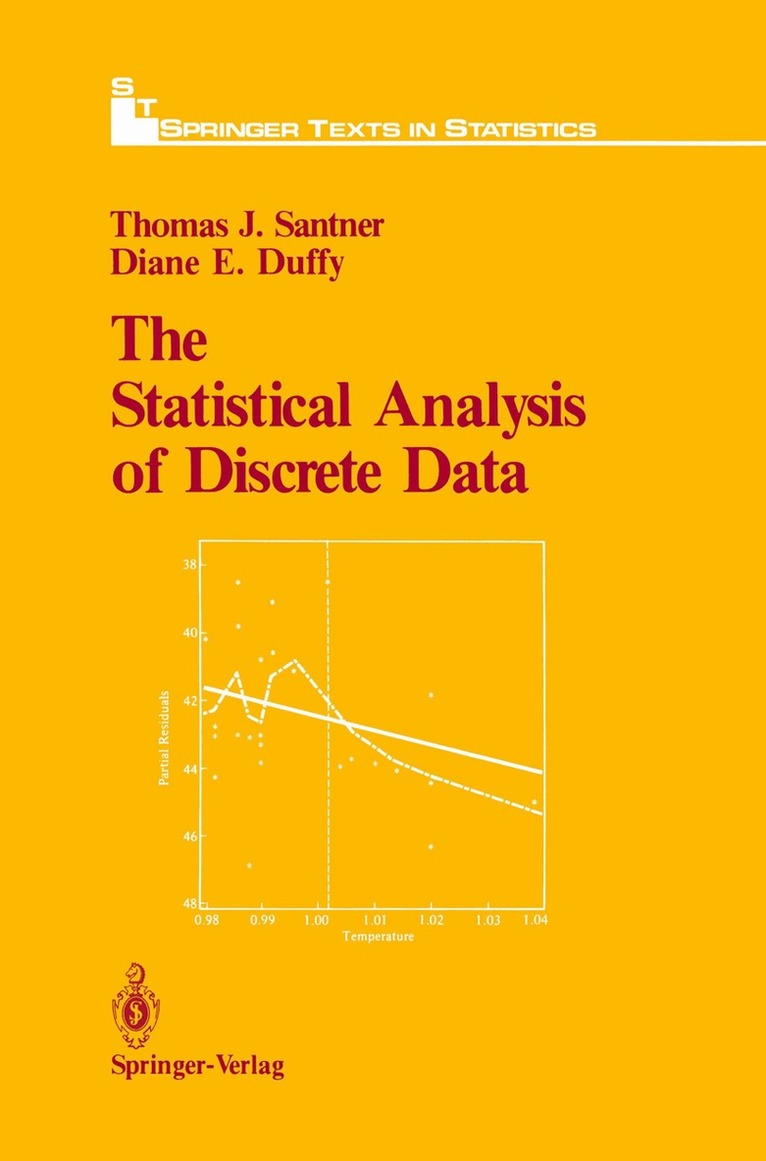
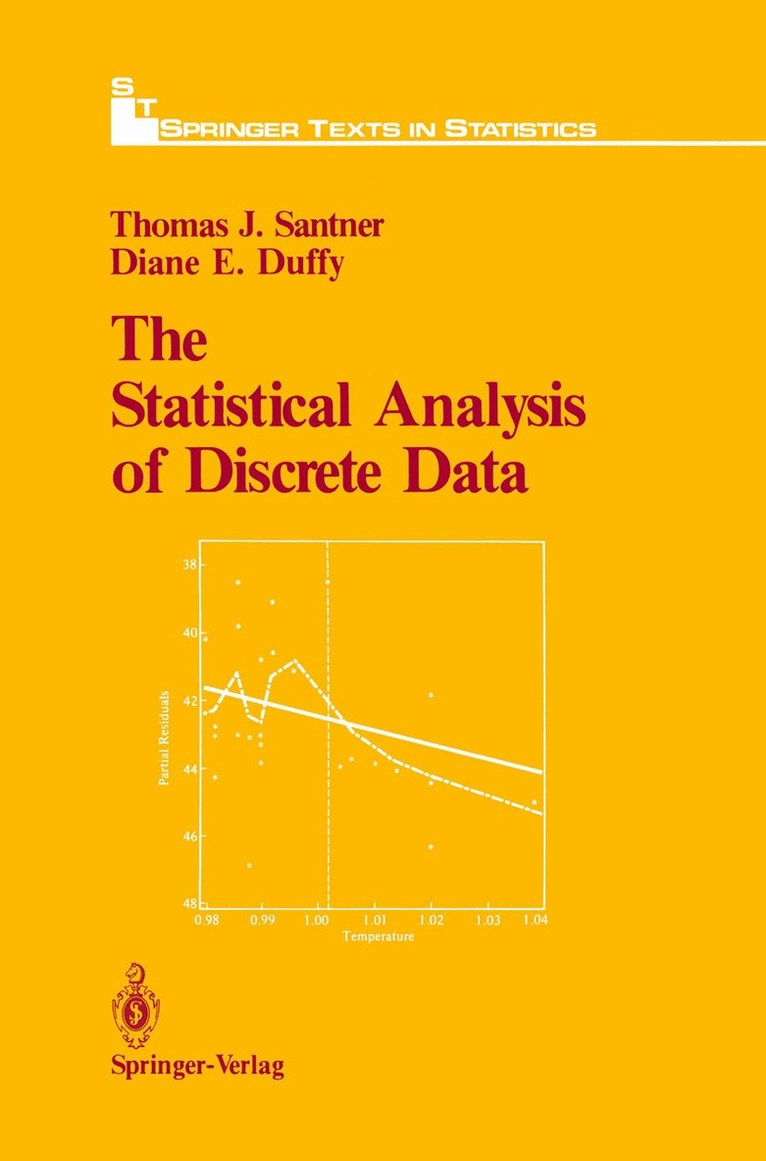
The Statistical Analysis of Discrete Data provides an introduction to cur rent statistical methods for analyzing discrete response data. The book can be used as a course text for graduate students and as a reference for researchers who analyze discrete data. The book's mathematical prereq uisites are linear algebra and elementary advanced calculus. It assumes a basic statistics course which includes some decision theory, and knowledge of classical linear model theory for continuous response data. Problems are provided at the end of each chapter to give the reader an opportunity to ap ply the methods in the text, to explore extensions of the material covered, and to analyze data with discrete responses. In the text examples, and in the problems, we have sought to include interesting data sets from a wide variety of fields including political science, medicine, nuclear engineering, sociology, ecology, cancer research, library science, and biology. Although there are several texts available on discrete data analysis, we felt there was a need for a book which incorporated some of the myriad recent research advances. Our motivation was to introduce the subject by emphasizing its ties to the well-known theories of linear models, experi mental design, and regression diagnostics, as well as to describe alterna tive methodologies (Bayesian, smoothing, etc. ); the latter are based on the premise that external information is available. These overriding goals, to gether with our own experiences and biases, have governed our choice of topics.
Del 284 - Wiley Series in Probability and Statistics
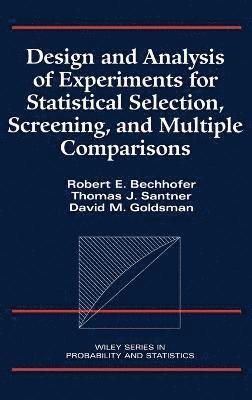
Design and Analysis of Experiments for Statistical Selection, Screening, and Multiple Comparisons
Inbunden, Engelska, 1995
2 396 kr
Skickas inom 7-10 vardagar
A practical guide to selection, screening, and multiplecomparisons This book addresses experimenters who have knowledge of classicalexperimental design methodology and expands their repertoire beyondhypothesis testing by providing statistical methods appropriate forselection, screening, and multiple comparisons. It concentrates onthree types of procedures: selection procedures that use the"indifference-zone" approach, screening procedures using the"subset" approach, and multiple comparison procedures involvingnormal means. This is the first book, specifically designed forpractitioners, to bring into focus many developments in the fieldpreviously covered only in university courses. It also presents newresults on the comparison of procedures that have been obtainedspecifically for this volume. This self-contained volume describes methods for designingexperiments when the scientific objective is selection of besttreatments, screening a set of treatments, and multiple comparisonsamong treatment means. The book emphasizes procedures appropriatein a variety of practical settings including those that requireblocking and randomization restriction. It compares the relativemerits of procedures when several different methods can be used inthe same circumstances. Providing practical guidance for experimenters in agriculture,engineering, medicine, and other empirical sciences, this book mayalso be used for a one-semester graduate course in selectionmethodology or to augment traditional courses in experimentaldesign. Design and Analysis of Experiments for Statistical Selection,Screening, and Multiple Comparisons:* Shows how selection and screening can be applied to data thatfollow one of three important probability models--normaldistribution, binomial distribution, and the multinomialdistribution models* Provides an extensive comparison of procedures, allowingexperimenters to choose among competitors when several differentprocedures are feasible for a given application* Gives an extensive set of tables of constants necessary toimplement the procedures* Supplements the tables of constants with listings of FORTRANprograms so that experimenters are not limited to those valuescovered by the tables* Focuses on frequent formulations, while also providing referencesto Bayesian and other alternative developments in the Chapter Notes
1 381 kr
Skickas inom 10-15 vardagar
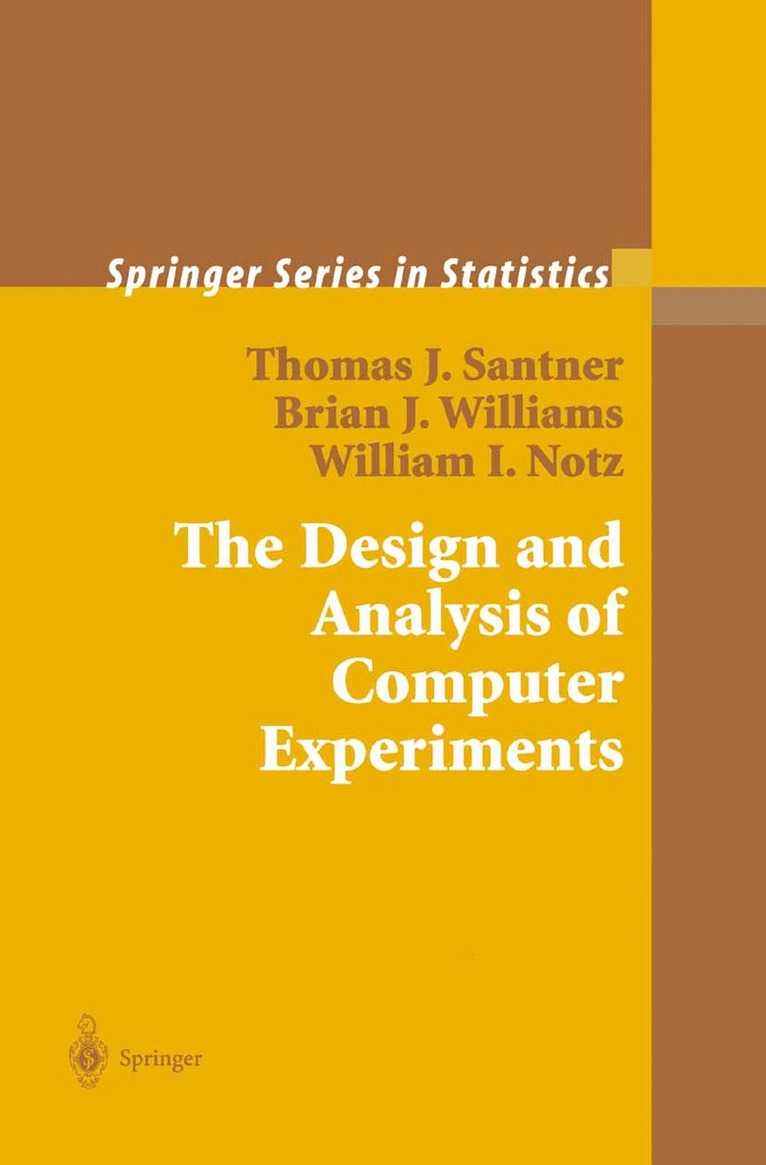
In the past 15 to 20 years, the computer has become a popular tool for exploring the relationship between a measured response and factors thought to affect the response. In many cases, scientific theories exist that implicitly relate the response to the factors by means of systems of mathematical equations. There also exist numerical methods for accurately solving such equations and appropriate computer hardware and software to implement these methods. In many engineering applications, for example, the relationship is described by a dynamical system and the numerical method is a finite element code. In such situations, these numerical methods allow one to produce computer code that can generate the response corresponding to any given set of values of the factors. This allows one to conduct an "experiment" (called a "computer experiment") to explore the relationship between the response and the factors using the code. Indeed, in some cases computer experimentation is feasible when a properly designed physical experiment (the gold standard for establishing cause and effect) is impossible. For example, the number of input variables may be too large to consider performing a physical experiment or it may simply be economically prohibitive to run an experiment on the scale required to gather sufficient information to answer a particular research question. This book describes methods for designing and analyzing experiments conducted using computer code in lieu of a physical experiment. It discusses how to select the values of the factors at which to run the code (the design of the computer experiment) in light of the research objectives of the experimenter. It also provides techniques for analyzing the resulting data so as to achieve these research goals.
535 kr
Skickas inom 10-15 vardagar
The Statistical Analysis of Discrete Data provides an introduction to cur rent statistical methods for analyzing discrete response data. The book can be used as a course text for graduate students and as a reference for researchers who analyze discrete data. The book's mathematical prereq uisites are linear algebra and elementary advanced calculus. It assumes a basic statistics course which includes some decision theory, and knowledge of classical linear model theory for continuous response data. Problems are provided at the end of each chapter to give the reader an opportunity to ap ply the methods in the text, to explore extensions of the material covered, and to analyze data with discrete responses. In the text examples, and in the problems, we have sought to include interesting data sets from a wide variety of fields including political science, medicine, nuclear engineering, sociology, ecology, cancer research, library science, and biology. Although there are several texts available on discrete data analysis, we felt there was a need for a book which incorporated some of the myriad recent research advances. Our motivation was to introduce the subject by emphasizing its ties to the well-known theories of linear models, experi mental design, and regression diagnostics, as well as to describe alterna tive methodologies (Bayesian, smoothing, etc. ); the latter are based on the premise that external information is available. These overriding goals, to gether with our own experiences and biases, have governed our choice of topics.
634 kr
Skickas inom 5-8 vardagar
1 682 kr
Skickas inom 10-15 vardagar
This book describes methods for designing and analyzing experiments that are conducted using a computer code, a computer experiment, and, when possible, a physical experiment. Computer experiments continue to increase in popularity as surrogates for and adjuncts to physical experiments. Since the publication of the first edition, there have been many methodological advances and software developments to implement these new methodologies. The computer experiments literature has emphasized the construction of algorithms for various data analysis tasks (design construction, prediction, sensitivity analysis, calibration among others), and the development of web-based repositories of designs for immediate application. While it is written at a level that is accessible to readers with Masters-level training in Statistics, the book is written in sufficient detail to be useful for practitioners and researchers. New to this revised and expanded edition:• An expanded presentation of basic material on computer experiments and Gaussian processes with additional simulations and examples • A new comparison of plug-in prediction methodologies for real-valued simulator output• An enlarged discussion of space-filling designs including Latin Hypercube designs (LHDs), near-orthogonal designs, and nonrectangular regions• A chapter length description of process-based designs for optimization, to improve good overall fit, quantile estimation, and Pareto optimization • A new chapter describing graphical and numerical sensitivity analysis tools• Substantial new material on calibration-based prediction and inference for calibration parameters • Lists of software that can be used to fit models discussed in the book to aid practitioners