Thomas Kjeller Johansen - Böcker
Visar alla böcker från författaren Thomas Kjeller Johansen. Handla med fri frakt och snabb leverans.
9 produkter
9 produkter
509 kr
Skickas inom 7-10 vardagar
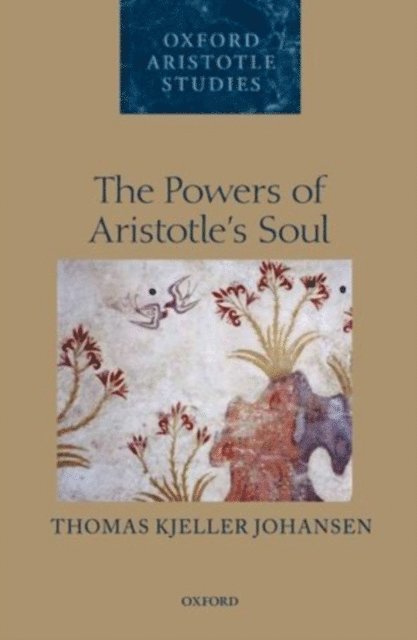
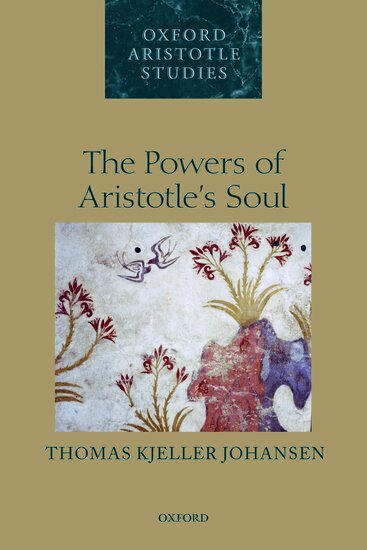
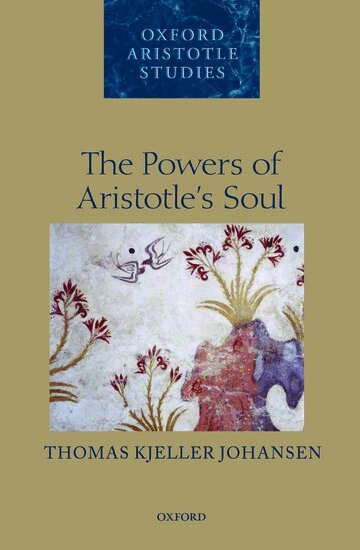
Aristotle is considered by many to be the founder of 'faculty psychology'--the attempt to explain a variety of psychological phenomena by reference to a few inborn capacities. In The Powers of Aristotle's Soul, Thomas Kjeller Johansen investigates his main work on psychology, the De Anima, from this perspective. He shows how Aristotle conceives of the soul's capacities and how he uses them to account for the souls of living beings. Johansen offers an original account of how Aristotle defines the capacities in relation to their activities and proper objects, and considers the relationship of the body to the definition of the soul's capacities. Against the background of Aristotle's theory of science, Johansen argues that the capacities of the soul serve as causal principles in the explanation of the various life forms. He develops detailed readings of Aristotle's treatment of nutrition, perception, and intellect, which show the soul's various roles as formal, final and efficient causes, and argues that the so-called 'agent' intellect falls outside the scope of Aristotle's natural scientific approach to the soul. Other psychological activities, various kinds of perception (including 'perceiving that we perceive'), memory, imagination, are accounted for in their explanatory dependency on the basic capacities. The ability to move spatially is similarly explained as derivative from the perceptual or intellectual capacities. Johansen claims that these capacities together with the nutritive may be understood as 'parts' of the soul, as they are basic to the definition and explanation of the various kinds of soul. Finally, he considers how the account of the capacities in the De Anima is adopted and adapted in Aristotle's biological and minor psychological works.
1 403 kr
Skickas inom 7-10 vardagar
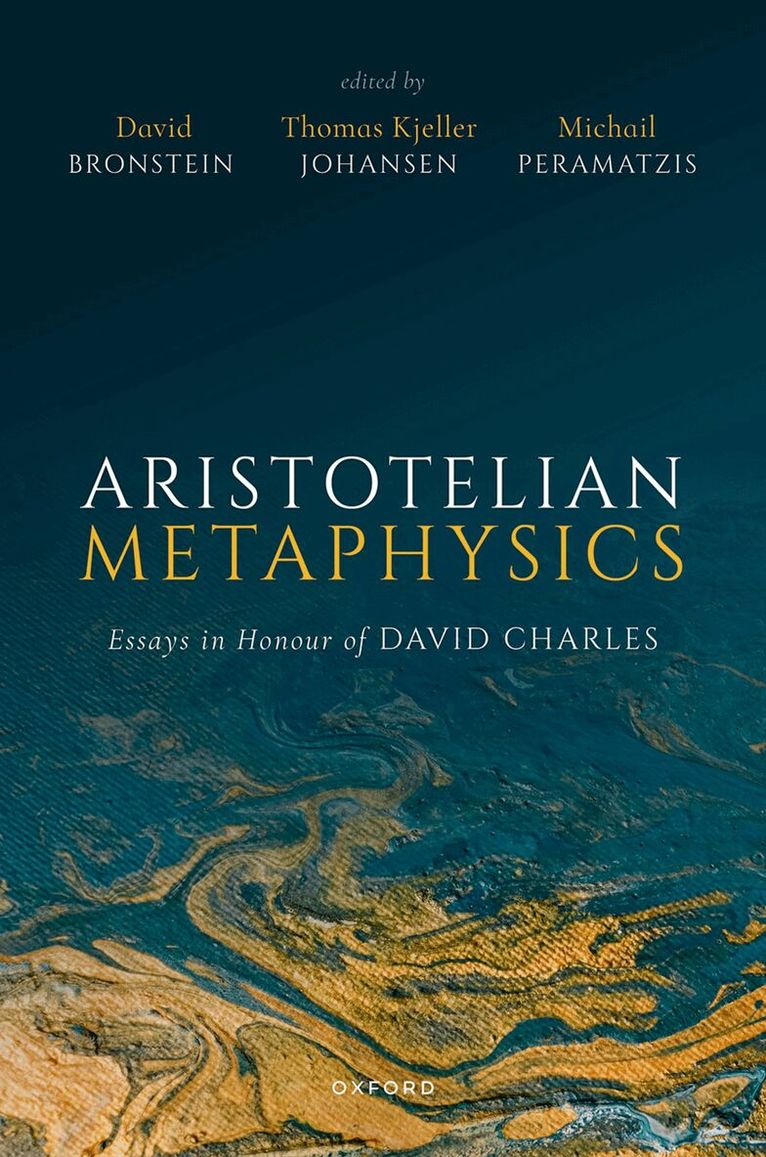
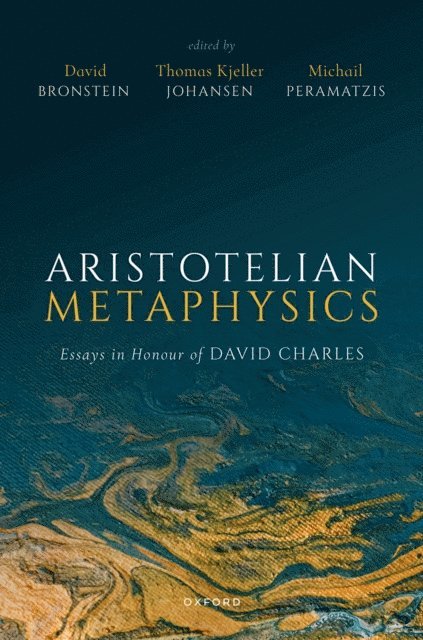
This volume provides a rich collection of original essays on Aristotle's metaphysics written by sixteen prominent scholars in the field. Honouring the seminal influence of David Charles to philosophical scholarship, it offers fresh interpretations and assessments of Aristotle's thinking in metaphysics and related areas such as philosophy of language, psychology, natural philosophy, and mathematics. The collection contributes to the recent resurgence of interest in Aristotelian metaphysics, furthering our understanding of Aristotle's seminal contribution to the history of western philosophy. It evaluates key features of Aristotle's metaphysical thinking: his accounts of definition and meaning; his understanding of being and the categories; his models of explanation, causation, and accounts of modality, space, and change. The chapters are written with clarity and attention to the detail of Aristotle's texts but presuppose no knowledge of ancient Greek and can be read with benefit by advanced philosophy students and scholars.
1 227 kr
Skickas inom 5-8 vardagar
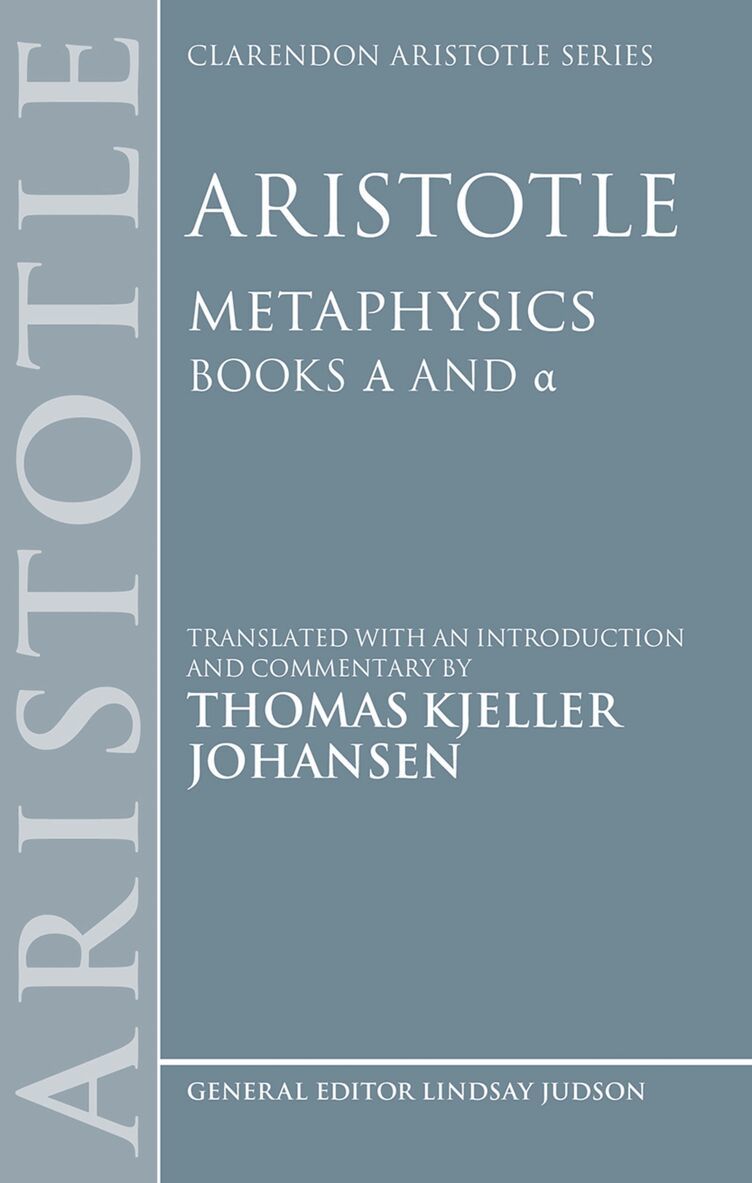
The Clarendon Aristotle Series is designed for both students and professionals. It provides accurate translations of selected Aristotelian texts, accompanied by incisive commentaries that focus on philosophical problems and issues. The volumes in the series have been widely welcomed and favourably reviewed. Important new titles are being added to the series, and a number of well-established volumes are being reissued with revisions and/or supplementary material.This volume presents a new translation by Thomas Kjeller Johansen of Aristotle's Metaphysics Books A and α, a signature text within Aristotle's writings, of immense importance for the formation of Western metaphysics and for our understanding of early Greek philosophy. Aristotle's Metaphysics was the first work to define metaphysics as a distinct discipline, the study of the principles of being. When philosophers today discuss the basic questions of being in terms of categories, matter and structure, parts and wholes, identity and continuity, powers and actualities, causes and effects, necessity and contingency, they are pursuing questions first clearly articulated and brought together in Aristotle's Metaphysics. Book A introduces metaphysics or 'wisdom' as the study of first principles and explains why we should pursue it. Aristotle sets out the views of his predecessors and shows that, while they recognised one or more of the four causes, no-one understood any or all of them with sufficient clarity. In Book α, Aristotle further explores the status of the four causes as first principles, explains why it is so difficulty to achieve knowledge of them, and sets out the sorts of accuracy we should expect of various kinds of disciplines. This volume provides a commentary exploring the details of Aristotle's argumentation and its philosophical significance, along with an introduction to Books A and α, explaining their place within the Metaphysics and Aristotle's philosophy as a whole.
334 kr
Skickas inom 5-8 vardagar
The Clarendon Aristotle Series is designed for both students and professionals. It provides accurate translations of selected Aristotelian texts, accompanied by incisive commentaries that focus on philosophical problems and issues. The volumes in the series have been widely welcomed and favourably reviewed. Important new titles are being added to the series, and a number of well-established volumes are being reissued with revisions and/or supplementary material.This volume presents a new translation by Thomas Kjeller Johansen of Aristotle's Metaphysics Books A and α, a signature text within Aristotle's writings, of immense importance for the formation of Western metaphysics and for our understanding of early Greek philosophy. Aristotle's Metaphysics was the first work to define metaphysics as a distinct discipline, the study of the principles of being. When philosophers today discuss the basic questions of being in terms of categories, matter and structure, parts and wholes, identity and continuity, powers and actualities, causes and effects, necessity and contingency, they are pursuing questions first clearly articulated and brought together in Aristotle's Metaphysics. Book A introduces metaphysics or 'wisdom' as the study of first principles and explains why we should pursue it. Aristotle sets out the views of his predecessors and shows that, while they recognised one or more of the four causes, no-one understood any or all of them with sufficient clarity. In Book α, Aristotle further explores the status of the four causes as first principles, explains why it is so difficulty to achieve knowledge of them, and sets out the sorts of accuracy we should expect of various kinds of disciplines. This volume provides a commentary exploring the details of Aristotle's argumentation and its philosophical significance, along with an introduction to Books A and α, explaining their place within the Metaphysics and Aristotle's philosophy as a whole.
1 444 kr
Skickas inom 5-8 vardagar
Aristotle is considered by many to be the founder of 'faculty psychology'--the attempt to explain a variety of psychological phenomena by reference to a few inborn capacities. In The Powers of Aristotle's Soul, Thomas Kjeller Johansen investigates his main work on psychology, the De Anima, from this perspective. He shows how Aristotle conceives of the soul's capacities and how he uses them to account for the souls of living beings. Johansen offers an original account of how Aristotle defines the capacities in relation to their activities and proper objects, and considers the relationship of the body to the definition of the soul's capacities. Against the background of Aristotle's theory of science, Johansen argues that the capacities of the soul serve as causal principles in the explanation of the various life forms. He develops detailed readings of Aristotle's treatment of nutrition, perception, and intellect, which show the soul's various roles as formal, final and efficient causes, and argues that the so-called 'agent' intellect falls outside the scope of Aristotle's natural scientific approach to the soul. Other psychological activities, various kinds of perception (including 'perceiving that we perceive'), memory, imagination, are accounted for in their explanatory dependency on the basic capacities. The ability to move spatially is similarly explained as derivative from the perceptual or intellectual capacities. Johansen claims that these capacities together with the nutritive may be understood as 'parts' of the soul, as they are basic to the definition and explanation of the various kinds of soul. Finally, he considers how the account of the capacities in the De Anima is adopted and adapted in Aristotle's biological and minor psychological works.
560 kr
Skickas inom 7-10 vardagar
Plato's dialogue the Timaeus-Critias presents two connected accounts, that of the story of Atlantis and its defeat by ancient Athens and that of the creation of the cosmos by a divine craftsman. This book offers a unified reading of the dialogue. It tackles a wide range of interpretative and philosophical issues. Topics discussed include the function of the famous Atlantis story, the notion of cosmology as 'myth' and as 'likely', and the role of God in Platonic cosmology. Other areas commented upon are Plato's concepts of 'necessity' and 'teleology', the nature of the 'receptacle', the relationship between the soul and the body, the use of perception in cosmology, and the work's peculiar monologue form. The unifying theme is teleology: Plato's attempt to show the cosmos to be organised for the good. A central lesson which emerges is that the Timaeus is closer to Aristotle's physics than previously thought.
1 245 kr
Skickas inom 7-10 vardagar
Plato's dialogue the Timaeus-Critias presents two connected accounts, that of the story of Atlantis and its defeat by ancient Athens and that of the creation of the cosmos by a divine craftsman. This book offers a unified reading of the dialogue. It tackles a wide range of interpretative and philosophical issues. Topics discussed include the function of the famous Atlantis story, the notion of cosmology as 'myth' and as 'likely', and the role of God in Platonic cosmology. Other areas commented upon are Plato's concepts of 'necessity' and 'teleology', the nature of the 'receptacle', the relationship between the soul and the body, the use of perception in cosmology, and the work's peculiar monologue form. The unifying theme is teleology: Plato's attempt to show the cosmos to be organised for the good. A central lesson which emerges is that the Timaeus is closer to Aristotle's physics than previously thought.
1 100 kr
Skickas inom 7-10 vardagar
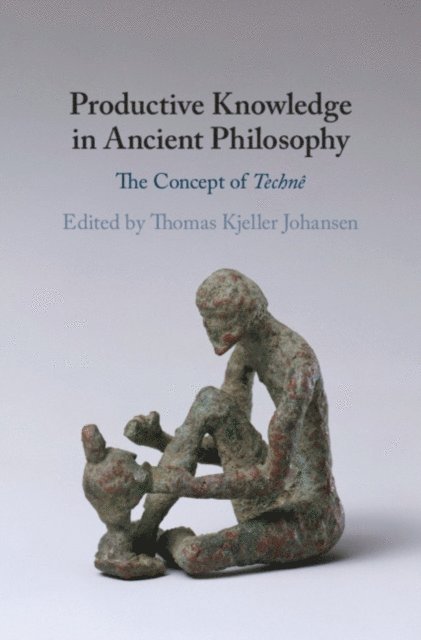
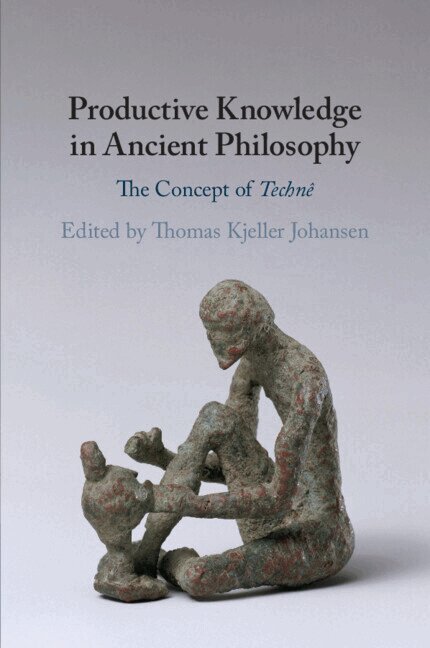
This work investigates how ancient philosophers understood productive knowledge or technê and used it to explain ethics, rhetoric, politics and cosmology. In eleven chapters leading scholars set out the ancient debates about technê from the Presocratic and Hippocratic writers, through Plato and Aristotle and the Hellenistic age (Stoics, Epicureans and Sceptics), ending in the Neoplatonism of Plotinus and Proclus. Amongst the many themes that come into focus are: the model status of ancient medicine in defining the political art, the similarities between the Platonic and Aristotelian conceptions of technê, the use of technê as a paradigm for virtue and practical rationality, technê´s determining role in Platonic conceptions of cosmology, technê´s relationship to experience and theoretical knowledge, virtue as an 'art of living', the adaptability of the criteria of technê to suit different skills, including philosophy itself, the use in productive knowledge of models, deliberation, conjecture and imagination.
428 kr
Skickas inom 7-10 vardagar
This work investigates how ancient philosophers understood productive knowledge or technê and used it to explain ethics, rhetoric, politics and cosmology. In eleven chapters leading scholars set out the ancient debates about technê from the Presocratic and Hippocratic writers, through Plato and Aristotle and the Hellenistic age (Stoics, Epicureans and Sceptics), ending in the Neoplatonism of Plotinus and Proclus. Amongst the many themes that come into focus are: the model status of ancient medicine in defining the political art, the similarities between the Platonic and Aristotelian conceptions of technê, the use of technê as a paradigm for virtue and practical rationality, technê´s determining role in Platonic conceptions of cosmology, technê´s relationship to experience and theoretical knowledge, virtue as an 'art of living', the adaptability of the criteria of technê to suit different skills, including philosophy itself, the use in productive knowledge of models, deliberation, conjecture and imagination.