Thomas Lyon - Böcker
Visar alla böcker från författaren Thomas Lyon. Handla med fri frakt och snabb leverans.
3 produkter
3 produkter
12 106 kr
Tillfälligt slut
In recent times the academic world has focused increasing attention on the challenges of corporate sustainability. While the concept of corporate sustainability originated in the context of environmental impact and natural resources, in recent years the concept has been broadened to include various social concerns ranging from animal welfare, human rights and labor conditions, to issues of inequality and social justice. There is now a large literature that provides many insights into the factors driving firms to become more sustainable, the key steps they take to do so, and the impacts of these actions.This interdisciplinary 4-volume major work brings together the most significant papers from the body of literature on corporate sustainability, drawing from a wide range of research journals. The introductory chapter written by the major work’s editors explores the highlights of the literature therein and identifies directions for future research.Volume 1: ConceptsVolume 2: DriversVolume 3: StrategyVolume 4: Consequences
652 kr
Skickas inom 10-15 vardagar
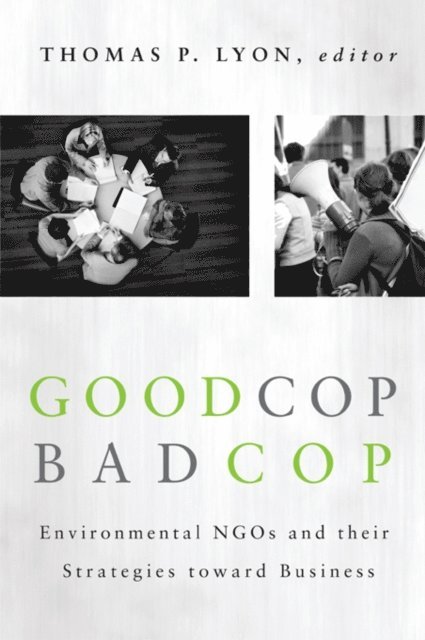
Non-governmental organizations (NGOs) play an increasingly prominent role in addressing complex environmental issues such as climate change, persistent bio-accumulative pollutants, and the conservation of biodiversity. At the same time, the landscape in which they operate is changing rapidly. Markets, and direct engagement with industry, rather than traditional government regulation, are often the tools of choice for NGOs seeking to change corporate behavior today. Yet these new strategies are poorly understood-by business, academics, and NGOs themselves. How will NGOs choose which battles to fight, differentiate themselves from one another in order to attract membership and funding, and decide when to form alliances and when to work separately? In Good Cop/Bad Cop, Thomas P. Lyon brings together perspectives on environmental NGOs from leading social scientists, as well as leaders from within the NGO and corporate worlds, to assess the state of knowledge on the tactics and the effectiveness of environmental groups. Contributions from Greenpeace, Rainforest Action Network, the Environmental Defense Fund, and the World Wildlife Fund describe each organization‘s structure and key objectives, and present case studies that illustrate how each organization makes a difference, especially with regard to its strategies toward corporate engagement. To provide additional perspective, high-level executives from BP and Ford share their views on what causes these relationships between companies and NGOs to either succeed or fail. For students of the social sciences and NGO practitioners, this book takes an important step in addressing an urgent need for objective study of NGO operations and their effectiveness.
2 108 kr
Skickas inom 7-10 vardagar
Non-governmental organizations (NGOs) play an increasingly prominent role in addressing complex environmental issues such as climate change, persistent bio-accumulative pollutants, and the conservation of biodiversity. At the same time, the landscape in which they operate is changing rapidly. Markets, and direct engagement with industry, rather than traditional government regulation, are often the tools of choice for NGOs seeking to change corporate behavior today. Yet these new strategies are poorly understood-by business, academics, and NGOs themselves. How will NGOs choose which battles to fight, differentiate themselves from one another in order to attract membership and funding, and decide when to form alliances and when to work separately? In Good Cop/Bad Cop, Thomas P. Lyon brings together perspectives on environmental NGOs from leading social scientists, as well as leaders from within the NGO and corporate worlds, to assess the state of knowledge on the tactics and the effectiveness of environmental groups. Contributions from Greenpeace, Rainforest Action Network, the Environmental Defense Fund, and the World Wildlife Fund describe each organization‘s structure and key objectives, and present case studies that illustrate how each organization makes a difference, especially with regard to its strategies toward corporate engagement. To provide additional perspective, high-level executives from BP and Ford share their views on what causes these relationships between companies and NGOs to either succeed or fail. For students of the social sciences and NGO practitioners, this book takes an important step in addressing an urgent need for objective study of NGO operations and their effectiveness.