Thomas Marois - Böcker
Visar alla böcker från författaren Thomas Marois. Handla med fri frakt och snabb leverans.
11 produkter
11 produkter
582 kr
Skickas inom 10-15 vardagar
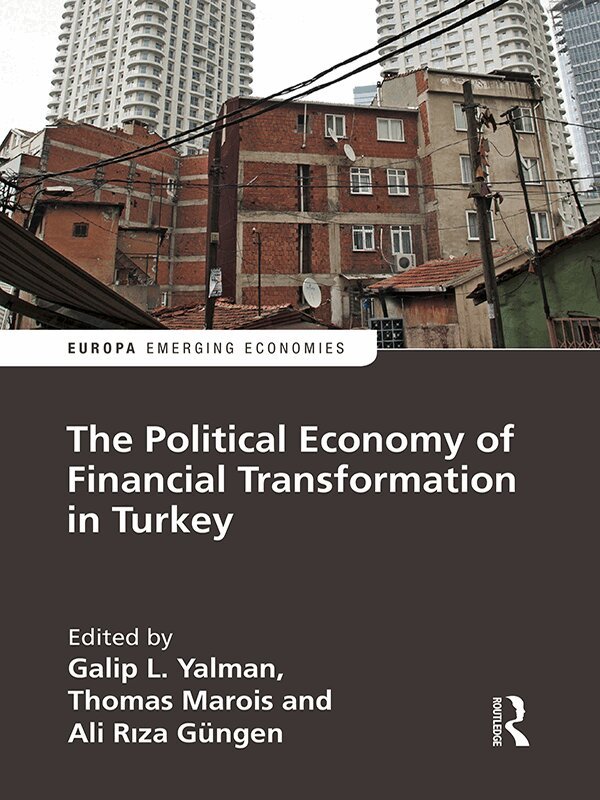
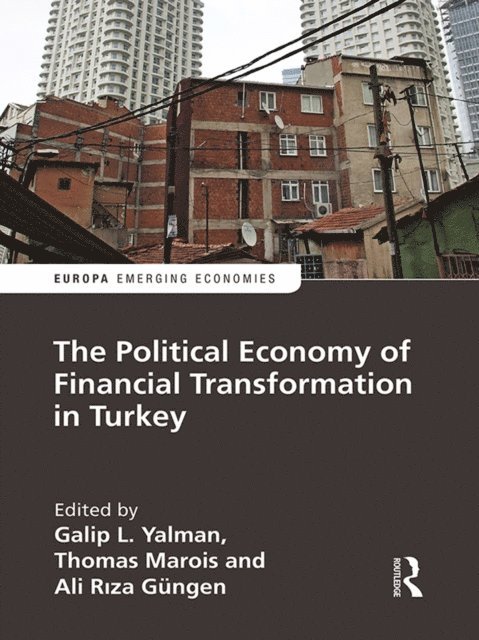
This volume provides a comprehensive study of Turkey’s financial transformation into one of the most dynamic, if not trouble-free, emerging capitalisms. While this financial evolution has underwritten Turkey’s dramatic economic growth, it has done so without ameliorating the persistently exploitative and unequal social structures that characterize neoliberalism today. This edited volume, written by an interdisciplinary range of political economists, critically examines Turkey’s financial transformation, contributing to debates on the nature of peripheral financialization.Eschewing economistic interpretations, The Political Economy of Financial Transformation in Turkey underscores both the quantitative significance of exponential growth in financial flows and investments, and the qualitative importance of the state’s institutional restructuring around financial imperatives. The book presents today’s reality as historically rooted. By understanding the choices made under the new Republic (from 1923 onwards), one can better locate the changes launched as a newly liberalizing society (since 1980). Likewise, the decisions made in response to Turkey’s 2001 financial crisis spurred a tectonic break in state–market–society financial relations. The waves of change have reached far and wide: from corporate strategies of accumulation and growth to small- and medium-sized enterprises’ strategies of financial survival; from how finance has penetrated the provisioning of housing to how households have become financialized. Put together, one grasps the complexity and historicity of the power of contemporary finance. One also sees that the changes made have not been class-neutral, but have entailed elevating the interests of major capital groups, particularly financial capital, above the interests of the poor and workers in Turkey. Nor are these changes constrained to its national borders, as what transpires domestically contributes to the making of a financialized world market. Through this ‘Made in Turkey’ approach the contributions in this volume thus challenge dominant understandings of financialization, which are derived from the advanced capitalisms, by sharing the specificity of emerging capitalisms such as Turkey.
361 kr
Skickas inom 7-10 vardagar
The global economic crisis has exposed the limits of neoliberalism and dramatically deepened social polarization. Yet, despite increasing social resistance and opposition, neoliberalism prevails globally.Radical alternatives, moreover, are only rarely debated. And if they are, such alternatives are reduced to new Keynesian and new developmental agendas, which fail to address existing class divisions and imperialist relations of domination. This collection of essays polarizes the debate between radical and reformist alternatives by exploring head-on the antagonistic structure of capitalist development. The contributors ground their proposals in an international, non-Eurocentric and Marxian inspired analysis of capitalism and its crises. From Latin America to Asia, Africa to the Middle East and Europe to the US, social and labour movements have emerged as the protagonists behind creating alternatives.This book's new generation of scholars has written accessible yet theoretically informed and empirically rich chapters elaborating radical worldwide strategies for moving beyond neoliberalism, and beyond capitalism. The intent is to provoke critical reflection and positive action towards substantive change.
1 848 kr
Skickas inom 7-10 vardagar
Thomas Marois' groundbreaking interpretation of banking and development in Mexico and Turkey builds on a Marxian-inspired framework premised on understanding states and banks as social relationships alongside crisis and labor as vital to finance today. The book's rich historical and empirical content reveals definite institutionalized relationships of power that mainstream political economists often miss. While leading to a timely analysis of the impact of the Great Recession on Mexico and Turkey, the major contribution of States, Banks and Crisis in its account of emerging finance capitalism. This is defined as the current phase of accumulation wherein the interests of financial capital are fused in the state apparatus as the institutionalized priorities and overarching social logic guiding the actions of state managers and government elites, often to the detriment of labor. This interdisciplinary and accessible study on banking and development will prove to be an important resource for upper-level undergraduates, graduates, and scholars in economics, development studies, political science, political economy, development finance, sociology, international relations and international political economy.
1 895 kr
Skickas inom 10-15 vardagar
This book explores the potential for public banks to help finance the expansion, democratization, and sustainability of public water services in Europe, with implications for public water financing elsewhere in the world.Financing the UN’s Sustainable Development Goal 6 for water and sanitation will be enormously expensive and will also depend largely on public water operators. Where will this money to fund public water services come from? One option is public banks. These state-owned institutions constitute just under 20% of global banking assets, holding close to $50 trillion in assets. Many public banks have explicit mandates to finance public water management and related public goods, and they have been doing so for decades. And yet, despite a resurgence of interest in public banks, their roles and potential in funding public water services have been largely ignored by researchers and policy makers.This book aims to measure the scale and nature of interactions between public banks and public water operators in the European region; identify challenges and opportunities for deeper engagement between public banks and public water operators; recognize promising practices and how these might be transferred elsewhere in the world; and assess possibilities for more democratic forms of public bank and public water interactions. This volume will be of great use to students and researchers interested in political ecology and economy, development and cooperation, public policy as well as water governance and management.The chapters in this book were originally published as a special issue of Water International.
565 kr
Skickas inom 10-15 vardagar
This book explores the potential for public banks to help finance the expansion, democratization, and sustainability of public water services in Europe, with implications for public water financing elsewhere in the world.Financing the UN’s Sustainable Development Goal 6 for water and sanitation will be enormously expensive and will also depend largely on public water operators. Where will this money to fund public water services come from? One option is public banks. These state-owned institutions constitute just under 20% of global banking assets, holding close to $50 trillion in assets. Many public banks have explicit mandates to finance public water management and related public goods, and they have been doing so for decades. And yet, despite a resurgence of interest in public banks, their roles and potential in funding public water services have been largely ignored by researchers and policy makers.This book aims to measure the scale and nature of interactions between public banks and public water operators in the European region; identify challenges and opportunities for deeper engagement between public banks and public water operators; recognize promising practices and how these might be transferred elsewhere in the world; and assess possibilities for more democratic forms of public bank and public water interactions. This volume will be of great use to students and researchers interested in political ecology and economy, development and cooperation, public policy as well as water governance and management.The chapters in this book were originally published as a special issue of Water International.
Public Banks and Public Water in the Global South
Financing Options for Sustainable Development
Inbunden, Engelska, 2024
1 963 kr
Skickas inom 10-15 vardagar
This volume presents the first systematic review of public bank lending in the water sector in the Global South.Many public banks have an explicit mandate to finance public water management, yet despite a resurgence of interest in public banks and the role they can play in sustainable development, their role in funding water management has been largely ignored. Drawing on case studies from Asia, Africa and Latin America, this book measures the scale and nature of interaction between public banks and public water operators for the provision of safe drinking water and sanitation. It identifies challenges and opportunities for deeper engagement between public banks and public water operators in the Global South and highlights promising practices, showcasing how these might be transferred to different regions and different sectors. Each case study is based on in-depth interviews with public banks that have funded public water operators, and public water operators that have borrowed from public banks, including Banco Popular in Costa Rica, the Development Bank of the Philippines, the National Bank for Agricultural and Rural Development in India and the TIB Development Bank in Tanzania. Overall, this book provides a critical analysis of the potential of public banks to address global water security issues.This book will be of great interest to students and scholars of water resource management, water and health, sanitation and sustainable development. It will also be of interest to professionals and policymakers working with public and development banks in the supply of safe water and sanitation for all.The Open Access version of this book, available at www.taylorfrancis.com, has been made available under a Creative Commons Attribution-Non Commercial-No Derivatives (CC-BY-NC-ND) 4.0 license.
Public Banks and Public Water in the Global South
Financing Options for Sustainable Development
Häftad, Engelska, 2026
675 kr
Kommande
This volume presents the first systematic review of public bank lending in the water sector in the Global South.Many public banks have an explicit mandate to finance public water management, yet despite a resurgence of interest in public banks and the role they can play in sustainable development, their role in funding water management has been largely ignored. Drawing on case studies from Asia, Africa and Latin America, this book measures the scale and nature of interaction between public banks and public water operators for the provision of safe drinking water and sanitation. It identifies challenges and opportunities for deeper engagement between public banks and public water operators in the Global South and highlights promising practices, showcasing how these might be transferred to different regions and different sectors. Each case study is based on in-depth interviews with public banks that have funded public water operators, and public water operators that have borrowed from public banks, including Banco Popular in Costa Rica, the Development Bank of the Philippines, the National Bank for Agricultural and Rural Development in India and the TIB Development Bank in Tanzania. Overall, this book provides a critical analysis of the potential of public banks to address global water security issues.This book will be of great interest to students and scholars of water resource management, water and health, sanitation and sustainable development. It will also be of interest to professionals and policymakers working with public and development banks in the supply of safe water and sanitation for all.The Open Access version of this book, available at www.taylorfrancis.com, has been made available under a Creative Commons Attribution-Non Commercial-No Derivatives (CC-BY-NC-ND) 4.0 license.
Public Banks and Public Purpose
From Short-Term Crisis Responses to Long-Term Climate Prospects
Inbunden, Engelska, 2026
2 160 kr
Skickas inom 10-15 vardagar
This book examines the resurgence of public banks and their critical role in addressing global climate and development-related challenges. Drawing from the lessons of the 2008-09 financial crisis, the implementation of the UN Sustainable Development Goals, and most crucially, the COVID-19 pandemic, it provides a comprehensive analysis of how public banking institutions can effectively scale up and deliver climate-aligned development finance, at affordable rates and favourable terms.Through diverse case studies spanning national and multilateral public banks across both wealthy and developing regions, the volume employs multidisciplinary approaches and mixed methodologies to evaluate their capacity, mandate fulfilment, and accountability mechanisms. The research illuminates the complex power dynamics that determine who benefits from public banking initiatives and offers evidence-based insights for strengthening these institutions' ability to serve the public interest in the face of climate challenges.This volume will appeal to a diverse readership including policymakers and government officials involved in development, financial regulation, and climate policy; academics and researchers in economics, finance, political economy, business, and sustainable development; professionals working in public, private, and development banks; climate activists and NGOs focused on sustainable finance; and graduate students studying public finance, development economics, sustainability, and climate policy. The book provides valuable insights for anyone interested in understanding how public financial institutions can be leveraged to address the pressing challenges of climate change while promoting equitable development outcomes.
1 266 kr
Skickas inom 7-10 vardagar
Public banks are banks located within the public sphere of a state. They are pervasive, with more than 900 institutions worldwide, and powerful, with tens of trillions in assets. Public banks are neither essentially good nor bad. Rather, they are dynamic institutions, made and remade by contentious social forces. As the first single-authored book on public banks, this timely intervention examines how these institutions can confront the crisis of climate finance and catalyse a green and just transition. The author explores six case studies across the globe, demonstrating that public banks have acquired the representative structures, financial capacity, institutional knowledge, collaborative networks, and geographical reach to tackle decarbonisation, definancialisation, and democratisation. These institutions are not without contradictions, torn as they are between contending public and private interests in class-divided society. Ultimately, social forces and struggles shape how and if public banks serve the public good.
297 kr
Skickas inom 7-10 vardagar
Public banks are banks located within the public sphere of a state. They are pervasive, with more than 900 institutions worldwide, and powerful, with tens of trillions in assets. Public banks are neither essentially good nor bad. Rather, they are dynamic institutions, made and remade by contentious social forces. As the first single-authored book on public banks, this timely intervention examines how these institutions can confront the crisis of climate finance and catalyse a green and just transition. The author explores six case studies across the globe, demonstrating that public banks have acquired the representative structures, financial capacity, institutional knowledge, collaborative networks, and geographical reach to tackle decarbonisation, definancialisation, and democratisation. These institutions are not without contradictions, torn as they are between contending public and private interests in class-divided society. Ultimately, social forces and struggles shape how and if public banks serve the public good.
1 952 kr
Skickas inom 10-15 vardagar
This volume provides a comprehensive study of Turkey’s financial transformation into one of the most dynamic, if not trouble-free, emerging capitalisms. While this financial evolution has underwritten Turkey’s dramatic economic growth, it has done so without ameliorating the persistently exploitative and unequal social structures that characterize neoliberalism today. This edited volume, written by an interdisciplinary range of political economists, critically examines Turkey’s financial transformation, contributing to debates on the nature of peripheral financialization.Eschewing economistic interpretations, The Political Economy of Financial Transformation in Turkey underscores both the quantitative significance of exponential growth in financial flows and investments, and the qualitative importance of the state’s institutional restructuring around financial imperatives. The book presents today’s reality as historically rooted. By understanding the choices made under the new Republic (from 1923 onwards), one can better locate the changes launched as a newly liberalizing society (since 1980). Likewise, the decisions made in response to Turkey’s 2001 financial crisis spurred a tectonic break in state–market–society financial relations. The waves of change have reached far and wide: from corporate strategies of accumulation and growth to small- and medium-sized enterprises’ strategies of financial survival; from how finance has penetrated the provisioning of housing to how households have become financialized. Put together, one grasps the complexity and historicity of the power of contemporary finance. One also sees that the changes made have not been class-neutral, but have entailed elevating the interests of major capital groups, particularly financial capital, above the interests of the poor and workers in Turkey. Nor are these changes constrained to its national borders, as what transpires domestically contributes to the making of a financialized world market. Through this ‘Made in Turkey’ approach the contributions in this volume thus challenge dominant understandings of financialization, which are derived from the advanced capitalisms, by sharing the specificity of emerging capitalisms such as Turkey.