Thomas Miller Klubock - Böcker
Visar alla böcker från författaren Thomas Miller Klubock. Handla med fri frakt och snabb leverans.
5 produkter
5 produkter
467 kr
Skickas inom 7-10 vardagar
The first major history of Chile’s most significant peasant rebellion and the violent repression that followed In 1934, peasants turned to revolution to overturn Chile’s oligarchic political order and the profound social inequalities in the Chilean countryside. The brutal military counterinsurgency that followed was one of the worst acts of state terror in Chile until the military dictatorship of Augusto Pinochet (1973–1990). Using untapped archival sources, award-winning scholar Thomas Miller Klubock exposes Chile’s long history of political violence and authoritarianism and chronicles peasants’ movements to build a more just and freer society. Klubock further explores how an amnesty law that erased both the rebellion and the military atrocities lay the foundation for the political stability that characterized Chile’s multi-party democracy. This historical amnesia or olvido, Klubock argues, was a precondition of national reconciliation and democratic rule, which endured until 1973, when conflict in the countryside ended once again with violent repression during the Pinochet dictatorship.
Contested Communities
Class, Gender, and Politics in Chile's El Teniente Copper Mine, 1904-1951
Häftad, Engelska, 1998
624 kr
Skickas inom 3-6 vardagar
In Contested Communities Thomas Miller Klubock analyzes the experiences of the El Teniente copper miners during the first fifty years of the twentieth century. Describing the everyday life and culture of the mining community, its impact on Chilean politics and national events, and the sense of self and identity working-class men and women developed in the foreign-owned enclave, Klubock provides important insights into the cultural and social history of Chile.Klubock shows how a militant working-class community was established through the interplay between capitalist development, state formation, and the ideologies of gender. In describing how the North American copper company attempted to reconfigure and reform the work and social-cultural lives of men and women who migrated to the mine, Klubock demonstrates how struggles between labor and capital took place on a gendered field of power and reconstituted social constructions of masculinity and femininity. As a result, Contested Communities describes more accurately than any previous study the nature of grassroots labor militancy, working-class culture, and everyday politics of gender relations during crucial years of the Chilean Popular Front in the 1930s and 1940s.
337 kr
Skickas inom 10-15 vardagar
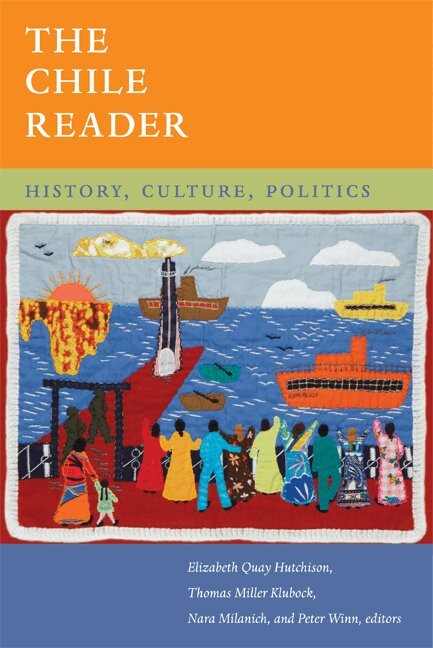
The Chile Reader makes available a rich variety of documents spanning more than five hundred years of Chilean history. Most of the selections are by Chileans; many have never before appeared in English. The history of Chile is rendered from diverse perspectives, including those of Mapuche Indians and Spanish colonists, peasants and aristocrats, feminists and military strongmen, entrepreneurs and workers, and priests and poets. Among the many selections are interviews, travel diaries, letters, diplomatic cables, cartoons, photographs, and song lyrics.Texts and images, each introduced by the editors, provide insights into the ways that Chile's unique geography has shaped its national identity, the country's unusually violent colonial history, and the stable but autocratic republic that emerged after independence from Spain. They shed light on Chile's role in the world economy, the social impact of economic modernization, and the enduring problems of deep inequality. The Reader also covers Chile's bold experiments with reform and revolution, its subsequent descent into one of Latin America's most ruthless Cold War dictatorships, and its much-admired transition to democracy and a market economy in the years since dictatorship.
1 724 kr
Skickas inom 7-10 vardagar
In La Frontera, Thomas Miller Klubock offers a pioneering social and environmental history of southern Chile, exploring the origins of today’s forestry "miracle" in Chile. Although Chile's forestry boom is often attributed to the free-market policies of the Pinochet dictatorship, La Frontera shows that forestry development began in the early twentieth century when Chilean governments turned to forestry science and plantations of the North American Monterey pine to establish their governance of the frontier's natural and social worlds. Klubock demonstrates that modern conservationist policies and scientific forestry drove the enclosure of frontier commons occupied by indigenous and non-indigenous peasants who were defined as a threat to both native forests and tree plantations. La Frontera narrates the century-long struggles among peasants, Mapuche indigenous communities, large landowners, and the state over access to forest commons in the frontier territory. It traces the shifting social meanings of environmentalism by showing how, during the 1990s, rural laborers and Mapuches, once vilified by conservationists and foresters, drew on the language of modern environmentalism to critique the social dislocations produced by Chile's much vaunted neoliberal economic model, linking a more just social order to the biodiversity of native forests.
427 kr
Skickas inom 7-10 vardagar
In La Frontera, Thomas Miller Klubock offers a pioneering social and environmental history of southern Chile, exploring the origins of today’s forestry "miracle" in Chile. Although Chile's forestry boom is often attributed to the free-market policies of the Pinochet dictatorship, La Frontera shows that forestry development began in the early twentieth century when Chilean governments turned to forestry science and plantations of the North American Monterey pine to establish their governance of the frontier's natural and social worlds. Klubock demonstrates that modern conservationist policies and scientific forestry drove the enclosure of frontier commons occupied by indigenous and non-indigenous peasants who were defined as a threat to both native forests and tree plantations. La Frontera narrates the century-long struggles among peasants, Mapuche indigenous communities, large landowners, and the state over access to forest commons in the frontier territory. It traces the shifting social meanings of environmentalism by showing how, during the 1990s, rural laborers and Mapuches, once vilified by conservationists and foresters, drew on the language of modern environmentalism to critique the social dislocations produced by Chile's much vaunted neoliberal economic model, linking a more just social order to the biodiversity of native forests.