Thomas Q. Sibley - Böcker
Visar alla böcker från författaren Thomas Q. Sibley. Handla med fri frakt och snabb leverans.
4 produkter
4 produkter
2 771 kr
Skickas inom 7-10 vardagar
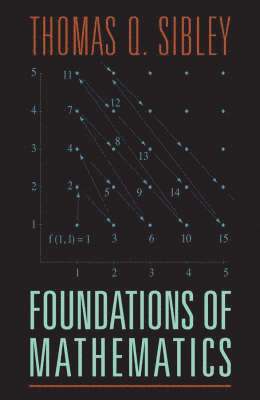
The Foundations of Mathematics provides a careful introduction to proofs in mathematics, along with basic concepts of logic, set theory and other broadly used areas of mathematics. The concepts are introduced in a pedagogically effective manner without compromising mathematical accuracy and completeness. Thus, in Part I students explore concepts before they use them in proofs. The exercises range from reading comprehension questions and many standard exercises to proving more challenging statements, formulating conjectures and critiquing a variety of false and questionable proofs. The discussion of metamathematics, including Gödel’s Theorems, and philosophy of mathematics provides an unusual and valuable addition compared to other similar texts
972 kr
Skickas inom 7-10 vardagar
Thinking Algebraically presents the insights of abstract algebra in a welcoming and accessible way. It succeeds in combining the advantages of rings-first and groups-first approaches while avoiding the disadvantages. After an historical overview, the first chapter studies familiar examples and elementary properties of groups and rings simultaneously to motivate the modern understanding of algebra. The text builds intuition for abstract algebra starting from high school algebra. In addition to the standard number systems, polynomials, vectors, and matrices, the first chapter introduces modular arithmetic and dihedral groups. The second chapter builds on these basic examples and properties, enabling students to learn structural ideas common to rings and groups: isomorphism, homomorphism, and direct product. The third chapter investigates introductory group theory. Later chapters delve more deeply into groups, rings, and fields, including Galois theory, and they also introduce other topics, such as lattices. The exposition is clear and conversational throughout. The book has numerous exercises in each section as well as supplemental exercises and projects for each chapter. Many examples and well over 100 figures provide support for learning. Short biographies introduce the mathematicians who proved many of the results. The book presents a pathway to algebraic thinking in a semester- or year-long algebra course.
787 kr
Skickas inom 7-10 vardagar
Together with its clear mathematical exposition, the problems in this book take the reader from an introduction to discrete geometry all the way to its frontiers. Investigations start with easily drawn figures, such as dividing a polygon into triangles or finding the minimum number of ""guards"" for a polygon (""art gallery"" problem). These early explorations build intuition and set the stage. Variations on the initial problems stretch this intuition in new directions. These variations on problems together with growing intuition and understanding illustrate the theme of this book: ""When you have answered the question, it is time to question the answer."" Numerous drawings, informal explanations, and careful reasoning build on high school algebra and geometry.
905 kr
Skickas inom 7-10 vardagar
This is a well written and comprehensive survey of college geometry that would serve a wide variety of courses for both mathematics majors and mathematics education majors. Great care and attention is spent on developing visual insights and geometric intuition while stressing the logical structure, historical development, and deep interconnectedness of the ideas. Students with less mathematical preparation than upper-division mathematics majors can successfully study the topics needed for the preparation of high school teachers. There is a multitude of exercises and projects in those chapters developing all aspects of geometric thinking for these students as well as for more advanced students. These chapters include Euclidean Geometry, Axiomatic Systems and Models, Analytic Geometry, Transformational Geometry, and Symmetry. Topics in the other chapters, including Non-Euclidean Geometry, Projective Geometry, Finite Geometry, Differential Geometry, and Discrete Geometry, provide a broader view of geometry.The different chapters are as independent as possible, while the text still manages to highlight the many connections between topics. The text is self-contained, including appendices with the material in Euclid's first book and a high school axiomatic system as well as Hilbert's axioms. Appendices give brief summaries of the parts of linear algebra and multivariable calculus needed for certain chapters. While some chapters use the language of groups, no prior experience with abstract algebra is presumed. The text will support an approach emphasizing dynamical geometry software without being tied to any particular software.