Timothy Hellwig - Böcker
Visar alla böcker från författaren Timothy Hellwig. Handla med fri frakt och snabb leverans.
6 produkter
6 produkter
Economics and Politics Revisited
Executive Approval and the New Calculus of Support
Inbunden, Engelska, 2023
1 430 kr
Skickas inom 5-8 vardagar
What drives government popularity? For decades, scholars, journalists, and political pundits alike have converged on a single answer: the economy. A rising economy lifts the popularity of the government, and if the economy's fortunes turn south, so too does that of the government. This conventional wisdom informs politicians' decisions as well as the scholarly commentary on parties and elections. Yet the conditions that underlie this model have changed in many countries as globalization has shifted control away from national policymakers, as non-economic cultural issues have risen in importance, and as our politics have become more polarized. At the same time, since the Great Recession in 2008 persistent economic volatility has kept the economy on the agenda. What, then, fuels government popularity in our current volatile environment? Are political fortunes tied to economic stability, as in the past? Or has the economy-popularity link-the popularity function-been severed by a host of new and less predictable factors in post-industrial societies?To answer these questions, Economics and Politics Revisited uses data from the Executive Approval Project (EAP), a cross-nationally comparable data on leader popularity, to model the fundamental dynamics of government support in advanced industrial democracies. Eleven country-specific chapters, each written by experts in the politics of the country, examine the role of economic performance in generating leader support in each country. In all cases, chapter authors show that the economy matters for popularity. However, the economy-popularity link is stronger in some countries than others. Further, chapters leverage EAP series to highlight change over time. Pooled analyses extend these findings, highlighting how the public's responses to the economy are reduced when political campaigns shift to non-economic issues and when parties are polarization on non-economic issues. Collectively, the volume highlights how evolving issue agendas are changing the nature of political accountability in advanced industrialized democracies. While the economy remains important, the book calls on students of political accountability to give greater attention to the role of non-economic issues.Comparative Politics is a series for researchers, teachers, and students of political science that deals with contemporary government and politics. Global in scope, books in the series are characterized by a stress on comparative analysis and strong methodological rigour. The series is published in association with the European Consortium for Political Research. For more information visit: www.ecprnet.eu .The series is edited by Nicole Bolleyer, Chair of Comparative Political Science, Geschwister Scholl Institut, LMU Munich and Jonathan Slapin, Professor of Political Institutions and European Politics, Department of Political Science, University of Zurich.
Democracy Under Siege?
Parties, Voters, and Elections After the Great Recession
Inbunden, Engelska, 2020
1 268 kr
Skickas inom 5-8 vardagar
The Global Financial Crisis of 2008-2009 was catalyst for the most precipitous economic downturn in eight decades. This book examines how the GFC and ensuing Great Recession affected electoral politics in the world's developed democracies. The initial wave of research on the crisis concluded it did little to change the established relationships between voters, parties, and elections. Yet nearly a decade since the initial shock, the political landscape has changed in many ways, the extent to which has not been fully explained by existing studies. Democracy Under Siege? pushes against the received wisdom by advancing a framework for understanding citizen attitudes, preferences, and behaviour. It makes two central claims. First, while previous studies of the GFC tend to focus on an immediate impact of the crisis, Hellwig, Kweon, and Vowles argue that economic malaise has a long lasting impact. In addition to economic shock, the economic recovery has a significant impact on citizens' assessment of political elites. Second, the authors argue that unanticipated exogenous shocks like the GFC grants party elites an opening for political manoeuvre through public policy and rhetoric. As a result, political elites have a high degree of agency to shape public perceptions and behaviour. Political parties can strategically moderate citizens' economic uncertainty, mobilise/demobilise voters, and alter individuals' political preferences. By leveraging data from over 150,000 individuals across over 100 nationally-representative post-election surveys from the 1990s to 2017, this book shows how economic change during a tumultuous era affected economic perceptions, policy demands, political participation, and the vote.The Comparative Study of Electoral Systems (CSES) is a collaborative program of research among election study teams from around the world. Participating countries include a common module of survey questions in their post-election studies. The resulting data are deposited along with voting, demographic, district, and macro variables. The studies are then merged into a single, free, public dataset for use in comparative study and cross-level analysis. The set of volumes in this series is based on these CSES modules, and the volumes address the key theoretical issues and empirical debates in the study of elections and representative democracy. Some of the volumes will be organized around the theoretical issues raised by a particular module, while others will be thematic in their focus. Taken together, these volumes will provide a rigorous and ongoing contribution to understanding the expansion and consolidation of democracy in the twenty-first century. Series editors: Hans-Dieter Klingemann and Ian McAllister.
1 192 kr
Skickas inom 7-10 vardagar
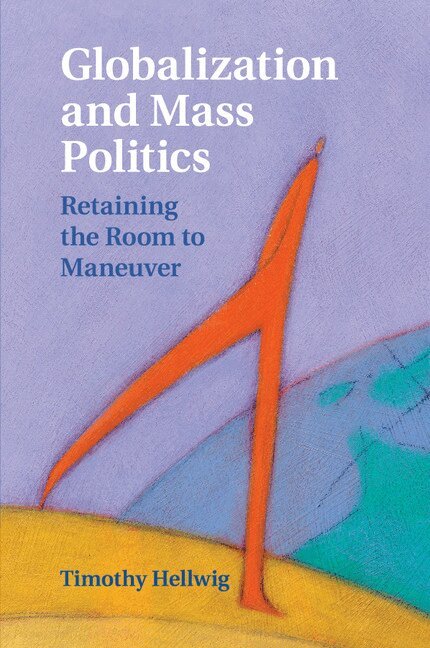
This book analyzes how increases in international trade, finance, and production have altered voter decisions, political party positions, and the types of public issues that parties focus on in postindustrial democracies. Although many studies interrogate whether internationalization matters in regard to policy outcomes and how globalization relates to mass protest, few examine globalization and mass politics more generally. This book argues that by reducing the room in which to maneuver in policy making, globalization reduces the importance of economic-based issues while increasing the electoral importance of non-economic issues. The argument is tested on original and existing data sources.
428 kr
Skickas inom 7-10 vardagar
This book analyzes how increases in international trade, finance, and production have altered voter decisions, political party positions, and the types of public issues that parties focus on in postindustrial democracies. Although many studies interrogate whether internationalization matters in regard to policy outcomes and how globalization relates to mass protest, few examine globalization and mass politics more generally. This book argues that by reducing the room in which to maneuver in policy making, globalization reduces the importance of economic-based issues while increasing the electoral importance of non-economic issues. The argument is tested on original and existing data sources.
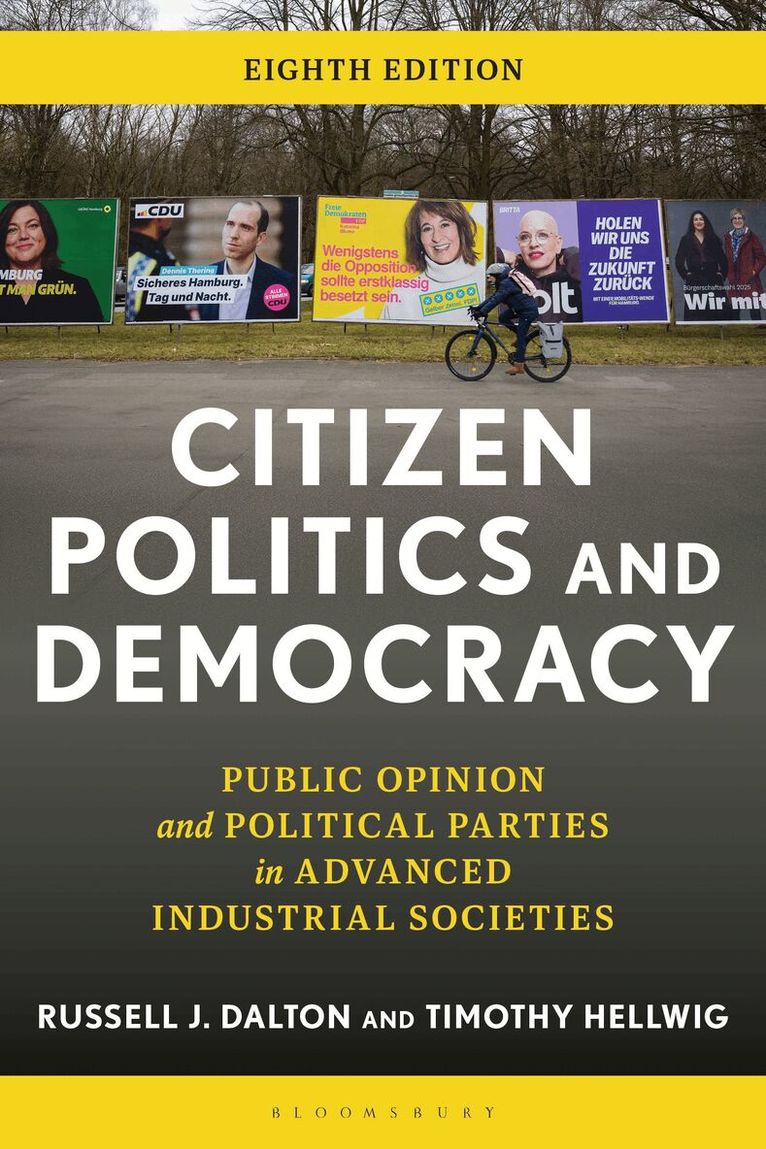
Citizen Politics and Democracy
Public Opinion and Political Parties in Advanced Industrial Societies
Inbunden, Engelska, 2026
888 kr
Kommande
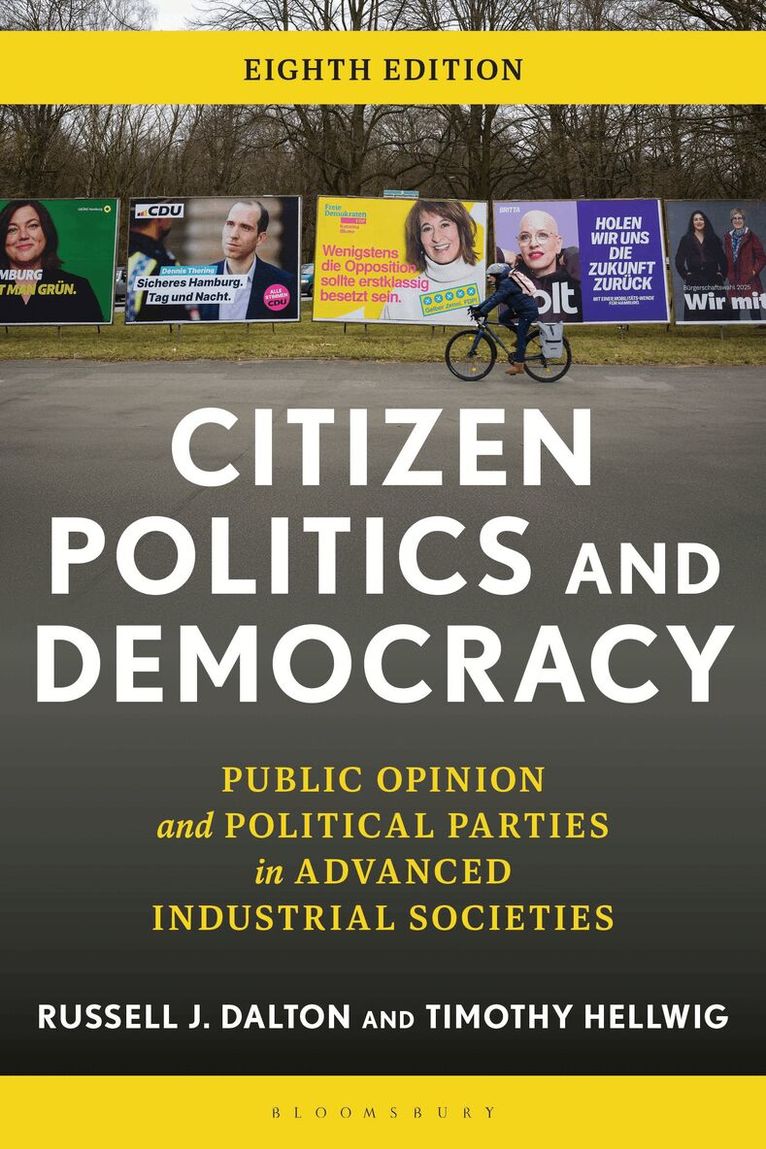
Since its first edition in 1988, Citizen Politics has provided a concise examination of citizens’ political behavior and politicians’ responses in advanced industrial democracies. It communicates findings from state-of-the-art research on parties, public opinion, and voters in a way that is at once accessible and comprehensive. It argues that ordinary people do, in fact, have what it takes to meet the demands of their roles as citizens in representative democracies. Informed by evidence from cross-national public opinion surveys, past editions of the book offered a tone of moderation—or perhaps guarded optimism—that leans against the more extreme, attention-grabbing approach of the 24-hour news cycle. The eighth edition will continue in this vein. The text will focus on opinion, voter choice, and political representation by comparing recent elections in the UK, France, Germany, and the United States. This four-nation comparison strikes the right balance between depth and breadth and does so in the space of 300 pages. The basic chapter structure will continue, with updated results from several new elections in each of the four core nations, new surveys, and new literature. This is essential to capture student and instructor interest. This new edition will focus more on the contemporary challenges facing democracies and their citizens. The attack at the U.S. Capitol on January 6, 2021, brought to the fore how much democratic stability requires the consent of the governed and respect for established rules and norms by citizens and elites. This and other events have pushed researchers to revisit foundational questions about the role of the citizen in a democracy. One innovation is that the new edition will focus more on how citizens’ participation, values, opinions, and assessments contribute to how democracy does (or does not) work. Thus, we will rebrand the eighth edition as Citizen Politics and Democracy, to emphasize both continuity and change in mass politics.
Citizen Politics and Democracy
Public Opinion and Political Parties in Advanced Industrial Societies
Häftad, Engelska, 2026
473 kr
Kommande
Since its first edition in 1988, Citizen Politics has provided a concise examination of citizens’ political behavior and politicians’ responses in advanced industrial democracies. It communicates findings from state-of-the-art research on parties, public opinion, and voters in a way that is at once accessible and comprehensive. It argues that ordinary people do, in fact, have what it takes to meet the demands of their roles as citizens in representative democracies. Informed by evidence from cross-national public opinion surveys, past editions of the book offered a tone of moderation—or perhaps guarded optimism—that leans against the more extreme, attention-grabbing approach of the 24-hour news cycle. The eighth edition will continue in this vein. The text will focus on opinion, voter choice, and political representation by comparing recent elections in the UK, France, Germany, and the United States. This four-nation comparison strikes the right balance between depth and breadth and does so in the space of 300 pages. The basic chapter structure will continue, with updated results from several new elections in each of the four core nations, new surveys, and new literature. This is essential to capture student and instructor interest. This new edition will focus more on the contemporary challenges facing democracies and their citizens. The attack at the U.S. Capitol on January 6, 2021, brought to the fore how much democratic stability requires the consent of the governed and respect for established rules and norms by citizens and elites. This and other events have pushed researchers to revisit foundational questions about the role of the citizen in a democracy. One innovation is that the new edition will focus more on how citizens’ participation, values, opinions, and assessments contribute to how democracy does (or does not) work. Thus, we will rebrand the eighth edition as Citizen Politics and Democracy, to emphasize both continuity and change in mass politics.