Timothy J. Sluckin - Böcker
Visar alla böcker från författaren Timothy J. Sluckin. Handla med fri frakt och snabb leverans.
3 produkter
3 produkter
1 327 kr
Tillfälligt slut
Liquid crystal science underlies the technology of about half the current display technology by value, an industry now worth some $10 billion per annum worldwide. The fundamental science straddles the disciplines of chemistry, physics, engineering, mathematics and computer science. Among liquid crystal scientists today there is much interest in the historical process that has brought the subject to its present level. The historical roots lie in the years following 1888, again in the interwar years, and finally in the late 60s and 70s.This book has collected important papers in the development of liquid crystal science into one reference volume. The collection is divided into sections, each of which is prefaced by a brief commentary, referring to the historic-scientific context of the time. Some of these papers are available for the first time in English. More modern papers carry a short commentary from the original author, offering recollections of the context in which the work was carried out and what its impact has been.Crystals that Flow is aimed at liquid crystal scientists- from whatever background- physics, mathematics, chemistry, engineering or computer science. Historians of science will also find this a useful reference.
1 452 kr
Tillfälligt slut
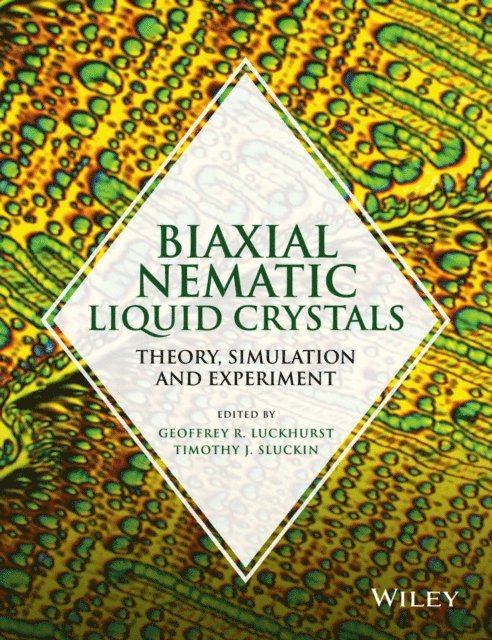
In the nematic liquid crystal phase, rod-shaped molecules move randomly but remain essentially parallel to one another. Biaxial nematics, which were first predicted in 1970 by Marvin Freiser, have their molecules differentially oriented along two axes. They have the potential to create displays with fast switching times and may have applications in thin-film displays and other liquid crystal technologies. This book is the first to be concerned solely with biaxial nematic liquid crystals, both lyotropic and thermotropic, formed by low molar mass as well as polymeric systems. It opens with a general introduction to the biaxial nematic phase and covers: • Order parameters and distribution functions • Molecular field theory • Theories for hard biaxial particles • Computer simulation of biaxial nematics • Alignment of the phase • Display applications • Characterisation and identification • Lyotropic, thermotropic and colloidal systems together with material design With a consistent, coherent and pedagogical approach, this book brings together theory, simulations and experimental studies; it includes contributions from some of the leading figures in the field. It is relevant to students and researchers as well as to industry professionals working in soft matter, liquid crystals, liquid crystal devices and their applications throughout materials science, chemistry, physics, mathematics and display engineering.
697 kr
Skickas inom 10-15 vardagar
Liquid crystal science underlies the technology of about half the current display technology by value, an industry now worth some $10 billion per annum worldwide. The fundamental science straddles the disciplines of chemistry, physics, engineering, mathematics and computer science. Among liquid crystal scientists today there is much interest in the historical process that has brought the subject to its present level. The historical roots lie in the years following 1888, again in the interwar years, and finally in the late 60s and 70s.This book has collected important papers in the development of liquid crystal science into one reference volume. The collection is divided into sections, each of which is prefaced by a brief commentary, referring to the historic-scientific context of the time. Some of these papers are available for the first time in English. More modern papers carry a short commentary from the original author, offering recollections of the context in which the work was carried out and what its impact has been.Crystals that Flow is aimed at liquid crystal scientists- from whatever background- physics, mathematics, chemistry, engineering or computer science. Historians of science will also find this a useful reference.